Showing posts with label Staatskapelle Berlin. Show all posts

Thursday, 9 July 2026

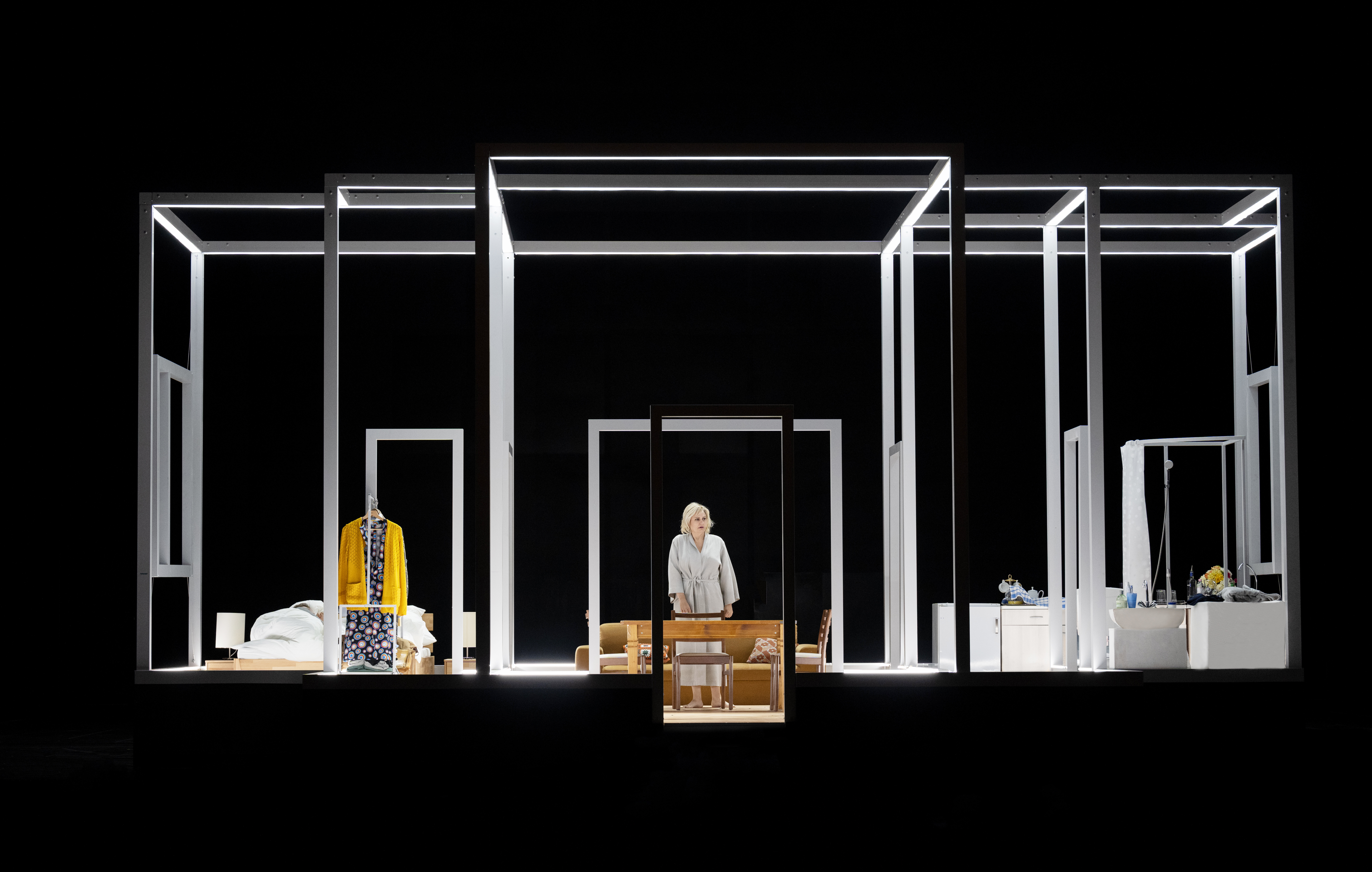
Die Entführung aus dem Serail, Staatsoper Unter den Linden, 5 July 2026


Images: Stephan Rabold


Bassa Selim – Bülent Ceylan
Konstanze – Adela Zaharia
Blonde – Serafina Starke
Belmonte – Siyabonga Maqungo
Pedrillo – Michael Laurenz
Osmin – David Steffens

New version and presentation – Bülent Ceylan, Andrea Moses, Michael Höppner
Director – Andrea Moses
Set designs – Raimund Bauer
Costumes – Anja Rabes
Lighting – Irene Selka
Video – Andrea Gabriel
Dramaturgy – Michael Höppner, Detlef Giese

Staatsopernchor Berlin (chorus director: Gerhard Polifka)
Staatskapelle Berlin
Thomas Guggeis (conductor)

No one is perfect, although Mozart’s music often is. One of many differences between the Staatsoper Unter den Linden’s previous and current musical directors is the latter’s apparent lack of interest in the operas of Mozart. Christian Thielemann’s ongoing rejuvenation of the house’s record in Strauss’s dramatic works has already offered some compensation. Both he and Daniel Barenboim have of course long since proved themselves distinguished, if strikingly different, Wagnerians. It was, in his context, a heartening development to see the house offer a new production of Die Entführung aus dem Serail—not, I think, a work Barenboim ever conducted in full, although he was known to offer its overture in Busoni’s conclusion. (Barenboim’s advocacy of his fellow adoptive Berliner Busoni’s music is another aspect of the old regime yet to be reprised, but there is time.) That, however, was before reckoning with the new ‘version’ served up by director Andrea Moses, dramaturge Michael Höppner, and comedian Bülent Ceylan. In what proved to be an increasingly depressing evening, there were important redeeming features: the singers and, still more, the players of the Staatskapelle Berlin. The abiding memory, alas, will be of one of the most important musical works in German theatrical history having been treated with undisguised contempt by a director and dramaturge who seemed not even to have bothered to engage with it in the first place. 


Billing this as an encounter between comedy and opera immediately posed the question (or rather, sadly did not) of what the relationship between the two might hitherto have been. Have there not been a few such ‘encounters’, or rather more than that, before? It is always worth, though, trying to approach something on its own terms: not that those terms cannot be criticised, but one will better criticise if one has discovered what they might have been. In that, I am afraid I can at best prove only partially successful. Ceylan essentially set the parameters for the evening by introducing it as a comedy show, ‘Entführung Live’. The idea of him as host drifting in and out of the character of the Bassa Selim is not an uninteresting one. Something improvised might, moreover, have sat in fruitful conflict with the work and the more general aesthetic of Vienna’s Nationalsingspiel. If anything, though, the tyranny of a new script proved more of a problem, Ceylan initially speaking as if this were the premiere, only later referring to that in the past tense. Whilst, to an extent, the lack of projection may have been part of the joke, incomprehensibility (to some) of Turkish German and Mannheim dialect the point, I am not sure it can be let off quite so easily. Moreover, for an event that prided itself on speaking to an international audience, the lack of titles, if not for the comedy then at least for the ‘new’ dialogue, was odd. If non-German-speakers, or indeed those of us with some German who nonetheless may have struggled at times, would have known anything, it would surely be the musical texts—the only part of the ‘action’ with titles in English or German. Ceylan was at least respectful to the musical artists, at least until the third act, in which his activity involved a good deal of speaking over them. Melodrama, I suppose, one might call it, but the game show element of highlighting apparen members of the audience – presumably in reference, in one case, to that recent Coldplay concert – had nothing to do with Die Entführung, even in its newly ‘presented’ state.

That said, he did what he was engaged for, and largely did it well. Ire should be reserved for Moses and her dramaturge. For what the production itself was ultimately concerned with remained to me elusive: very little, so far as I could tell, beyond this ‘encounter’. ‘Love’, perhaps, yet without any real questioning of what that might be—or have been. Characterisation went out of the window; there was some very odd direction of Konstanze in ‘Martern aller Arten’, in which she suddenly seemed turned on by the whole farrago, only immediately to forget that. Also absent was much sense of place, beyond a slightly baffling setting of much of it on a ship. Worst of all, the set design at one point revealed an offensive caricature of a woman’s eyes peering out from behind a burqa, hardly ever seen in Turkey, then or now: Orientalism and, let us be honest, Islamophobia far worse than anything in the work, by twenty-first- let alone eighteenth-century standards. (In her incoherent Staatsoper Meistersinger, she arbitrarily incorporated ‘sinister’ Arab figures towards the close, so there seems to be something of a pattern, both undiscriminating and, well, something worse.) The final moral, according to T-shirts thrust upon actors and chorus, appeared to be that everyone loved Bassa Selim. Hmmm, maybe. And even if true: is that it? 


There were occasional suggestions that the perennial question ‘was its deutsch? / ‘what is German?’ – we have all been there – might be a theme, but it was so poorly sustained and, worse, haplessly addressed, that it would have been better left alone. If you start from the smug liberal standpoint that your values, more or less anti-historical, stand at such a level of perfection that they are all anyone has needed, currently needs, or will need, you are unlikely to advance politically and certain not to advance dramatically. To quote the unlamented Kamala Harris, ‘I’m speaking.’ Harris’s notorious refusal to acknowledge the right of protestors to be heard, let alone the justice of their cause, indeed points to the ‘elephant in the room’ chez Moses et al. in a city and country that proudly flies Israeli flags (antisemitically described by the present Federal Chancellor as ‘Judenfahne’) from public buildings. If you want a contemporary Orientalist theme, it is staring you in the face, but that would require a little courage. What we heard instead were less calls to Lessing’s gospel of tolerance, let alone modern diversity, than of self-congratulation that Berlin first and Germany second had advanced to their current stage of enlightenment. In reality, Moses offered no real concept beyond self-congratulation and enabling sections of the audience to congratulate themselves too, and strikingly little interest in, or even awareness of, the work. The craft of actual stage direction seemed more notable for absence than presence (unless, clutching at straws, the impression of non-direction were itself a misguided aesthetic choice). 

Enough—though enough did not come soon enough. There were, as I said, aspects of the evening’s ‘entertainment’ truly to praise. One would not hear superior Mozart orchestral playing anywhere in the world; one would almost certainly hear significantly worse. Woodwind solo playing, duetting, and more was exquisite beyond words. (Much here, for better or worse, was beyond words.) The Staatskapelle strings, though, were every bit as fine, eschewing any hint of what passes today, quite erroneously, for ‘period style’, whilst as alive and alert in the present as one could hope for: unquestionably far more so than anything in the production and its ‘presentation’. What cavils I had lay with sometimes fussy direction by Thomas Guggeis. Whilst there was much to admire in his contribution – if not his unwillingness or perhaps inability to put his foot down in cases of the most egregious directorial intervention – then he could sometimes hold the orchestra down a little too ‘prettily’. Moreover, his participation in the contemporary fad of fortepiano ‘commentary’ was, alas, all too predictable in nature. When it was anything more than tracing an orchestral line on the keyboard in front of him, it came to still less, one particularly embarrassing moment excerpts from Mozart elsewhere, albeit with ‘jazzy’ (certainly not jazz-like) syncopation. Still, when he conducted, he mostly conducted very well and, crucially, let the orchestra mostly speak for itself. 

The orchestra’s twin partner in virtue, the opera chorus, acquitted itself well too, whatever the trials presented to it onstage. So too did the cast, headed by a sweet-toned, tender Belmont in Siyabonga Maqungo and the almost instrumentally conceived Konstanze of Adela Zaharia (once past a few balance problems early on). Both made their coloratura dramatically expressive, insofar as Moses permitted, as well as musically glittering. So too did the outstanding Blonde of Serafina Starke, a member of the Staatsoper’s International Opera Studio, and her well-matched Pedrillo, Michael Laurenz, as alert to the many demands placed on him onstage as by the score. David Steffens’s Osmin was also first-class: surprisingly subtle, again insofar as permitted. 


There's the rub, alas. I suppose one might try to mount a defence rooted in the genre banished by Joseph II’s theatrical reforms, founded in the ideas of Mozart’s friend Joseph von Sonnenfels. Might we see this as a return to the world of Hanswurst and, especially, his improvisational theatre? Sonnenfels’s – by extension, Joseph’s – objections had related to impurity of language, that is it was not (literary) German enough; dramatic triviality; and extensive extemporisation, that is in terms we might now employ, that it did not present a dramatic ‘work’. Its improvisatory nature, shows often only attaining literary form in their musical items, also rendered it extremely difficult to censor. But no, my heart is not in it. Ultimately, in any particular instance, there are no rules. Do whatever you want; a canonical, if slightly precarious, work will survive. But make sure you know what it is you are dealing with and do it well; otherwise, still more than mocking the work, it will mock you. If only this Entführung were anything like as ‘live’ as it thought it was.


Monday, 25 March 2024

Der Ring des Nibelungen, Staatsoper Unter den Linden, 18, 19, 21, and 24 March 2024

Images: Monika Rittershaus
Brünnhilde (Anja Kampe)


Wotan/Wanderer – Tomas Konieczny
Donner, Gunther – Roman Trekel
Froh – Siyabonga Maqungo
Loge – Rolando Villazón
Fricka – Claudia Mahnke
Freia – Anett Fritsch
Erda, Rossweisse – Anna Kissjudit
Alberich – Johannes Martin Kränzle
Mime – Stephan Rügamer
Fasolt – Matthew Rose
Fafner – Peter Rose
Woglinde – Evelin Novak
Wellgunde – Natalia Skrycka
Flosshilde, Siegrune – Ekaterina Chayka-Rubinstein
Siegmund – Robert Watson
Sieglinde – Vida Miknevičutė
Hunding – René Pape
Brünnhilde – Anja Kampe
Gerhilde – Clara Nadeshdin
Helmwige – Christiane Kohl
Waltraute – Michal Doron, Violeta Urmana
Schwertleite – Alexandra Ionis
Ortlinde, Third Norn – Anna Samuil
Grimgerde – Aytaj Shikhalizada
Siegfried – Andreas Schager
Woodbird – Victoria Randem
Hagen – Stephen Milling
Gutrune – Mandy Friedrich
First Norn – Marina Prudenskaya
Second Norn – Kristina Stanek

Director – Dmitri Tcherniakov
Revival directors – Lilli Fischer, Thorsten Cölle
Costumes – Elena Zaytseva
Lighting – Gleb Filshtinsky
Video – Alexey Poluboyarinov

Staatsopernchor Berlin (chorus director: Dani Juris)
Staatskapelle Berlin
Philippe Jordan (conductor)


Returning to Dmitri Tcherniakov’s Berlin Ring a year after I first saw it, it seems very much the same production: thought-provoking, amenable to almost endless further questioning, and yet, as we reach the denouement, seemingly turning aside: not, I think, or at least not straightforwardly, as George Bernard Shaw accused Wagner of having done in Götterdammerung, on account of succumbing to the ‘love panacea’, but rather from having failed to see its Konzept through. I decided this time to write a single review rather than four instalments, partly so I could make connections between the four parts more readily, not necessarily explicitly, but at least writing with the whole in min. Comparison with what went before last year, with a largely yet not entirely different cast, and a different conductor (then Thomas Guggeis, now Philippe Jordan) is both interesting and, on some level, inevitable, but I shall try to limit 2023 references, so this can be read on its own terms. (I shall re-read my reviews, here, here, here, and here, once this has been written and posted.) Whatever its flaws, this remains an important piece of theatre, and performances were of a high, often outstanding, standard throughout. If we continue to miss Daniel Barenboim, life goes on—and very well too.


Alberich (Johannes Martin Kränzle)

Set in the ESCHE research centre, with an ash appropriately enough at its centre, Das Rheingold does very well in setting up expectations for the Ring as a whole. In some though not all respects, we may safely delete ‘expectations for’. It is difficult not to think of Blake’s ‘Art is the Tree of Life … Science is the Tree of Death,’ nor indeed of the Biblical Tree of Life, as well of course as Wagner’s kindred World-Ash. For this is unquestionably the realm of science, and in the most overtly political of all Wagner’s dramas, one is led – at least I was – to consider the relationship between politics and the natural sciences: in many respects, at least since the Enlightenment onwards, a key question of political and indeed other philosophy. Hegel, notably, is the trickiest figure here, at least for those who, like Charles Taylor, find his ontology impossible to accept; but he is arguably all the more important for that. Whatever else one might say, for instance, of Marx and Engels – to name perhaps the two most important political philosophers of Wagner’s generations – they were anything but vulgar materialists. Dialectical materialism: the clue is in the name. In the following generation, Nietzsche is an equally tricky case, arguably more ambiguous (take his interest, often overlooked, in eighteenth-century materialism) than self-styled Nieztscheans. Such thinkers, and others, inform our response to this world of observation, surveillance, and experimental psychology, in which the first scene physically abuses – and watches – Alberich more thoroughly than any other I can recall. Arguably this is above all Loge’s world, the world of the instrumental reason he seems to represent: that which Adorno and Horkheimer identified as the key to modernity’s deadly dialectic of enlightenment. When Loge gestures to Wotan in the third scene of Das Rheingold that he knows all too well what is going on, but they need to continue to play the game for Alberich’s benefit, the game is truly afoot. And Wotan, quite properly after Erda’s intervention, realises something is rotten in the state of Valhalla. Following the ineffectual yet crowd-pleasing magic tricks of Froh and Donner, he remains alone, in despair, grabbing the once ‘natural’ ash tree, though it is probably too late already. No one else, though, seems to know or care. 

For perhaps the key question as the drama develops is who is in charge, who is running these experiments. It might first seem to be Wotan and the gods, yet ultimately, like serious (non-naïve, non-liberal) political philosophy in general, there seems to be something and/or someone beyond those we thought was ruling the roost. Rousseau’s problem of the Legislator returns—but so ultimately does his inability to answer the questions he set himself in The Social Contract. Questions of agency come to the fore, just as they do with respect to Wotan and his ‘great idea’, announced at the end of Das Rheingold and torn to shreds by Fricka. What are we to make, when we reach Götterdämmerung, of the institute carrying on more or less before, but with still less of an evident chain of command. Frankenstein’s monster, in politics, even metaphysics, as in philosophy? Perhaps. 

Siegmund is an escaped inmate, with a touch both of Ukrainian Zelensky and Russian Tcherniakov to him via Elena Zaytseva’s costumes, Tcherniakov’s direction, and Robert Watson’s determined yet damaged portrayal. (The Ukrainian President is, after all, nothing if he is not an actor.) This we learn via Gleb Filshtinsky’s striking video police report, which accompanies Die Walküre’s opening orchestral storm. And yet, reopening or extending questions concerning scope, authority, agency, and so forth, he is nonetheless under observation by Wotan and Fricka, a one-way mirror from Hunding’s dwelling revealing the god’s Erich Mielke-like office, from which his own brand of state security (failings pointed out unsparingly both by Fricka and, more sympathetically, by Wagner) may be dispensed. Perhaps surprisingly, given the lack of an object for the ring, there is a sword, which in this particular context imparts a sense, if not quite of playacting, then of enforced roleplay (an echo, perhaps, of Tcherniakov’s Aix Carmen).


Siegmund (Robert Watson) and Sieglinde (Vida Miknevičutė)

Forcible return of the Volsung hero to the facility proper, or to more intense observation within, is at least as shocking as, in the previous instalment, Alberich’s not dissimilar bundling off, courtesy of research centre heavies, and approaches Fafner’s horrifying gun-murder of Fasolt. Violence is omnipresent both in the Ring and Tcherniakov’s reading of it, whatever Wotan (‘Nichts durch Gewalt!’) might claim. We might also mention in that breath Wotan’s dragging a hooded – essentially imprisoned and undoubtedly traumatised – Sieglinde back to the lecture theatre, which makes the tentative steps toward childhood play and then full display of father-daughter love between him and Brünnhilde all the more moving, as did magnificent performances from both Tomasz Koniezcny and Anja Kampe.

In Siegfried, there is also much to glean and admire. The thug-orphan-hero’s smashing of childhood toys in the first act has obvious symbolism. So too has his sheer might. Intriguingly, he sees Wotan at the end of that act, through what had once seemed to be a one-way-mirror. Maybe it never was; we may just have wanted to believe that. Or perhaps it is testament to the old order and/or older generation giving way. There is room for different interpretation here. Certainly, Konieczny’s Wotan, previously the loudest – at least at his loudest – I have heard, though that is not to deny his verbal subtlety either, seemed transformed, and not only visually (though tremendous work is done there through costume, make-up, and prosthetics). This Wanderer was old, and we heard it too. So too, far from incidentally, was Johannes Martin Kränzle’s Alberich; their confrontation at the beginning of the second act was one of the deepest I can recall, as focused on Wagner’s poem as any ‘straight’ theatre performance, but with the additional intensity only music, vocal and orchestral, can bring. 

The enclosed violence of something approaching a cage-fight – a lab fight – between Fafner and Siegfried is terrible to behold, though it was a pity for Peter Rose’s Fafner, so powerful and intelligent elsewhere (a fine pair earlier with his namesake Matthew Rose, as Fasolt), to let out his final ‘Siegfried’ seemingly without any recognition of what that name might mean. The experiment on our ‘rebel without a consciousness’, as Peter Wapnewski once called Siegfried, has him gain some of that, though oddly not really fear. (Nor does he have the slightest idea who the Norns are when he passes them: perhaps a missed opportunity to depict change.) It is in the final scene that things really begin to fall apart. Much seems merely silly, the forced laughter of Brünnhilde and Siegfried grating, as if Tcherniakov can no longer bear the seriousness of Wagner’s dramas and just wishes to mock it. It prefigures similar laughter in Götterdämmerung, for instance between Gunther and Gutrune; more seriously, it prefigures the failure of that drama chez Tcherniakov.


Siegfried (Andreas Schager) and Mime (Stephan Rügamer)
 

Before, though, we turn to the denouement, let us consider the musical achievements, at least those not discussed above. Above all, there is the astonishing achievement of the Staatskapelle Berlin. I am not sure I have ever heard quite so faultless a performance, even under Barenboim. That there were a few instances of tiredness in Götterdämmerung is only to be expected; that there were so few is eminently worthy of note. Jordan’s conducting was extremely fluent, navigating the score almost as if he were Karajan. The sheer elegance of his approach will not be to all tastes, but it deserves serious consideration. Ultimately, I felt there was often, though not always, a degree or two of range lacking, and that Götterdämmerung had a tendency to drag just a little, as if tempi were slightly out of sync with the overall conception. But Jordan’s command of his forces and the sheer excellence of those forces – there was not a single vocal performance that really fell short – was testament to more than Barenboim’s extraordinary legacy, however important that may be. It was certainly the best Wagner yet I have heard from the conductor; it was also just as heartening to hear this great orchestra continue to consign any other Wagner band, Bayreuth’s included, to the shade.  

Some individual performances I have mentioned already. I cannot run through them all, but shall select some highlights. Rolando Villazón’s Loge is always likely to remain controversial, though it seemed to me to have progressed significantly from last year: less bel canto, more Rheingold dialectic. There could be no doubting his wholehearted commitment, nor his thriving on stage. That is surely more important than individual preferences for what a role ‘should’ be. Siyabnoga Maqungo made for a pleasingly lyric Froh. If I felt Claudia Mahnke’s Fricka came more into her own in Die Walküre, that is doubtless as much a matter of work and production than performance as such. She certainly lived and breathed her character’s argument and ruthlessness in its presentation, with none of the misguided recent trend to make Fricka unduly sympathetic (cheered on by commentators who clearly have little understanding of either the drama itself or Wagner’s position). Anna Kissjudit’s Erda remained essential; as with so many exponents of the role, she seems to be a singer who can do no wrong (her recent Ježibaba a case in point). That does not mean we should take for granted the deep beauty and penetrating verbal commitment of her portrayal; we should not.


Alberich
 

Kränzle’s Alberich may have been less black of tone than many, but that offered a caution against essentialism, the intelligence of his portrayal showing it is perfectly possible for an artist both to play the forger of the ring in three out of four evenings, yet also to be capable of satisfying the very different requirements of a Beckmesser. Stephan Rügamer’s Mime was every bit as distinguished, thoughtful, and similarly verbally founded a portrayal as one would expect from this fine artist: again never something we should take for granted. Vida Miknevičutė’s Sieglinde was everything one could wish for: vulnerable, yes, yet with great inner strength, blossoming and crushed according to the dramatic requirements of work and production—and René Pape’s brutal, yet beautifully sung Hunding. This is surely more his role than Wotan. 

Andreas Schager’s Siegfried continues to be a significant achievement. If Schager’s voice no longer has the freshness it once did – how could it? – his was a tireless performance, committed throughout in its attempt to show us what both Wagner and Tcherniakov asked of him. Kampe went from strength to strength as Brünnhilde, truly enlisting our sympathy, without ever playing a ‘mere’ victim’. A more distinguished set of ‘other’ Valkyries, some of whom appeared in additional roles, one would struggle to find anywhere at any time. Not only the ‘Ride’ but the crucial scene thereafter, cast from such vocal and acting strength, came to urgent, necessary life such as may only rarely be experienced. (To have such a Wotan, Brünnhilde, and Sieglinde did no harm, of course.) Stephen Milling’s Hagen was another commanding performance, and I greatly enjoyed Victoria Randem’s performance, likewise completely inhabiting the world of the Woodbird. Rhinemaidens and Norns were similarly of the highest standard.

Back, then, to Tcherniakov. It pains me to say, as a great admirer of his work in general, that the perverse achievement of his Götterdämmerung is to have made it so boring. Having seemingly run out of ideas (and/or time?) by the last scene of Siegfried, he goes through the motions here. I presume the lack of observation from elsewhere in the centre signifies something—and one can certainly speculate about what that might be. Given that it occurs before the Norns’ rope snaps, it must have happened either at the end of Siegfried or in between. I have no objection to trying to fill in the gaps; there is no reason the audience should not have to do some work too. The problem is that it becomes difficult to care. Whatever explanations one comes up with, the production seems either to repeat itself, for want of anything better to do, or introduces something arbitrarily new. No basketball so far? Why not introduce it for the hunting scene. Of course, one can argue that such sport is a reasonable masculine equivalent, but it is unprepared at best. The return of various characters, Erda (still played by Kissjudit, rather than an actor) and an elderly Wanderer included, to observe Siegfried’s funeral rites could be touching. It is certainly not an intrinsically bad idea. But amidst a host of apparently ‘new’ characters, presumably from younger generations (although the decor has not changed at all), it is all a bit confusing, even random.


Brünnhilde

I do not think I have seen a less eventful Immolation Scene, and hope never to do so. Brünnhilde really is parked, if not to bark, then to sing very well. After that, she jumps on top of Siegfried on a hospital trolley, and that is that until a final scene change to follow Hagen’s ‘Zurück vom Ring’ (from offstage). She has packed her bag – it is not quite a suitcase, I suppose, but come on… – and is heading off somewhere to be intercepted by Erda, who offers her a bird. Perhaps there was a fire after all, since the research centre seems to have vanished. For want of anything more meaningful, the words of Wagner’s so-called ‘Schopenhauer ending’ are projected for us to read. If Schopenhauer is being invoked as therapy, this must rank as the weakest, least motivated instalment of Tcherniakov’s often intriguing therapeutic turn. This, alas, seems more, not less, tired on a second viewing. One looks to do more than shrug and say ‘so what?’ at the end of a Ring, all the more so when it had started and, for the most part, continued so well. It is above all a great pity, and not in a Parsifalian-Mitleid sort of way.


Saturday, 8 April 2023

Berlin Festtage (3) - Staatskapelle Berlin/Rhorer - Beethoven, 7 April 2023


Philharmonie

Missa solemnis in D major, op.123


Camilla Nylund (soprano)
Anna Kissjudit (mezzo-soprano)
Saimir Pirgu (tenor)
René Pape (bass)

Staatsopern Chor Berlin (chorus director: Martin Wright)
Staatskapelle Berlin
Jérémie Rhorer (conductor)


Image: © Peter Adamik

Thirty years since the release of his recording of Beethoven’s Missa solemnis with the Chicago Symphony Orchestra, Daniel Barenboim was due to return to the work, conducting it for the first time with the Staatskapelle Berlin. Alas, that was not to be, yet the first performances the orchestras has given since 1962, at the Staatsoper under Franz Konwitschny – the only others since the Second World War in 1952 and 1947, at the Admiralspalast – went ahead. French ‘early music’ conductor Jérémie Rhorer seemed a strange replacement for Barenboim, but there was probably not a multitude of candidates available. Few conductors approach it regularly; many never do. Wilhelm Furtwängler famously declined to conduct it in later years, considering himself unable to do justice to what he continued to believe to be Beethoven’s greatest work. (Many of us, with a gun to our heads, would agree.) It was also a very strange choice for Good Friday, though perhaps that was not foremost in the minds of those assembling the programme. Rhorer’s approach and, more seriously, his command of these distinguished forces proved of variable success. There were nonetheless (aural) glimpses, sometimes more than that, of what this extraordinary work might in the right hands still be. 

The Kyrie, like much of the work, was taken swiftly. It sounded almost cheerful, at times as if a setting of a different text by a lesser pupil of Haydn. At least the ‘Christe’ section suggested a little more strain, more effort, more difficulty, the four soloists richly expressive on their own, somewhat operatic, terms—which did not seem always to be the same as Rhorer’s. Balances were at times awry. The lead in to the second ‘Kyrie’, though, went both smoothly and inevitably. Rhorer was certainly not without appreciation of the work’s dynamism, even if that sometimes meant scaling it down to something more digestible, rather than scaling it up to antinomies reconciled, if at all, only at the level of the Divinity. And therein, perhaps, lay the greatest problem. What did this mean? What was Beethoven attempting to achieve? Did he do so? Much was too prettified, all too readily reconciled. 

There was, to be fair, creditable, even ecstatic hyperbole to the opening of the Gloria, from both chorus and orchestra. However, Rhorer’s concern for fluency, not in itself of course a bad thing, again continued to smooth over rather than to expose the implacable. Motivic integrity was (often) present, yet a sense of struggle was only intermittent. The timpani roll (Dominic Oelze) announcing the ‘Quoniam’ was really quite something, as indeed was Oelze’s playing throughout that section. And the sheer strangeness of some of Beethoven’s harmonies, allied to their scoring, told here too. Alas, the race to the finish was only successful in parts. There was again some sense of the cumulative, but majesty was more or less entirely lacking, and balances in the setting of ‘Amen’ were all over the place. 

The Credo was likewise more successful when Rhorer gave it space to announce its strangeness. Transparency allowed hearing of often neglected details: a crucial double bass line, for instance, as well as more general counterpoint. Much seemed rushed, though: a great pity when Saimir Pighu announced ‘Et homo factus est’. Again, what did this mean? Should it not be (almost) everything? It certainly did not sound like it. The ascent of Christ into Heaven (‘et ascendit in caelum’) thrilled, though it was peculiar, even unnerving, to hear it on Good Friday. Moreover, necessary strain on the chorus’s soprano voices could be heard towards the close. Beethoven’s writing is cruel, and should sound so. That it did not add up to much more than the sum of its variable parts was, I am afraid to say, Rhorer’s fault, and his alone. 

The Staatskapelle players offered playing of beautiful gravity to the opening of the Sanctus, ‘as if’ chamber music—and all the better for such intimacy. When solo voices joined, the impression was enhanced rather than effaced. Contrast with all the company of Heaven on ‘Pleni sunt coeli’ was one of the most successful, indeed moving, moments in the entire performance. Vibrato-less archaism, somewhere between an old viol consort reimagined and orchestration of an organist’s liturgical ‘preluding’, prefaced the ‘Benedictus’, which at times approached the Beethovenian sublime – Wolfgang Brandl’s solo violin could not be faulted – and was at least not harried; yet much was too readily tamed, even domesticated. 

A different, yet allied, sort of gravity possessed the first section of the Agnus Dei. Its sadness, first reinforced by René Pape’s bass solo, then by other soloists, Martin Wright’s outstanding chorus shadowing them, permitted a fine unfolding. Ultimately, though, it remained a bit too ‘normal’, as battlefield sounds came and went, pictorial, perhaps even ‘interesting’, yet little more. It was well shaped, yet all the time I longed for some sense that everything, even something, was at stake. One does not hear the Missa solemnis often; nor, probably, should one. For me, just one live performance, from Colin Davis at the Proms in 2011, has aspired to and, for the most part, realised the work’s greatness: of ambition, of humility, of awe, of humanity, and of much else. Whether I shall hear another such performance remains to be seen.

Saturday, 11 September 2021

Argerich/Staatskapelle Berlin/Barenboim - Schumann, 6 September 2021


Staatsoper Unter den Linden

Schumann: Symphony no.1 in B-flat major, op.38, ‘Spring’
Piano Concerto in A minor, op.54
Symphony no.2 in C major, op.61
 
Martha Argerich (piano)
Staatskapelle Berlin
Daniel Barenboim (conductor)

There are worse ways to celebrate one’s birthday than to hear Martha Argerich, the Staatskapelle Berlin, and Daniel Barenboim in an all-Schumann concert. In truth, there are few, if any, better. Tastes vary, of course; there is notoriously no account for them. Taste, a merely personal matter, aside, though, there are no musicians alive any reasonable listener would esteem in this music. What a treat, moreover, to have Barenboim defiantly—whether in the face of endemic ‘period’ talk or pandemic viral contagion—deploy a full-scale symphony orchestra, from sixteen first violins down to eight double basses, on the Staatsoper stage.

An echt-Romantic horn call, full of expectancy, repeated by full orchestra heralded the Spring Symphony. This introduction had such depth of tone and palpable drama, one knew it would be a special evening. Freshness, precision, and depth characterised playing throughout, the first movement development’s counterpoint clear, directed, and above all meaningful. The music fairly danced, even balletically, when called for. Festal, with inwardness where required, its balances were just right. The second movement flowed tenderly, Barenboim here and elsewhere often content to let the players play with little or no direction from him. Shifting moods were always, rightly, founded on harmonic change. The scherzo was on the grand scale, wanting nothing either in vigour nor in ravishing woodwind solo playing; likewise its trios. Magnificent! A finale full of picturesque incident, Mendelssohn and even Elgar coming to mind, revealed its not uncomplicated structure readily, Barenboim never losing sight of the wood for the trees. A Tristan-esque ripeness to the Staatskapelle horns recalled former nights in this very house. Splitting violins left and right truly paid dividends in antiphonal statement and response. The closing flourish alone was worth the price of admission.

Lyricism and grandeur, urgency and expanse: that was only the first few bars of the Piano Concerto. This was both chamber and orchestral music, with again extraordinarily fine woodwind solos. Argerich’s shading of a single phrase was eloquent, never fussy, never for its own sake. Even at the height of reverie, there was no question of line and direction. Voice-leading beguiled yet with clear purpose. The first-movement cadenza has its own trajectory, of course, verging on Brahms—and so it sounded here. Just to hear Argerich’s trills was (almost) enough. Eusebius responded in the slow movement, taken attacca, thereby heightening the impression of two sides to the same coin of personality. Its tricky mix of skittishness and Innigkeit suited Argerich to a tee. Strings, above all cellos, shone with equal brightness. It seemed over almost before it had begun, transition to the finale begun. It was ever inch a concerto finale, full of light and shade, for there was quite a journey still to go, ever more exhilarating, infections even (in a good sense!) Piano and woodwind ravished alike, counterpoint and harmony directed as one. If again the piano sometimes sounded close to Brahms, that is only because it should. What strength and delicacy there was in those fingers, so ably supported by Barenboim and his orchestra. As an encore—yes, an Argerich encore—we heard the first of Schumann’s Kinderszenen, ‘Von fremden Ländern und Menschen’. Limpid, warm, and directed, it sounded as if a microcosm of the Concerto.

If counterpoint were crucial before, it was at least doubly so in the Second Symphony, which opened in strikingly Bachian style: not the lamentable, enfeebled Bach of today’s ‘specialists’, but Schumann’s Bach, the world’s Bach. And so it continued, with well-nigh Beethovenian strength of purpose, urgency something born from within, not applied from without. (You know the sort of performance and conductors I have in mind.) To hear this string section in all its glory was everything. One heard afresh, moreover, quite what a complex, radical opening movement this is, imbued with post-Beethovenian humanism that by now is almost Barenboim’s own. Fast need not mean dehumanised, though all too often it does in a culture that prizes all things other than spirit. The scherzo thrilled at quite a tempo, virtuosic, but in a musical sense, Beethoven steel added to Mendelssohn-like effervescence. The first trio relaxed, not too much, but enough, Tender and colourful, it looked back to the First Symphony and the Piano Concerto. Its successor sang beautifully, string counterpoint propelling it on its way. The dash to the finish was duly exhilarating: a force of nature, one might say, save for the artistry involved. A gravely beautiful slow movement was richly sustained throughout, strings once again tugging at the heart strings. Bach’s example was felt throughout the counterpoint: calling his name in declaring it anew. If anything, the orchestra sounded still more miraculous in the finale. Weight and warmth, vigour and virtuosity: music poured forth like Wagnerian molten lava, form created in the moment, yet unerringly prepared. We need Barenboim to return to Bach—and, as Edward Said urged him, finally to conduct the St Matthew Passion.


Sunday, 30 August 2020

Musikfest Berlin (1) - Staatskapelle Berlin/Barenboim: Mozart, 29 August 2020


Philharmonie 


Images: © Monika Karczmarczyk / Berliner Festspiele
Images: © Monika Karczmarczyk / Berliner Festspiele 


Symphony no.39 in E-flat major, KV 543
Symphony no.40 in G minor, KV 550
Symphony no.41 in C major, KV 551

Staatskapelle Berlin
Daniel Barenboim (conductor)


Almost six months ago, I penned my last concert review, Daniel Barenboim and Pinchas Zukerman having completed, all of three days in time, their latest survey of the Beethoven violin sonatas. I had had every reason, or so I believed, to look forward to a good deal more Beethoven in Berlin before reluctant return to London. The nine symphonies from Barenboim and the Staatskapelle Berlin, together with Fidelio from the Berlin Philharmonic and Kirill Petrenko were all booked, as were several other concerts and theatre visits, two new Mozart opera productions (Idomeneo and Così fan tutte) included. None took place. Instead, I scrambled to make another booking: a flight ‘home’ before it was too late. Literally homeless and unable to find anywhere to live during lockdown, I spent three months in Yorkshire with my brother and his family, to reach London once again only in mid-June, to start to rebuild my life. Since then, one short dress rehearsal apart, that life has truly been a Land ohne Musik, an especially strange coincidence with reception of the chalice, more bitterly poisoned than ever, bearing the name ‘Head of the Department of Music’ for the next three years. (There are baptisms of fire, and there are baptisms of March 2020.)
 

I could scarcely believe, then, that not only had I been able to reach Berlin, to say goodbyes previously denied; not only was I about to hear music once more in the flesh; but also that it would be with Mozart and the man who was to have conducted that never-to-be-seen Così, as well as the never-to-be-heard Beethoven series: Daniel Barenboim. But so it was. All was not the same. Under necessary social distancing, the Philharmonie can only offer interval-less concerts of up to ninety minutes and, more importantly, at what looked to me barely more than one in five capacity. This was no orchestra for Mahler; it was a typical Barenboim Mozart orchestra, strings 12.10.8.6.4, spaced so as to fill the stage, whether masked, as the players came on to and left the platform, or not, when (of course!) they played. Barenboim too was masked until after taking his podium bow. But then, in the presence of the President of the Federal Republic of Germany, the attempt to create a ‘new orchestral normal’ could begin.
 

It was not normal, of course; how could it be? That E-flat chord with which the first of the evening’s three symphonies opened would, even at the best of times have been heard with all manner of resonances. Here, however, it was not only a matter of presaging The Magic Flute. ‘The music itself’, a few years ago the bane of many a musicologist’s life, was recreated before our very ears, and to hell with pedantic criticism. It is always an introduction rich in expectancy; here, a whole world of possibilities lay before us, with all the fabled warmth of this great orchestra, the Staatskapelle Berlin, and its music director, Barenboim. Unsurprisingly, I welled up, surrendering—as if I had any choice—but then found myself able to listen, almost as if the intentness and immediacy of the experience were to compensate for the deprivations of the last six months. Silences to shame Bruckner played their part, but as ever with Barenboim at his best, it was above all understanding and communication of harmony that led us to the exposition proper, in a performance both collegiately genial and generatively constructed. Every note mattered, was connected, played its part: like every player, perhaps even every audience member. All the drama of opera denied erupted. Cello scales sounded for the miracles they are, transmuted from figures into music by the most Mozartian of alchemy. The lack of a repeat—one ear on the legal clock?—made for an uncommonly Boulezian overview from Barenboim, but it worked with similar purpose and acuity. Not his least strength as a musician has been constant rethinking of his way with familiar works, constantly on offer here today. The recapitulation sounded as a second development, that lack of an exposition repeat perhaps necessitating this still more strongly: how everything had changed by the ‘return’ to the second group! The triumph of the coda, often overlooked among the miracles of this triptych, sent shivers down the spine. Yes, music had returned, and it was music at its most exalted.


In the slow movement, Barenboim negotiated the difficult balance between development and, well, balance so well that would never have known its difficulty. The minor-key episode was expertly prefigured—harmony again!—so that the strange description I read as a teenager in a borrowed LP liner note, ‘bizarre’, seemed more bizarre than ever. The personal inscrutability born of apparently different subjectivity, which so strongly differentiates Mozart and Beethoven, however close they may otherwise become, was a guiding spirit here. Mozart never judges. Dramatic flexibility of tempo suggested, not without reason, the world of Don Giovanni. There was all the time, also all the urgency, in the world, and how we needed them; how those dissonances ached and their resolutions healed. The minute, ebullient yet yielding, likewise was founded on the securest of harmonic understandings. Its counterpoint told with a directed clarity vouchsafed only to the finest of Mozartians. The trio proved a garden of similarly directed delights, straight out of Così, or rather vice versa. Champagne with especially present pinot noir was the hallmark of the finale, its extraordinary concision uncannily prophetic of Webern. Motivic integrity and dynamism played a crucial role, once more founded upon harmony. The final, Haydnesque phrase was thrown away not as if nothing, but as if almost nothing, thereby rendering it everything.


The G minor Symphony began with Furtwänglerian fury, yet perhaps greater precision than Barenboim’s hero might have elicited. Concision again proved Mozart’s order of the day, likewise a motivic intensity to rival Beethoven, albeit with a tragedy that could only be Mozart’s. Disorienting descent and battle royal in the development wound down in well-nigh Mendelssohnian exhaustion to ignite a recapitulation that was again very much a second development. The fear and fury of the Requiem to come rendered the tragedy of the ‘failure’ to turn away from the tonic minor in the second group and coda all the more vivid and felt. The second movement likewise flowed as a wordless theatrical scene, with both the variety and unity that implies, at least chez Mozart. A particular form of inevitability, recalling more strongly than I can recall the music of Bach, characterised the minuet. Its trio offered balm, the promise of a better world, the purity of the Staatskapelle’s horns enough once again to have tear ducts do their thing. The finale burst forth as resolution to the truest of tragedies: no histrionics, but musical fate. There was hope, of course, but a rock-steady, almost Klemperer-like overall command marshalled its inevitable demise. The disjuncture with which the development opened ‘spoke’ almost as if a Wagner arioso. Here at least, Mozart needed no words.


I do not think it was temporal requirements that led Barenboim to take a brisker, even brusquer approach with the first movement of the Jupiter than I can remember him doing so before. In some ways, it seemed closer to Haydn and Beethoven than to Mozart. I may not have liked the idea a priori, but it worked: again, testimony to his determination to rethink, not to rest on his laurels. It was defiant; perhaps therein lay the key, given our present ‘circumstances’. Beethovenian goal-direction was very much the guiding principle to this movement as a whole, which is not to say that other musical themes lacked charm. However, it unfolded with a solemnity very much of our time, with little sense of celebration, though once again with an increasingly important role played, so it seemed, by Mozart’s study of Bach. 


The second movement was imbued with a humanity to match any of Barenboim’s Beethoven. This mattered, whether in the harmonic depths or on the melodic surface, such opposition more than usually meaningless. Mozart here spoke with all the moral goodness that he would with the late Colin Davis, and all the complexity of Schoenberg. Barenboim’s rethinking of the minuet was striking too, opening intimacy preparing the way for a veritable panoply of Viennese Redoutensaal life. Public-private contrast and interconnection proved the foundation of the trio too, relationship between the diatonic and chromatic adding a further layer of meaning to both dances of this third movement. The finale burned with fiery urgency as much contrapuntal as harmonic, though it was certainly both. (Bach again!) Perhaps it lacked the sense of absolute triumph, of a musical QED, that sometimes it will boast, but surely that was again to be expected in times of plague. It certainly lacked nothing in freshness, nor in thrill. I could happily, repeats or no repeats, have heard it all again.


Wednesday, 26 February 2020

Argerich/Staatskapelle Berlin/Mehta - Ravel and Stravinsky, 23 February 2020


Philharmonie

Ravel: La Valse
Ravel: Piano Concerto in G major
Stravinsky: The Rite of Spring

Martha Argerich (piano)
Staatskapelle Berlin
Zubin Mehta (conductor)


Martha Argerich notwithstanding, this was, I am afraid, a disappointing concert: in the vein of Zubin Mehta’s Berlin Philharmonic Bruckner Eighth in the autumn, only more so. Perhaps that was because what can to a certain extent pass muster in Bruckner, at best letting the music flow without interference, leads to scrappiness and other lack of necessary control in Ravel.


At any rate, near collapse at two moments in the first movement of the G major Piano Concerto can hardly be accounted a positive; likewise bizarre orchestral balances, seemingly resulting less from an eccentric hearing of Ravel than from an inability to hear him at all. It was difficult to escape the view that the concerto and especially this movement would have been better off without a conductor. Once the fabled tigress of the keyboard took the lead, there was much to enjoy in terms of pellucidity, drive, and clarity, not least of the rhythmic variety. Her opening solo in the slow movement was everything one could wish for: line, voicing, nobility, a refusal to mistake sentiment for sentimentality. Beating time, Mehta did a reasonable job for the most part, despite a couple of audibly difficult corners to turn. The Staatskapelle Berlin’s woodwind nevertheless sounded gorgeous. Argerich’s pianism proved in equal measure muscular and variegated, spot on throughout the finale. When she was not playing and occasionally even when she was, Mehta’s tendency was to let the orchestra fall behind.


La Valse, preceding the concerto, had perhaps fared better, so long as one were not looking for revelation. Growling double basses – eight of them – at the opening augured well, but soon the performance had fallen strangely rigid. When Mehta intervened a little more, it helped; that is, until he drove the score too hard. Again there were wonderful woodwind solos, often allied to string playing of sheen and depth: recognisably this great orchestra. Overall form, however, remained elusive in a performance that seemed simply to move from phrase to phrase, sometimes even bar to bar. The sign-off was, by any accounts, bizarrely plodding.


To my surprise, The Rite of Spring probably came off best, albeit in strictly relative terms. So long as one were not expecting Pierre Boulez or Esa-Pekka Salonen, there would have been enough to make sense of the piece. Its opening in particular verily teemed with signs of rebirth, capturing fascinating instrumental combinations and balances and relationships between freedom and metrical precision prophetic for later-twentieth-century modernism. For most of the first part, there was nothing eccentric about Mehta’s tempi, nor did he lose momentum. Indeed, tension increased, notwithstanding a few strange decisions concerning balance. Stravinsky’s rite became more involving, seemingly of its own ‘volition’ or at least material: that is surely the trick here, at least to mainstream Rite interpretation. There was something properly horrifying to the apparent automation of the Procession of the Sage, although its immediate aftermath fell oddly flat. The final dance of the first part, however, perked up. Alas, the second part was somehow rather on the dull side. There was nothing really to complain about, save for an overtly sectional approach. It was neither involving nor intriguingly ‘objective’, just ultimately rather nondescript and lacking in cumulative power. I have never felt less thrilled at the close.

Wednesday, 15 January 2020

Zukerman/Staatskapelle Berlin/Shani - Elgar and Mussorgsky, 13 January 2020


Staatsoper Unter den Linden

Elgar: Violin Concerto in B minor, op.61
Mussorgsky-Ravel: Pictures at an Exhibition

Pinchas Zukerman (violin)
Staatskapelle Berlin
Lahav Shani (conductor)


Strange though this may sound to the uninitiated, Daniel Barenboim’s Staatskapelle Berlin now stands second to none in contemporary Elgar performance. Barenboim’s long association with the composer has latterly seen an Indian summer, much of which I have been privileged to hear. This evening, in the fourth of the orchestra’s seasonal subscription concerts and the third to include music by Elgar (!), it was time to hear from Barenboim’s similarly long-term associate, Pinchas Zukerman, and a more recent associate, Lahav Shani, with whom the orchestra already seems to be on good terms.


The opening tutti certainly suggested a similar affinity on Shani’s part for the composer: passionate, urgent, and flexible as required, as idiomatic as it was ‘objectively’ convincing. The Staatskapelle, moreover, played as if it were playing for Barenboim himself. Tender, noble, rich, and dark: one could not reasonably have asked for more. This was a Romantic rather than a modernist Elgar, but there is nothing wrong with that. There would have been little virtue in attempting to present a performance someone else, let alone Barenboim, would have given. Zukerman’s entry suggested something similar, his golden, even glamorous tone recognisable of old. There was something, moreover, intriguing, not just here in the first movement but throughout, to the Brahmsian confrontation of soloist and orchestra we heard: these interpreters again very much their own men. Sadly, the charms of what increasingly sounded more like aggression on Zukerman’s part began to pale. Not only was he sometimes out of sync with the orchestra in his passagework – however craftily Shani covered up for him – but the unyielding, squarer quality of his playing was less than suggestive of much in the way of musical sensitivity. At its best, the glamour was irresistible, but was it Elgar? The slow movement fared better, roots in German Romanticism clear and meaningful. It was taken very slowly, but was none the worse for that. Shani, however, was still doing most of the real work. The finale was probably better forgotten. By turns unduly deliberate and running away with itself, it never settled down and threatened to seem interminable. There were wonderful moments, but the golden thread proved sadly elusive. A pity.


I felt no such reservations or difficulties concerning the second half: Pictures at an Exhibition in Ravel’s orchestration. Insofar as I had any at all, they related as ever to Ravel’s enterprise itself; even on that count, I had fewer than usual. Shani, seemingly liberated, conducted without a score, leading a performance full of incident but also possessed of long-term coherence. The opening Promenade had a similar urgency to the opening of the Elgar, yet rightly opened the door to music of very different qualities. ‘Gnomus’ boasted depth of string tone and agility in equal measure, colour, and above all mystery. There was not a little of that to ‘Il vechhio castello’ too, Gallic suavity – also heard later, in ‘Limoges: Le marché’ – balanced by occasional hints at an intriguing post-Mozartian sensibility. ‘Bydlo’, however, was more Russian, Ravel’s crescendo and diminuendo notwithstanding. (Surely he had to do something along such lines anyway. Mussorgsky’s strategy could hardly have worked as it did with orchestra.) Its shadow darkened the following Promenade and seemed also to inspire the portrait of ‘Samuel Goldenberg and Schmuyle’. Antisemitic? Undoubtedly, yet we lose something if we sit too sternly in judgement. Wagnerian brass turned Russian as we toured the catacombs. The spirit of Boris Godunov appeared not for the first time in the unease and sheer malevelonce of ‘Cum mortuis in lingua mortua’. Baba Yaga’s arrival took one’s breath away, Shani’s insistence on motor rhythms strongly suggestive of Prokofiev. Perhaps perversely, I missed the piano most for ‘The Great Gate of Kiev’, though there was no doubting the excellence of the playing, nor Shani’s command. Ravel’s cunning hints at Boris-like orchestration made their point in any case.


Friday, 3 January 2020

Staatskapelle Berlin/Barenboim - Mozart and Beethoven, 31 December 2019


Staatsoper Unter den Linden

Mozart: Piano Concerto no.20 in D minor, KV 466
Beethoven: Symphony no.9 in D minor, op.125

Elena Stikhina (soprano)
Marina Prudenskaya (mezzo-soprano)
Andreas Schager (tenor)
René Pape (bass)

Staatsopernchor Berlin (chorus director: Martin Wright)
Staatskapelle Berlin
Daniel Barenboim (conductor)


It is difficult to imagine many people missing 2019, save for any comparisons drawn with 2020. Such is the basis on which many of us have been operating since 2016. Alas, civilisation’s relentless downward slide, at least in the Anglosphere, still shows no sign whatsoever of being arrested; quite the contrary. We have music, though, and we have Beethoven in particular. Moreover, not only will 2020 be his anniversary year, it will be that of the Staatskapelle Berlin, celebrating its 450th anniversary. The orchestra’s traditional New Year performances of Beethoven’s Ninth Symphony thus seemed more than usually apt—and, dare I say, more than usually welcome too. On coming to the stage, Daniel Barenboim paid tribute to the recently departed souls of Peter Schreier and Harry Kupfer, to whose memory this New Year’s Eve concert was dedicated.


Mozart’s Piano Concerto in B-flat major, KV 450, had originally been advertised to precede the symphony. It would have had splendid numerical resonance and would surely have disappointed no one, but the D minor Concerto, KV 466, another journey from D minor to major, arguably made better sense still. The sound and spirit of the Staatskapelle Berlin, dark and cultivated in equal measure, spoke unmistakeably of tragedy, perhaps of anger and loss too. Balance, though, proved equally important, both in this first movement and throughout—as within the orchestra and between orchestra and piano. Versicle and response; chamber and orchestral music; Beethoven and beyond: such apparent oppositions turned out to be complementary, collaborative. Mozartian perfection ultimately brooks no dissent. Phrasing was exquisite in the best sense: quite without self-regard, presenting this extraordinarily developmental music ‘as it is’. Beethoven’s cadenza proved just the thing for this performance. What knowledge, experience, and drama Barenboim poured into it, without sacrifice to essential simplicity.


The slow movement opened in tones of balm, consolation, even forgiveness: unfathomably deep, without apparent effort. An unfortunate memory lapse at the onset of the G minor episode, Barenboim apparently lost in reverie, was recovered from, serving perhaps as a reminder that we are all human. At any rate, the finale opened as urgently as ever I have heard it, perhaps more so. On a knife-edge, frankly terrifying, this was music that spoke less of Figaro’s forgiveness than of Don Giovanni’s defiance and retribution. It was also, ultimately, as richly comedic—in the proper sense. Given another strange disjuncture between piano and orchestra, it was difficult to escape the conclusion that the preceding movement’s mishap had continued to distress Barenboim as soloist. The cadenza's intensity, however, sounded all the greater for it.


The Ninth Symphony likewise opened in vehement, tragic mode, albeit more elemental. Motivic and harmonic insistence seemed both to do battle with motivic and harmonic development and to depend on each other: just as it should be. The suspended strangeness of the opening to the first movement development was little short of astounding, similarly the rawness of return. Tension held, indeed increased, to the end of the movement likewise had to be heard to be believed. Violas took us down to Hades; woodwind suggested an alternative, rendering Beethoven’s final tragedy all the more awesome. A scherzo both ghostly and raucous, inexorable yet never unyielding, found contrast and complement in a haunted trio that tried to console yet knew it was too early. Incarnation and communion characterised the slow movement; mystery, the sweetest of mysteries, came down to and dwelled among us. Unfolding with all the time in the world, it seemed already to embrace those millions of whom we should hear more later. It flowed like the mightiest yet also the gentlest of rivers, its source still discernible in Haydn, yet leading us down to the metaphysical sea.


The urgency of Beethoven’s search for the human voice seemed to recall the urgency of the opening of Mozart’s finale. Horrors and hopes of the past year(s) flashed before us. The advent of the theme proved almost too much to take; Beethoven and these wonderful musicians offered succour. This was everything, or so it seemed. René Pape’s cry of ‘O Freunde, nicht diese Töne!’, free yet perfectly judged, might have had one wish ‘if only…’. For now, at least, though, one could and must believe. Impetus and line: these and more were in Barenboim’s gift and were readily, hungrily received. There was something almost Mahlerian to the apparition of Heaven before us. There was no question, moreover, with these soloists and this choir of failing to hear the words and feel their meaning. Andreas Schager’s proud delivery in the Turkish March was followed by a string-based battle royal, both human and divine. Trombones both rich and tender on ‘Seid umschlungen’ sounded, rightly, archaic, of then, of now, and perhaps also of a hope for a future. The company not only of heaven but of Europe and all humanity could resound and did. However fleetingly, alle Menschen wurden Brüder.