Showing posts with label Tomasz Konieczny. Show all posts

Monday, 25 March 2024

Der Ring des Nibelungen, Staatsoper Unter den Linden, 18, 19, 21, and 24 March 2024

Images: Monika Rittershaus
Brünnhilde (Anja Kampe)


Wotan/Wanderer – Tomas Konieczny
Donner, Gunther – Roman Trekel
Froh – Siyabonga Maqungo
Loge – Rolando Villazón
Fricka – Claudia Mahnke
Freia – Anett Fritsch
Erda, Rossweisse – Anna Kissjudit
Alberich – Johannes Martin Kränzle
Mime – Stephan Rügamer
Fasolt – Matthew Rose
Fafner – Peter Rose
Woglinde – Evelin Novak
Wellgunde – Natalia Skrycka
Flosshilde, Siegrune – Ekaterina Chayka-Rubinstein
Siegmund – Robert Watson
Sieglinde – Vida Miknevičutė
Hunding – René Pape
Brünnhilde – Anja Kampe
Gerhilde – Clara Nadeshdin
Helmwige – Christiane Kohl
Waltraute – Michal Doron, Violeta Urmana
Schwertleite – Alexandra Ionis
Ortlinde, Third Norn – Anna Samuil
Grimgerde – Aytaj Shikhalizada
Siegfried – Andreas Schager
Woodbird – Victoria Randem
Hagen – Stephen Milling
Gutrune – Mandy Friedrich
First Norn – Marina Prudenskaya
Second Norn – Kristina Stanek

Director – Dmitri Tcherniakov
Revival directors – Lilli Fischer, Thorsten Cölle
Costumes – Elena Zaytseva
Lighting – Gleb Filshtinsky
Video – Alexey Poluboyarinov

Staatsopernchor Berlin (chorus director: Dani Juris)
Staatskapelle Berlin
Philippe Jordan (conductor)


Returning to Dmitri Tcherniakov’s Berlin Ring a year after I first saw it, it seems very much the same production: thought-provoking, amenable to almost endless further questioning, and yet, as we reach the denouement, seemingly turning aside: not, I think, or at least not straightforwardly, as George Bernard Shaw accused Wagner of having done in Götterdammerung, on account of succumbing to the ‘love panacea’, but rather from having failed to see its Konzept through. I decided this time to write a single review rather than four instalments, partly so I could make connections between the four parts more readily, not necessarily explicitly, but at least writing with the whole in min. Comparison with what went before last year, with a largely yet not entirely different cast, and a different conductor (then Thomas Guggeis, now Philippe Jordan) is both interesting and, on some level, inevitable, but I shall try to limit 2023 references, so this can be read on its own terms. (I shall re-read my reviews, here, here, here, and here, once this has been written and posted.) Whatever its flaws, this remains an important piece of theatre, and performances were of a high, often outstanding, standard throughout. If we continue to miss Daniel Barenboim, life goes on—and very well too.


Alberich (Johannes Martin Kränzle)

Set in the ESCHE research centre, with an ash appropriately enough at its centre, Das Rheingold does very well in setting up expectations for the Ring as a whole. In some though not all respects, we may safely delete ‘expectations for’. It is difficult not to think of Blake’s ‘Art is the Tree of Life … Science is the Tree of Death,’ nor indeed of the Biblical Tree of Life, as well of course as Wagner’s kindred World-Ash. For this is unquestionably the realm of science, and in the most overtly political of all Wagner’s dramas, one is led – at least I was – to consider the relationship between politics and the natural sciences: in many respects, at least since the Enlightenment onwards, a key question of political and indeed other philosophy. Hegel, notably, is the trickiest figure here, at least for those who, like Charles Taylor, find his ontology impossible to accept; but he is arguably all the more important for that. Whatever else one might say, for instance, of Marx and Engels – to name perhaps the two most important political philosophers of Wagner’s generations – they were anything but vulgar materialists. Dialectical materialism: the clue is in the name. In the following generation, Nietzsche is an equally tricky case, arguably more ambiguous (take his interest, often overlooked, in eighteenth-century materialism) than self-styled Nieztscheans. Such thinkers, and others, inform our response to this world of observation, surveillance, and experimental psychology, in which the first scene physically abuses – and watches – Alberich more thoroughly than any other I can recall. Arguably this is above all Loge’s world, the world of the instrumental reason he seems to represent: that which Adorno and Horkheimer identified as the key to modernity’s deadly dialectic of enlightenment. When Loge gestures to Wotan in the third scene of Das Rheingold that he knows all too well what is going on, but they need to continue to play the game for Alberich’s benefit, the game is truly afoot. And Wotan, quite properly after Erda’s intervention, realises something is rotten in the state of Valhalla. Following the ineffectual yet crowd-pleasing magic tricks of Froh and Donner, he remains alone, in despair, grabbing the once ‘natural’ ash tree, though it is probably too late already. No one else, though, seems to know or care. 

For perhaps the key question as the drama develops is who is in charge, who is running these experiments. It might first seem to be Wotan and the gods, yet ultimately, like serious (non-naïve, non-liberal) political philosophy in general, there seems to be something and/or someone beyond those we thought was ruling the roost. Rousseau’s problem of the Legislator returns—but so ultimately does his inability to answer the questions he set himself in The Social Contract. Questions of agency come to the fore, just as they do with respect to Wotan and his ‘great idea’, announced at the end of Das Rheingold and torn to shreds by Fricka. What are we to make, when we reach Götterdämmerung, of the institute carrying on more or less before, but with still less of an evident chain of command. Frankenstein’s monster, in politics, even metaphysics, as in philosophy? Perhaps. 

Siegmund is an escaped inmate, with a touch both of Ukrainian Zelensky and Russian Tcherniakov to him via Elena Zaytseva’s costumes, Tcherniakov’s direction, and Robert Watson’s determined yet damaged portrayal. (The Ukrainian President is, after all, nothing if he is not an actor.) This we learn via Gleb Filshtinsky’s striking video police report, which accompanies Die Walküre’s opening orchestral storm. And yet, reopening or extending questions concerning scope, authority, agency, and so forth, he is nonetheless under observation by Wotan and Fricka, a one-way mirror from Hunding’s dwelling revealing the god’s Erich Mielke-like office, from which his own brand of state security (failings pointed out unsparingly both by Fricka and, more sympathetically, by Wagner) may be dispensed. Perhaps surprisingly, given the lack of an object for the ring, there is a sword, which in this particular context imparts a sense, if not quite of playacting, then of enforced roleplay (an echo, perhaps, of Tcherniakov’s Aix Carmen).


Siegmund (Robert Watson) and Sieglinde (Vida Miknevičutė)

Forcible return of the Volsung hero to the facility proper, or to more intense observation within, is at least as shocking as, in the previous instalment, Alberich’s not dissimilar bundling off, courtesy of research centre heavies, and approaches Fafner’s horrifying gun-murder of Fasolt. Violence is omnipresent both in the Ring and Tcherniakov’s reading of it, whatever Wotan (‘Nichts durch Gewalt!’) might claim. We might also mention in that breath Wotan’s dragging a hooded – essentially imprisoned and undoubtedly traumatised – Sieglinde back to the lecture theatre, which makes the tentative steps toward childhood play and then full display of father-daughter love between him and Brünnhilde all the more moving, as did magnificent performances from both Tomasz Koniezcny and Anja Kampe.

In Siegfried, there is also much to glean and admire. The thug-orphan-hero’s smashing of childhood toys in the first act has obvious symbolism. So too has his sheer might. Intriguingly, he sees Wotan at the end of that act, through what had once seemed to be a one-way-mirror. Maybe it never was; we may just have wanted to believe that. Or perhaps it is testament to the old order and/or older generation giving way. There is room for different interpretation here. Certainly, Konieczny’s Wotan, previously the loudest – at least at his loudest – I have heard, though that is not to deny his verbal subtlety either, seemed transformed, and not only visually (though tremendous work is done there through costume, make-up, and prosthetics). This Wanderer was old, and we heard it too. So too, far from incidentally, was Johannes Martin Kränzle’s Alberich; their confrontation at the beginning of the second act was one of the deepest I can recall, as focused on Wagner’s poem as any ‘straight’ theatre performance, but with the additional intensity only music, vocal and orchestral, can bring. 

The enclosed violence of something approaching a cage-fight – a lab fight – between Fafner and Siegfried is terrible to behold, though it was a pity for Peter Rose’s Fafner, so powerful and intelligent elsewhere (a fine pair earlier with his namesake Matthew Rose, as Fasolt), to let out his final ‘Siegfried’ seemingly without any recognition of what that name might mean. The experiment on our ‘rebel without a consciousness’, as Peter Wapnewski once called Siegfried, has him gain some of that, though oddly not really fear. (Nor does he have the slightest idea who the Norns are when he passes them: perhaps a missed opportunity to depict change.) It is in the final scene that things really begin to fall apart. Much seems merely silly, the forced laughter of Brünnhilde and Siegfried grating, as if Tcherniakov can no longer bear the seriousness of Wagner’s dramas and just wishes to mock it. It prefigures similar laughter in Götterdämmerung, for instance between Gunther and Gutrune; more seriously, it prefigures the failure of that drama chez Tcherniakov.


Siegfried (Andreas Schager) and Mime (Stephan Rügamer)
 

Before, though, we turn to the denouement, let us consider the musical achievements, at least those not discussed above. Above all, there is the astonishing achievement of the Staatskapelle Berlin. I am not sure I have ever heard quite so faultless a performance, even under Barenboim. That there were a few instances of tiredness in Götterdämmerung is only to be expected; that there were so few is eminently worthy of note. Jordan’s conducting was extremely fluent, navigating the score almost as if he were Karajan. The sheer elegance of his approach will not be to all tastes, but it deserves serious consideration. Ultimately, I felt there was often, though not always, a degree or two of range lacking, and that Götterdämmerung had a tendency to drag just a little, as if tempi were slightly out of sync with the overall conception. But Jordan’s command of his forces and the sheer excellence of those forces – there was not a single vocal performance that really fell short – was testament to more than Barenboim’s extraordinary legacy, however important that may be. It was certainly the best Wagner yet I have heard from the conductor; it was also just as heartening to hear this great orchestra continue to consign any other Wagner band, Bayreuth’s included, to the shade.  

Some individual performances I have mentioned already. I cannot run through them all, but shall select some highlights. Rolando Villazón’s Loge is always likely to remain controversial, though it seemed to me to have progressed significantly from last year: less bel canto, more Rheingold dialectic. There could be no doubting his wholehearted commitment, nor his thriving on stage. That is surely more important than individual preferences for what a role ‘should’ be. Siyabnoga Maqungo made for a pleasingly lyric Froh. If I felt Claudia Mahnke’s Fricka came more into her own in Die Walküre, that is doubtless as much a matter of work and production than performance as such. She certainly lived and breathed her character’s argument and ruthlessness in its presentation, with none of the misguided recent trend to make Fricka unduly sympathetic (cheered on by commentators who clearly have little understanding of either the drama itself or Wagner’s position). Anna Kissjudit’s Erda remained essential; as with so many exponents of the role, she seems to be a singer who can do no wrong (her recent Ježibaba a case in point). That does not mean we should take for granted the deep beauty and penetrating verbal commitment of her portrayal; we should not.


Alberich
 

Kränzle’s Alberich may have been less black of tone than many, but that offered a caution against essentialism, the intelligence of his portrayal showing it is perfectly possible for an artist both to play the forger of the ring in three out of four evenings, yet also to be capable of satisfying the very different requirements of a Beckmesser. Stephan Rügamer’s Mime was every bit as distinguished, thoughtful, and similarly verbally founded a portrayal as one would expect from this fine artist: again never something we should take for granted. Vida Miknevičutė’s Sieglinde was everything one could wish for: vulnerable, yes, yet with great inner strength, blossoming and crushed according to the dramatic requirements of work and production—and René Pape’s brutal, yet beautifully sung Hunding. This is surely more his role than Wotan. 

Andreas Schager’s Siegfried continues to be a significant achievement. If Schager’s voice no longer has the freshness it once did – how could it? – his was a tireless performance, committed throughout in its attempt to show us what both Wagner and Tcherniakov asked of him. Kampe went from strength to strength as Brünnhilde, truly enlisting our sympathy, without ever playing a ‘mere’ victim’. A more distinguished set of ‘other’ Valkyries, some of whom appeared in additional roles, one would struggle to find anywhere at any time. Not only the ‘Ride’ but the crucial scene thereafter, cast from such vocal and acting strength, came to urgent, necessary life such as may only rarely be experienced. (To have such a Wotan, Brünnhilde, and Sieglinde did no harm, of course.) Stephen Milling’s Hagen was another commanding performance, and I greatly enjoyed Victoria Randem’s performance, likewise completely inhabiting the world of the Woodbird. Rhinemaidens and Norns were similarly of the highest standard.

Back, then, to Tcherniakov. It pains me to say, as a great admirer of his work in general, that the perverse achievement of his Götterdämmerung is to have made it so boring. Having seemingly run out of ideas (and/or time?) by the last scene of Siegfried, he goes through the motions here. I presume the lack of observation from elsewhere in the centre signifies something—and one can certainly speculate about what that might be. Given that it occurs before the Norns’ rope snaps, it must have happened either at the end of Siegfried or in between. I have no objection to trying to fill in the gaps; there is no reason the audience should not have to do some work too. The problem is that it becomes difficult to care. Whatever explanations one comes up with, the production seems either to repeat itself, for want of anything better to do, or introduces something arbitrarily new. No basketball so far? Why not introduce it for the hunting scene. Of course, one can argue that such sport is a reasonable masculine equivalent, but it is unprepared at best. The return of various characters, Erda (still played by Kissjudit, rather than an actor) and an elderly Wanderer included, to observe Siegfried’s funeral rites could be touching. It is certainly not an intrinsically bad idea. But amidst a host of apparently ‘new’ characters, presumably from younger generations (although the decor has not changed at all), it is all a bit confusing, even random.


Brünnhilde

I do not think I have seen a less eventful Immolation Scene, and hope never to do so. Brünnhilde really is parked, if not to bark, then to sing very well. After that, she jumps on top of Siegfried on a hospital trolley, and that is that until a final scene change to follow Hagen’s ‘Zurück vom Ring’ (from offstage). She has packed her bag – it is not quite a suitcase, I suppose, but come on… – and is heading off somewhere to be intercepted by Erda, who offers her a bird. Perhaps there was a fire after all, since the research centre seems to have vanished. For want of anything more meaningful, the words of Wagner’s so-called ‘Schopenhauer ending’ are projected for us to read. If Schopenhauer is being invoked as therapy, this must rank as the weakest, least motivated instalment of Tcherniakov’s often intriguing therapeutic turn. This, alas, seems more, not less, tired on a second viewing. One looks to do more than shrug and say ‘so what?’ at the end of a Ring, all the more so when it had started and, for the most part, continued so well. It is above all a great pity, and not in a Parsifalian-Mitleid sort of way.


Thursday, 4 August 2022

Bayreuth Festival (3): Siegfried, 3 August 2022


Festspielhaus


Siegfried – Andreas Schager
Mime – Arnold Bezuyen
Wanderer – Tomasz Koniezcny
Alberich – Olafur Sigurdarson
Fafner – Wilhelm Schwinghammer
Erda – Okka von der Damerau
Brünnhilde – Daniela Köhler
Woodbird – Alexandra Steiner
Young Hagen – Branko Buchberger
Grane – Igor Schwab

Valentin Schwarz (director)
Andrea Cozzi (designs)
Andy Besuch (costumes)
Konrad Kuhn (dramaturgy)
Reinhard Traub (lighting)

Bayreuth Festival Orchestra
Cornelius Meister (conductor)

This Siegfried made for pretty miserable music drama, I am afraid, the considerable qualities of the music ‘half’ notwithstanding. In a peculiar way, Wagner’s vision was vindicated. His works are not operas, nor are they intended to be. They may well impress in concert performances or in audio-only experiences at home—phenomena worthy of greater attention—but they need to impress musically and dramatically in the theatre, the whole so much more than the sum of its parts. One never knows what might be pulled out of the hat for Götterdämmerung, but it is difficult to imagine that it can truly redeem the incoherent, often tedious parade Valentin Schwarz has set before us so far. 

Incoherence may be the root problem, or at least a problem that takes us closer to the root. Some of the ideas set forth—some, rather than all—may well have merit, yet rarely do Schwarz and his team seem to have the persistence or even the attention-span necessary to pursue them. A claim might be put forward, I suppose, for an aesthetic of incoherence. Dramaturge Konrad Kuhn makes the claim in a programme note that ‘time and again, we encounter inconsistencies and contradictions in the Ring’. I am tempted to reply ‘speak for yourself’, but to an extent, it may well depend what one means. Rarely if ever are they straightforwardly ‘inconsistencies and contradictions’. The different standpoints presented, the dramatic and intellectual antagonisms put forward, the questions presented that are bigger than any possible attempt at answering them: these are part of what makes the Ring so extraordinary, so powerful, so life-changing a work. They are not signs of ineptitude, of carelessness, or some other shortcoming. This frankly slapdash attitude, however, does seem to inform what is set before us. It is not a matter of taking Wagner to task, of seeing how far a line may be pushed, but apparently of becoming bored with him and the challenges he sets us. It is a point of view, I suppose, or better an attitude or malaise; unsurprisingly, it offers little support for even a one-sided attempt to stage his most ambitious work. 

Siegfried opens in the same house in which we encountered Siegmund and Sieglinde, neither the first nor the last time when we return to the same location yet seek in vain a reason for having done so. Mime has done it up for Siegfried’s birthday party, ready to present a puppet show. If, like me, you are always intrigued by the possibilities of puppets and puppetry, you might have thought this augured well, I suspect you would soon have lost interest, when they were barely used—though perhaps not quite as quickly as the director. Having resolved to do without a sword in Die Walküre, or indeed Das Rheingold, Schwarz has Siegfried find one here concealed within Mime’s walking frame (which he does not appear to need). Since it is already there, never having been broken, the not inconsiderable time in words and music taken to reforge the sword requires something else on stage. Alas, none is forthcoming.

The second act takes place in Fafner’s expensive looking residence, irrespective of the changes in location required. Again, the starting idea does not seem unpromising. Various claimants to his wealth come to visit the giant-dragon (neither, in fact) to persuade him to leave it to them. Wotan, Alberich, Mime, Siegfried (in his way) all pay their house calls. Fafner’s carers do what needs to be done, the theme of abuse continuing to play out in his treatment of a female nurse who turns out to be the Woodbird. The other carer seems to be an adolescent version of the dark-haired boy from Das Rheingold. My speculation that he might turn out to be Hagen has been vindicated, though the symbolic identification Schwarz made between him and either the gold or the ring appears to have been dropped entirely. Siegfried has his sword but cannot be bothered to use it to kill Fafner; instead he throws him out of his chair and has Hagen strangle him to finish him off. Siegfried does use it on Mime, though. It looks at one point as if Siegfried and the Woodbird might go off together to further one part of his education, but instead he and Hagen run out together into the world, whilst the Woodbird returns to drop an item of clothing on top of her abuser as the curtain falls.


What should probably be the most decisive scene in the entire Ring, Wotan’s abandonment of Fate, quasi-identified with Erda, went for almost nothing, at least scenically. Another character, female, was present: a Valkyrie, a Norn, the girl Erda was chaperoning in Das Rheingold? Who knows? Increasingly, I was tempted also to ask: who cares? Hagen mostly sticks with Siegfried, who bullies the poor boy semi-insistently; until he does not, that is, disappearing at some point—I did not notice when—following the ascent to the mountain-top, which confusingly appears to be an adapted Valhalla. Nothing much else happens thereafter, though Grane-as-PA returns to compliment Brünnhilde on her new hat. Eventually, the work comes to a close.

Again, Cornelius Meister and the Festival Orchestra impressed. Meister’s discernment of the Ring’s architecture comes through unfailingly yet unobtrusively. If only some of this could have rubbed off on the production team. (I think as much of the dramaturge’s silly claim about inconsistency as in the inconsistencies and non sequiturs that play out visually. How well do they actually know the work?) Dynamic range was considerable, always with good reason, and never to the detriment of the singers. The theatre and covered pit help, of course, but they can only do so much. 

Andreas Schager’s Siegfried is for many of us a known quantity. On first hearing, it seems miraculous: at last someone who can sing this well-nigh impossible role and draw on seemingly infinite vocal resources to do so. None of that has changed—and we should all be thankful that we need no longer endure performances from singers who are simply not up to the job. Is it unfair to wish for something a little more, some greater verbal subtlety? Probably, yet in the absence of anything compelling from the production, I found myself doing so. Almost certainly, in fact, given the onstage chemistry shown with Arnold Bezuyen’s intelligent, wheedling Mime—who, for once, one never started wishing would emerge victorious.  Tomasz Koniezcny and Olafur Sigurdarson continued to prove themselves as the Wanderer and Alberich, the latter in particular never putting a dramatic foot wrong. This is fine singing, by any standards. 

I initially thought Wilhelm Schwinghammer’s Fafner a bit underpowered, but then realised that was not his fault; the lack of a cave and thus of any sort of projection just leaves him to himself. It is a perfectly intelligent performance on its own terms, let down by the staging. Okka von der Damerau’s Erda likewise deserved better, much better, yet could not be faulted on vocal terms. Likewise Alexandra Steiner’s Woodbird and Daniela Köhler’s Brünnhilde, whose gleaming tone and sheer relish for what promised to be new life offered both succour and inspiration. 

Wednesday, 3 August 2022

Bayreuth Festival (2): Die Walküre, 1 August 2022


Festspielhaus


Siegmund – Klaus Florian Vogt
Hunding – Georg Zeppenfeld
Wotan – Tomasz Konieczny, Michael Kupfer-Radecky
Sieglinde – Lise Davidsen
Brünnhilde – Iréne Theorin
Fricka, Schwertleite – Christa Mayer
Gerhilde – Kelly God
Ortlinde – Brit-Tone Müllertz
Waltraute – Stéphanie Müther
Helmwige – Daniela Köhler
Siegrune – Stephanie Houtzeel
Grimgerde – Marie Henriette Reinhold
Rossweiße – Katie Stevenson
Grane – Igor Schwab

Valentin Schwarz (director)
Andrea Cozzi (designs)
Andy Besuch (costumes)
Konrad Kuhn (dramaturgy)
Reinhard Traub (lighting)

Bayreuth Festival Orchestra
Cornelius Meister (conductor)

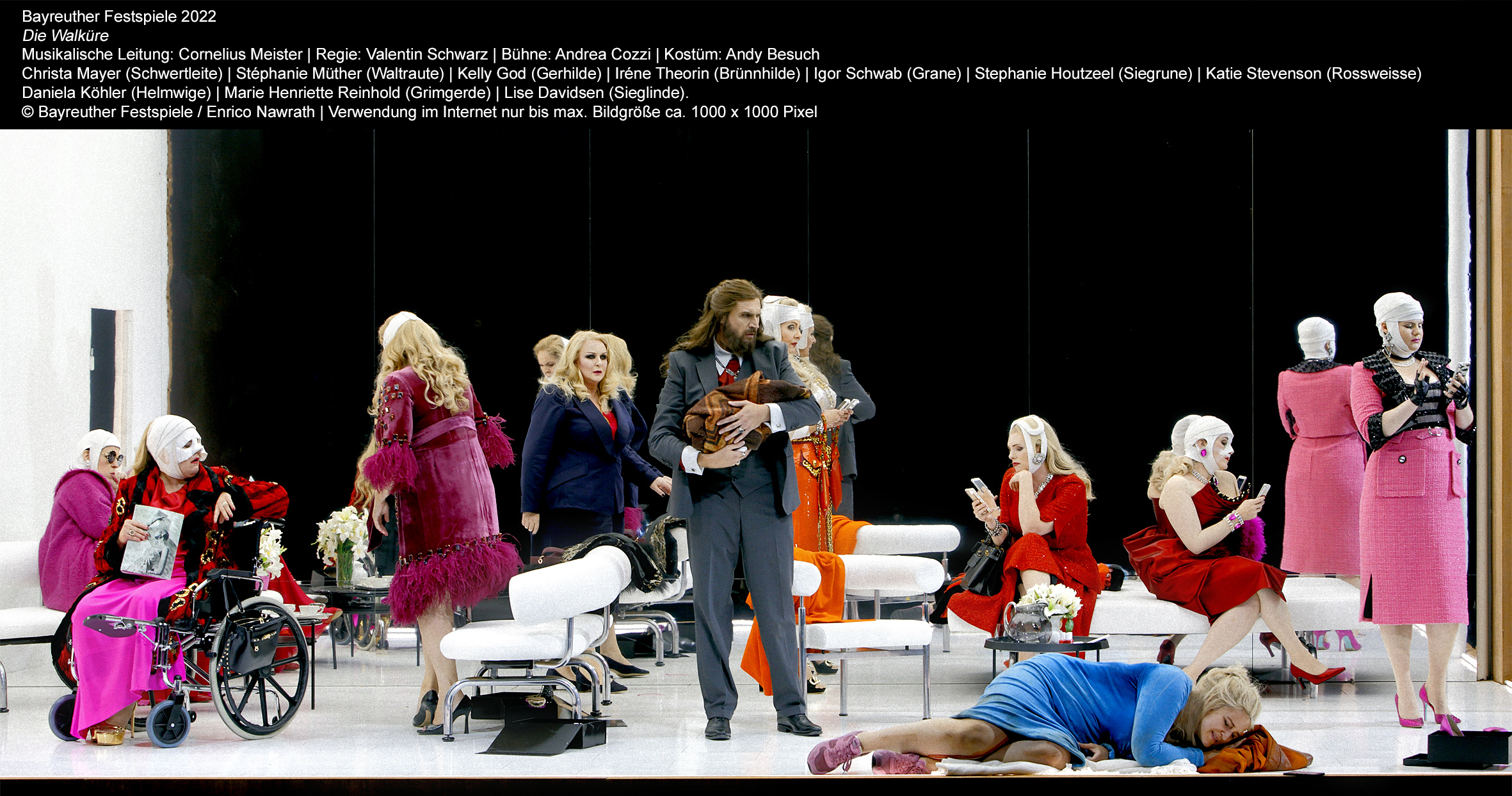
The boos are getting louder: not, I think, for the musicians, but for the production of Valentin Schwarz, who has yet to appear for a curtain-call. That need be no bad thing artistically, though the practice itself is fascistic; should a bourgeois audience feel satisfied with what it has consumed, it will be a disturbing outcome for art. Here, though, the open mind I am endeavouring to keep concerning Schwarz’s production is struggling a little. As a distinguished Wagner scholar said to me when I met him afterwards, ‘It is getting worse.’ On the basis of what I saw in Die Walküre, I had little choice but to agree.

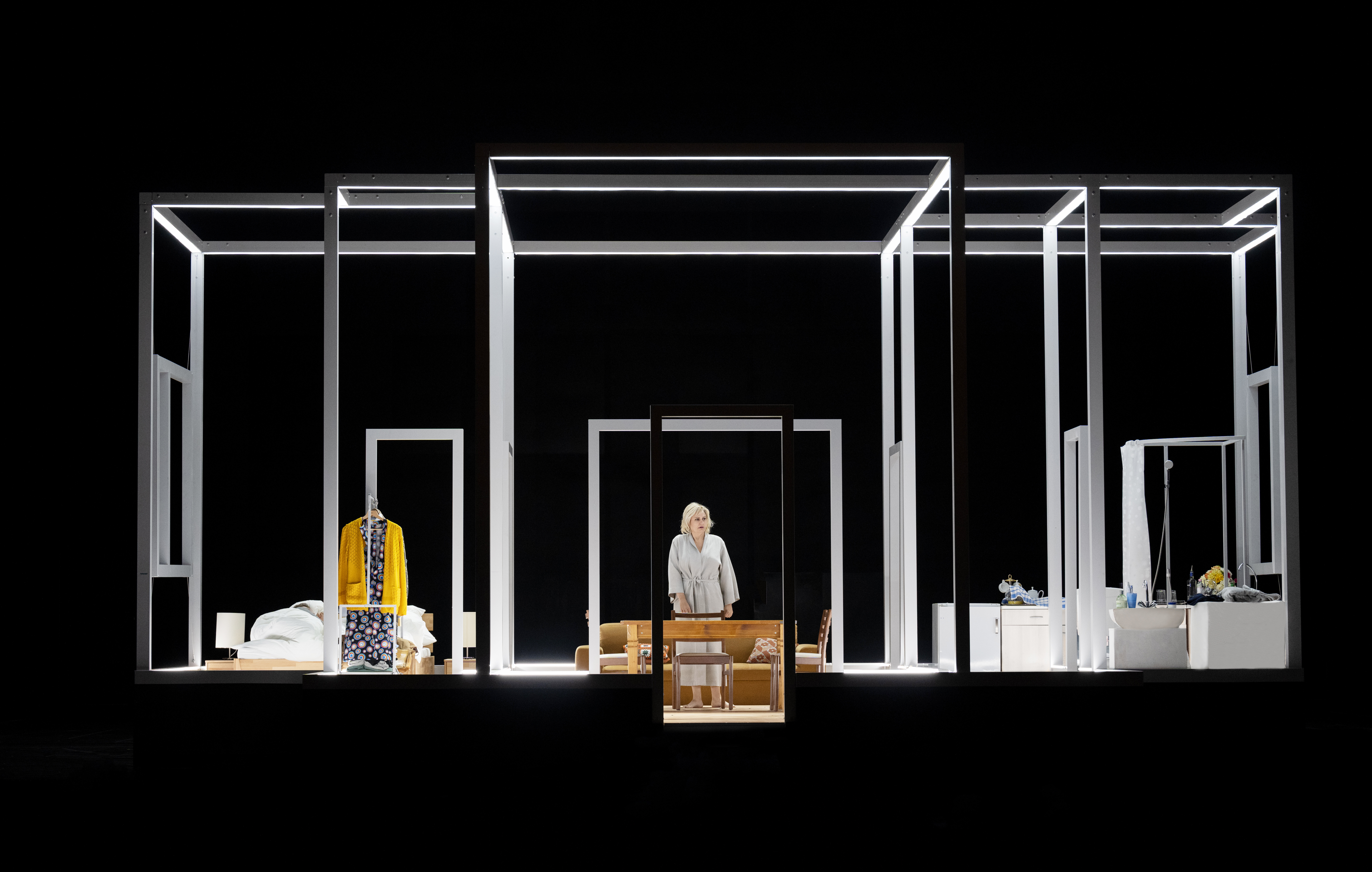
Short of the framing of the action as a saga of twins, which here seems more assumed to continue from Das Rheingold than illustrated, there is little at all to point to other than strange departures from Wagner’s drama, which taken separately or together fail to amount to anything very much. Siegmund and Sieglinde are, I think, taken back by their self-discovery to their childhood, joined by ‘symbolic’ star-children. (Either that, or they fantasise about the children they will have, but I think it is the former.) There is nothing wrong with that; it makes sense. But for it to have taken place in Wotan’s godly quarters seems peculiar—imagine Fricka’s thoughts on that—as well as quite at odds with what they have just sung, without obvious reason.

 It is later implied that Sieglinde, heavily pregnant throughout the first two acts, is carrying Wotan’s baby. At least I think that is why he ‘comforts’ her, whilst Siegmund and Hunding seek one another, pulling down her tights and apparently attempting to deliver the child. If not, it is a straightforward case of sexual assault, although I suppose it must have been anyway earlier. My guess would be that this is intended to enhance the parallelism between Wotan and Alberich, that both will be found to have produced children, Siegfried and Hagen, through rape. But where that leaves Siegmund, goodness knows: St Joseph with a twist, it would seem. Where, though, does that leave Hunding? He must surely have noticed. It is difficult not to conclude that Wagner’s plot would have been better left as it was.

In between, Freia’s funeral, or at least her lying in rest, had taken place. There were some germs of decent, if ultimately rather incidental ideas, here. Assuming we are still to take her as goddess of love, her death would have obvious implications (although its timing is arguably strange, given that Siegmund and Sieglinde have just met). In a Mafia-film-style mise-en-scène, a few people come to pay their respects, whilst Wotan and Fricka have their decisive confrontation. (Brünnhilde spends some of that scene in what appears to be a greenhouse. I don’t know either.) Hunding petitions the gods in person, an interesting touch. That Fricka returns at the end of the third act, after Wotan has put Brünnhilde to sleep (and made, you guessed it, his incestuous urges all too clear), suggests that she is confident in her triumph. She even wheels on a drinks trolley and offers Wotan a celebratory glass. He declines, though, so in the absence of a spear—just nothing at all, throughout—Fricka clinks together the glasses to make the requisite noise.


I am afraid I have no idea at all what happens in the Ride of the Valkyries. It veered all over the place—at least the BBC light entertainment place—from Dr Who to The Benny Hill Show to Casualty, with an apparently accidental turn for Diana Dors’s gender-reversal ‘The Worm that Turned’ series for The Two Ronnies. Sometimes the Valkyries were in charge, sometimes Wotan’s guards. There was a great deal of mobile telephone use. Perhaps it is time to call for a moratorium on those devices onstage, unless the director has a clear idea what they are for. As things stand, they seem to have become the new suitcases.

Lack of objects when called for and introduction of obscure alternatives does little to help. I have already mentioned the lack of a spear or any substitute.   Just as the role of Das Rheingold’s dark-haired boy is more unclear than ambiguous, so is that of the strange pyramid-in-a-box, earlier seen and quasi-worshipped upon the gods’ entry into Valhalla as if a grail-refugee from a production of Parsifal. It now reappears as a repository for a pistol. Sometimes a pistol is a Notung equivalent, sometimes not; sometimes there are several. None of it makes any sense, really, and try as I might to try to piece together some sort of explanation, I am really on the verge of giving up.

As for Grane’s reincarnation as Brünnhilde’s male, suited personal assistant, it makes even less sense when there have been a few apparently arbitrary visual references to actual horses elsewhere. Finally, there is a strong impression that the strongest acting is brought by the singers themselves to their roles. Personenregie is intermittent at best and sometimes disappears altogether in longer exchanges between characters. I suppose some of these things, minus the lack of Personenregie, might add up to something in retrospect, but I do not feel especially hopeful.

Musically, things are better, often much better. Cornelius Meister continues to impress greatly with his command of structure and detail, conveying and expressing a Wagner melos from the pit that drives and, in many respects, is the action. The sound he drew from the Bayreuth Festival Orchestra—and, I assume, to an extent, the sound its players wished to conjure too—was in some ways distant from that we might recall from old Bayreuth recordings, closer to those of other opera orchestras. Choices seem well justified to me, though, and there is no point merely trying to imitate Karl Böhm—or anyone else, for that matter. There is considerable emotional and conceptual range as the cauldron of Wagner’s Greek Chorus bubbles: quite a difference, alas, from what we see onstage.

Not, however, from what we hear onstage. Lise Davidsen’s Sieglinde was at least the equal of any I have heard. No one seems to have a bad word to say about this extraordinary soprano, and so far there seems no reason for anyone to do so. Her final peroration here, ‘O hehrstes Wunder!...’ was as vocally magnificent, riding the orchestral wave almost like no other, as it was clearly heartfelt, the culmination of a dramatic journey that now must end. Klaus Florian Vogt’s tenor will always divide opinion. Much of that is simply down to taste. Whether one liked his performance or not—and there is no getting away from the fact that its sound is very different from the baritonal Siegmunds we have come to expect—his was certainly a committed and, I think, highly likeable performance. Georg Zeppenfeld’s Hunding offered a masterclass in the role, everything present and correct, both considered and alert to the moment.

Tomasz Konieczny and Michael Kupfer-Radecky shared the role of Wotan, the former having become unable to continue during the second interval. Both gave strong performances, deeply rooted in Wagner’s text; if the ear took a little while to adjust to new sound and delivery, that was a tiny price to pay for so crucial, short-notice a substitution. Christa Mayer’s Fricka was once again first-class, fuller-throated than often one hears, and all the better for it. Iréne Theorin impressed as head Valkyrie, youthfully impetuous and headstrong, yet clearly transformed by what she had witnessed. The rest of her team was cast from depth, including a return for Mayer as Schwertleite. Had this been a concert performance, I suspect it would have moved more than it did in the theatre. This Ring, however, will continue in Wagner’s own theatre.


Thursday, 15 August 2019

Bayreuth Festival (3) - Lohengrin, 11 August 2019


Festspielhaus


Henry the Fowler – Georg Zeppenfeld
Lohengrin – Piotr Beczala
Elsa – Camilla Nylund
Friedrich von Telramund – Tomasz Konieczny
Ortrud – Elena Pankratova
King’s Herald – Egils Silins
Brabantian Nobles – Michael Gniffke, Tansel Akzeyebek, Marek Reichert, Timo Riihonen

Yuval Sharon (director)
Neo Rauch, Rosa Loy (designs)
Reinhard Traub (lighting)

Bayreuth Festival Chorus (chorus master: Eberhard Friedrich)
Bayreuth Festival Orchestra
Christian Thielemann (conductor)


The origins of this production of Lohengrin, first seen at last year’s Bayreuth Festival, are interesting and unusual. Alvis Hermanis, an avowed ‘conservative, and proud of it’ – for which, as usual nowadays, we should read something considerably more extreme – had been due to direct the new production. Hermanis withdrew in 2016, to little sadness from the rest of the world, yet nevertheless bequeathing the Festival a serious headache. By that time, work on the designs by the New Leipzig School artists, Neo Rauch and Rosa Loy, was already far advanced. Yuval Sharon, as incoming director, was presented with a greater challenge than simply directing a new production of Lohengrin (and, incidentally or otherwise, being the first American director to work at Bayreuth). He had to formulate and put into practice his own production, using designs intended for another production.


Watching the dress rehearsal last year – I did not see a public performance, and thus did not write about it – I saw a productive tension, an immanent critique, which fascinated me: broadly, and thus misleadingly, politics pitted against fairy-tale, not unlike the work itself. It was doubtless in some respects still a work-in-progress: every production, every performance is. It made me think, though, and I was greatly looking forward to seeing it again this year, to seeing how it had progressed, hoping that the cracks, the fissures, the contradictions would have provocatively deepened. Alas, that did not seem to have been the case; if anything, the production seemed to have reconciled itself to the designs. Perhaps it is too much to ask of a staging that the two can continue to struggle like that, especially when performers have their own imperatives. I genuinely do not know and it may have been entirely my own fault, but I must confess that, to my great sadness, I missed a good deal of what I saw and gleaned last year.


At first, this was not apparent. Indeed, the first act engenders considerable expectancy (at least on my part!) It comes across, or at least did to me, in painterly fashion: a Romantic fairy-tale world, slightly frozen – so blue, so very blue! – from which things can and must progress. It is, then, waiting for Lohengrin; as are we all. When he comes, he ignites the world. He brings electricity, literally as well as figuratively. Is this the beginning of the route from an early-modern Brabant to socialism, a short-circuit, as it were? If so, only fitfully – and that, this time, does not necessarily seem to be a deliberate undercutting. Instead, the critique seems to halt, even to vanish, in the second act, not helped at all by Christian Thielemann’s sometimes interminable scenic-route reveries. At times, other than marshalling of the forces onstage, little else comes across. There is more in the third act, though even that seems considerably less bold. Lohengrin tying Elsa up comes across more as pretty choreography than a deadly game of sado-masochism. And the hints at green politics, culminating in a bizarre, if intriguing green Gottfried, do not come across nearly as strongly as they might. Ortrud’s rightful oppositional status – what if she is right, seems to be the question – is likewise considerably less clear. It is a pity, since I remain convinced that there is potentially much to be admired here. Perhaps 2020 will sharpen things up.


Thielemann’s conducting proved variable. Like the production, he was stronger in the first and third acts, although, as in his Tristan the night before, there was no doubting his extraordinary ability to have the superlative Bayreuth Festival Orchestra do whatever he asks of it. Speed, or otherwise, was not in itself the problem: indeed, speed is only a part, often a relatively unimportant part, of what we really mean by ‘tempo’. The listlessness and at times the self-regard we heard in the second act most certainly was. A little study of Wagner’s essay, Über das Dirigieren, might help. There were magical moments, magical passages, yet sometimes – only sometimes – they came at the expense of musico-dramatic momentum.


There was much to admire from the cast. A few vowels aside, Piotr Beczala’s Lohengrin approached the ideal. ‘Italianate’ might be a lazy way to describe his phrasing, but I hope it will be understood for what it is, in the very best sense. Not that it came at the expense of words, far from it. Beczala’s golden tone could be relished in and for itself, but that would have been to miss an acutely, astutely dramatic portrayal, one I should dearly love to hear again. Camilla Nylund’s Elsa had the occasional rocky moment in the first act, but hers was likewise an intelligent, committed, and beautifully sung performance. Tomasz Konieczny and Elena Pankratova offered similarly intelligent, highly musical portrayals of Telramund and Ortrud, although the latter’s diction occasionally left one having to fill in verbal gaps for oneself. Georg Zeppenfeld never, in my experience, disappoints; that is no reason to take singing such as that for King Henry for granted. Egils Silins’s Herald likewise compelled attention and admiration. So too, last but not least, did the outstanding performances of the Bayreuth Festival Chorus, vocal heft, stage versatility, and verbal comprehensibility all second to none.


Still a work-in-progress then? Doubtless. However, whatever work may remain to be done here – there is always work still to be done – we may give thanks that this was not an Alvis Hermanis production. Catastrophes such as his Vienna Parsifal and, perhaps still more, his Salzburg Liebe der Danae warn of what might have been.


Thursday, 6 July 2017

Munich Opera Festival (1) - Die Gezeichneten, 4 July 2017

Foreground (in white): Duke Adorno (Tomasz Konieczny) and Count Tamare (Christopher Maltman); Staatisterie of the Bavarian State Opera
Images: Wilfried Hösl

Nationaltheater, Munich

Duke Antoniotto Adorno/Capitaneo di giustizia – Tomasz Konieczny
Count Andrae Vitelozzo Tamare – Christopher Maltman
Lodovici Nardi – Alastair Miles
Carlotta Nardi – Catherine Nagelstad
Alviano Salvago – John Daszak
Guidobald Usodimare – Matthew Grills
Menaldo Negroni – Kevin Conners
Michelotto Cibo – Sean Michael Plumb
Gonsalvo Fieschi – Andrea Borghini
Julian Pinelli – Peter Lobert
Paolo Calvi – Andreas Wolf
Ginevra Scotti – Paula Iancic
Martuccia – Heike Grötzinger
Pietro – Dean Power
Youth – Galeano Salas
Friend/Servant/Giant Citizen (!) – Milan Siljanov
Girl – Selene Zanetti
Senators – Ulrich Reß, Christian Rieger, Kristof Klorek
Little Boy – Soloist from the Tölz Boys’ Choir
Servant – Niamh O’Sullivan
Father – Yo Chan Ahn
Mother – Eleanor Barnard
Citizens – Harald Thum, Thomas Briesemeister, Klaus Basten, Burkhard Kosche, Tobias Neumann, Sebastian Schmid

Krzysztof Warlikowski (director)
Malgorzata Szczęśniak (designs)
Felice Ross (lighting)
Claude Bardouil (choreography)
Denis Guéguin (video)
Miron Hakenbeck (dramaturgy)

Children’s Chorus (chorus master: Stellario Fagone) and Chorus (chorus master: Soren Eckhoff) of the Bavarian State Opera
Bavarian State Orchestra
Ingo Metzmacher (conductor)


There is a host of fine operas out there languishing more or less unperformed (in some cases, quite unperformed). A few of them might even qualify as ‘great’. (Feel free to remove inverted commas, should that be your thing.) Franz Schreker’s Die Gezeichneten, whatever its proponents might claim, is certainly not one of those: not even close. Nor, however, is it a piece that fails to merit the occasional outing. Whether it merits the torrent of productions seemingly in store is rather less clear. For what it is worth – and this is partly a matter of taste, or lack thereof – there is not a single opera by Mozart, Haydn, or Gluck I should not rather see before sitting through this again. That said, I was immensely grateful not only for the opportunity afforded by the Bavarian State Opera not only to see the opera staged, but to see and hear it performed and staged so well – so much so, indeed, that the whole experience was enjoyable, absorbing, very much more so, I think, than the intrinsic merits of the opera might suggest.

That might sound odd, but it is not really so very odd – at least not necessarily. A peculiarity, indeed a fascination, to the opera is that almost every charge one might lay at its door might conceivably meet with the rejoinder: ‘that is the point’. It depends whose point, really: it is less often the point if we focus narrowly on ‘intention’, but why should we? Krzysztof Warlikowski’s production seems to nod to this thorny question by interpolating, immediately after the interval, before the third of the three acts, Schreker’s own character sketch of 1921, in which he presents – even, to an extent, ‘reclaims’, as we might say – accusations thrown at him and his art. It is, we may be reasonably sure, intended ironically or, perhaps better, with understandably vicious sarcasm, having been constructed from criticisms he had received:
  I am an Impressionist, Expressionist, Internationalist, Futurist, a musical purveyor of verismo; Jewish, and rose through the power of Jewishness; Christian and was ‘made’ by a Catholic clique under the patronage of a Viennese arch-Catholic countess.

 I am a sound artist, sound fantasist, sound magician, sound aesthete, and have no trace of melody (other than so-called short-breathed empty phrases, newly known as Melodielein). I am a melodist of the purest blood, as a harmonist however, anaemic, but perversely in spite of this a full-blooded musician! I am (unfortunately) an erotomaniac and work balefully upon the German public (eroticism is obviously my innermost contrivance, despite Figaro, Don Giovanni, Carmen, Tannhäuser, Tristan, Walküre, Salome, Elektra, Rosenkavalier, and so on). ... 

 
The rest, in which he continues, to explain that he is not of the true modernistic ‘left’ (Schoenberg and Debussy), owes something to Verdi, Puccini, Halévy, Meyerbeer, et al, and so on, may be read here. (It is well worth doing so, if you have the German.) It made for a powerful moment, or rather few moments, in the theatre, not least since Warlikowski has it read by the tragic, ugly hero-artist (the libretto was originally intended for Zemlinsky), who thus becomes at least in part an explicit realisation of Schreker’s plight. The problem, however, remains that, insofar as we may dissociate criticism of Schreker from anti-Semitism – perhaps it is impossible historically, but it need not be so now – many of the criticisms levelled tend actually to be born out; either that or the comparisons (Figaro, Tristan, etc.!) are rather embarrassing, doing neither composer nor opera any favours at all.

Carlotta (Catherine Naglestad) and Salvago (John Daszak)

What we have, then, is an evening in the theatre in which that problem is, if not worked out, at least explored. The slipperiness of artistic creation and agency is embodied in Alviano Salvago. Is he a good artist or a con artist? There are many other possibilities; we do not end up necessarily falling short of Mozart and Wagner because we are not trying. Salvago has created a garden of delights, an island park of Elysium, which he wishes to give to the people of Genoa. Is the suspicion of its establishment justified? In part, perhaps. Dark things clearly go on there. Are they the creator’s doing? Not intentionally, but they can be readily understood, made out to be, especially by other, more attractive noblemen who wish to be able to pursue something far more dastardly, indeed truly shocking – such as to leave our aesthetic-moralistic sniping at Schreker-Salvago look at best misguided. Do we really want to be the ones to say ‘yes, I’m sorry, your music is overblown, verging on the formless, an illustration or at least a piece of evidence, moreover, that Schoenberg was right: once a certain point of chromaticism has been reached, there really is nowhere else to go other than somewhere you would not…’, and so on? Of course we do not, especially when we know with whom we are allying ourselves, especially when we know how the crowd may be swayed – either by Salvago or by his opponents. On the other hand, Goebbels is not the only option: there is Schoenberg too; there is Moses und Aron, where we can see and hear these antinomies, or better dialectics, actually treated with the seriousness they deserve.

Give ourselves a third hand, though, or, Blair forbid, a ‘third way’, and perhaps we may wish to tarry. It is not as bad as Korngold, say. There is genuine fascination in the harmonic and instrumental colour: evidence of the most extraordinary ear. Alas, there is such an utter lack of variety that it all sounds more or less the same. One may like the sound; I might, for a few minutes. But for three acts? Three acts, that is, intruded upon only by a strange vulgarity in the third: dramatically effective, to a certain extent, as a suggestion of crowd dynamics, yet ultimately incongruous and, more to the point, unconvincing. The lack of ‘traditional’ melodic invention is not the end of the world in itself, but let us not convince ourselves that this is replaced by the still well nigh incredible perpetual self-transformation of Erwartung. Nor is the lack of musical characterisation necessarily fatal, although it is clearly a flaw, for this is not Fidelio, in which characterisation is simply not the point. Returns, however magnificent they sound in themselves, diminish all the time, without ever being replaced by something which, in that old Romantic way, we might consider to be true inspiration. Contrivance is all very well; who cares, ultimately, if the result is good. But is it?


Warlikowski proves himself, unsurprisingly, a dab hand at the erotomaniac side of things. The burlesque dance performed before the angry Schreker-Salvago is not the half of it, although it is perhaps the most memorable side. He shows also, quite unsparingly, how evil one side of the accusers is: that is, the party of Vitelozzo Tamare. Rich, unscrupulous, deceiving, plausible, violent: it is they who do the real harm, who have kidnapped and abused Ginevra Scotti, whilst framing the poor Salvago. How many other productions manage to incorporate a boxing training session into proceedings, as if to underscore the lavish obscenity of the violence? The humanity of the genuine artist, Carlotta, is underscored equally well, not least given an exemplary, heartfelt performance from Catherine Naglestad. She looks for the soul and perhaps she finds it: or perhaps, given her fate, she realises there is none at all, and is better off out of the game entirely. In that, encasing herself, she becomes an installation, perhaps an artwork of her own. The raging rodent crowd – more than a nod to Hans Neuenfels’s Lohengrin – would neither understand nor care. Salvago does though – we think.


The Bavarian State Orchestra under Ingo Metzmacher played with such glorious golden tone that it might have been the Vienna Philharmonic in Strauss – other, that is, than the score itself not having Strauss’s sense of drama, of direction, of characterisation, and so on, and so on. There was no sense of hurrying, which may or may not have been an unalloyed advantage. I think it was pretty much an advantage, for one certainly gained the impression of the score being permitted to speak for itself, even if to be hoist by its own petard. John Daszak gave a deeply moving account – like so many of the performances, seemingly moving beyond the limitations of the work ‘itself’ – of the central role. Christopher Maltman proved diabolically irresistible as his wicked opponent in love, art, and so much more; there was more than a hint of an ultra-decadent Don Giovanni here (definitely without the idealism – or Idealism). Tomasz Konieczny gave a magnificently forthright performance as Duke Adorno: duly ambiguous as to whose side he was on, if any, never anything but fully committed, though, in vocal terms. The doubling of his part with that of the Capitaneo di giustizia – gleefully ripping off his mask to confirm what we suspected – only heightened the troubling implications. The huge cast did not, so far as I can recall, have a single weak link to it; this, and the equally fine choral contribution showed just what an opera house and company can achieve. The extraordinarily self-reflexive quality of the evening and its aftermath will, I suspect, continue to intrigue. The Vorspiel zu einer Drama, the concert version of the opening Prelude, says it all - and yet, in another way, says none of that.


Sunday, 14 August 2016

Salzburg Festival (6) - Die Liebe der Danae, 8 August 2016


Grosses Festspielhaus


Images: © Salzburger Festspiele / Forster
Jupiter (Tomasz Konieczny)


Danae – Krassimira Stoyanova
Jupiter – Tomasz Konieczny
Merkur – Norbert Ernst
Pollux – Wolfgang Ablinger-Speerhacke
Zanthe – Regine Hangler
Midas – Gerhard Siegel
Four Kings – Pavel Kolgatin, Andi Früh, Ryan Speedo Green, Jongmin Park
Semele – Mária Celeng
Europa – Olga Bezsmertna
Alkmene – Michaela Selinger
Leda – Jennifer Johnston
Four Watchmen – Hacik Bayvertian, Konrad Huber, Michael Wilder, Csaba Markovitz

Alvis Hermanis (director, set designs)
Juozas Statkevičius (costumes)
Gleb Filshtinsky (lighting)
Ineta Sipunova (video)
Alla Sigalova (choreography)
Gudrun Hartmann (assistant director)
Uta Gruber-Ballehr (assistant designer)
Ronny Dietrich (dramaturgy)

Concert Association of the Vienna State Opera Chorus (chorus master: Ernst Raffelsberger)
Vienna Philharmonic Orchestra
Franz Welser-Möst (conductor)


It is not every year one has the opportunity to see two different productions of Strauss’s penultimate opera, still – still! – never staged by either the Royal Opera or ENO. Before the Deutsche Oper’s revival earlier this year, I had indeed only seen Die Liebe der Danae once in the theatre before, also in Salzburg, in Günter Krämer’s 2002 production. I can only wish that Krämer’s production had been revived, for, despite its faults, its Salzburg successor from Alvis Hermanis is truly atrocious.


At best, it is a total waste of money (and bizarrely, given the golden subject matter, a non-ironic one). The sets and costumes look – and surely must have been – very expensive indeed, the dimensions of Midas’s hut threaten to have Franco Zeffirelli, surely the unacknowledged progenitor of Hermanis’s ‘aesthetic’, seem a model of modesty in his garretted vision for La bohème; indeed, we veer dangerously close to Zeffirelli-Turandot-land (far from coincidentally, as we shall have cause to discover). If the very occasional image, notably the portrayal of the shower of gold through dancers, augurs well, everything else is empty indeed. Chorus members wear individualised giant – and yes, I mean ‘giant’ – turbans. Why? Who knows? No one even seems to care. A still-more-giant elephant is wheeled on and off the stage. At the beginning of the third act, someone walks a real donkey on and off the stage in bizarre hommage to Francesca Zambello’s Carmen, or maybe not. Nothing seems to have any meaning. There is a total lack of interest – truly extraordinary in our own times – in the dramatic meaning and possibilities of temptation by and rejection of gold. Nor, unlike in Krämer’s production – which took us from the period of 1944 dress rehearsal, through 1952 for the first production, also of course in Salzburg, to its own time – is there any interest whatsoever shown in genesis and reception. This opera needs help to release its myriad of musical riches; it receives none; indeed, none is so much as attempted in a lengthy essay in – at best – vacuity.

 
Danae (Krassimira Stoyanova) with dancers (gold)

In a valiant attempt to defend or at least to skate over Hermanis’s indefensible, dramaturge Ronny Dietrich writes: ‘This blend of the traditional with the fictitious … has induced Alvis Hermanis to stage Die Liebe der Danae as a fairy tale, especially as the opera’s storyline takes us to the Orient. Even if the libretto mentions Syria as the country in which the encounter between god and man, i.e. Jupiter and Midas, took place, Alvis Hermanis prefers not to commit himself to any location or period in his production.’ It is not, on a moment’s reflection, so valiant after all (and I have checked the original German, lest the words were mistranslated). Why is a ‘fairy tale’ ‘especially’ suited to ‘the Orient’. Did Edward Said, let alone any of his successors, never exist? And why is a fairy tale somehow held to be devoid of meaning, of all manner of implications, psychological, social, political, cultural…?


The claim that no location is committed to is at best questionable. Why, then, do we see, for no obvious reason, that most noble passage in the whole opera – the interlude depicting ‘Jupiter’s resignation’ – ruined by a procession on stage of women in burqas? Well, I say burqas, but, in contrast with the expensive if vulgar designs for everything else, they are simply white sheets: childish, if one were to be charitable, but more likely deliberately insulting? We return to Hermanis. Now notorious for his anti-migrant outbursts – one of his most staggering, brazenly untruthful, brazenly racist claims having been ‘While not all refugees are terrorists, all terrorists are refugees or their children’ – I think we can hazard a guess why he might wish to hold to ridicule Muslim women, in a setting that is anything but non-specific, whatever Dietrich might claim. Likewise why Hermanis might depict ‘the Orient’ – have we really not moved on from that? Yes, we, of course, have – with an essentialism shading between ludicrous and sinister. There is no reason whatsoever for those women to have trekked on stage at all, setting up shop with looms in Midas’s bafflingly large tent; Dietrich offers the claim that carpets, ‘which epitomise the oriental topos’ (we are long past the time to stop digging) establish ‘a connection to the genesis of the opera – a process of intertwining and interweaving themes and motifs’. You could have fooled me. Hermanis’s recent interview with Der Standard, in which he defiantly nails his ‘conservative’ – for which, we can read something a little more than that – credentials to the mast tell us, sadly, much more about what has been going on. Why theatres continue to hire someone whose directorial skills are as impressive as his politics is beyond me – more so than ever, given the results of this production.


We had, then, to rely on the singing for anything in the way of enjoyment or edification. It is just as well that much of it was very good indeed. I doubt that the role of Jupiter has ever been better sung than it was by Tomasz Konieczny; his was a towering, tireless performance, as impressive in its moments of tenderness as of godly pride. Krassimira Stoyanova’s Danae was, for the most part, beautifully sung, in an evidently heartfelt assumption. Both singers showed themselves excellently matched in that glorious final duet. Gerhard Siegel’s musical and verbal skill was never in doubt, but I was not always entirely convinced that the voice of an excellent Mime offered a plausible Midas challenge to our Wotan-Jupiter. Norbert Ernst made for a lively Merkur and Wolfgang Ablinger-Sperrhacke once again proved himself a fine singing-actor as Pollux. Jupiter’s wives – what to say about their painted-on nipples, another Orientalist ‘fantasy’? – struck me as an altogether superior collection of consorts. Mária Celeng, Olga Bezemertna, Michaela Selinger, and Jennifer Johnston worked so well together, both individual of voice and indeed of character, and yet also cohesive as a vocal quartet, that I longed to hear more from them: a spin-off, please.


That leaves us to consider the orchestra and the conductor. Franz Welser-Möst, lavishly praised by Hermanis in that Standard interview, conducted somewhat stiffly for much of the evening. If Hermanis thinks, as he claims, that Welser-Möst is an aural equivalent of ‘strong LSD’, he needs to find himself a new dealer. When the conductor relaxed, when he let the music yield a little more, the Vienna Philharmonic came more into its own. There is much more to this score in terms of harmony, colour, a myriad of orchestral melody than we heard here, though. It was not only Hermanis’s fault that the aforementioned ‘Jupiter’s resignation’, one of the most moving orchestral passages in all of Strauss’s operas, went for so little.