Showing posts with label Tansel Akzeybek. Show all posts

Wednesday, 16 August 2023

Bayreuth Festival (1) - Der fliegende Holländer, 14 August 2023


Festspielhaus


Daland – Georg Zeppenfeld

Senta – Elisabeth Teige

Erik – Tomislav Mužek

Mary – Nadine Weissmann 

Steersman – Tansel Akzeybek

Dutchman – Michael Volle


Dmitri Tcherniakov (director, designs)

Elena Zaytseva (costumes)

Gleb Filshtinsky (lighting)

Tatiana Werestchagina (dramaturgy)


Bayreuth Festival Orchestra

Bayreuth Festival Orchestra (chorus master: Eberhard Friedrich)

Oksana Lyniv (conductor)


It had been six, not seven, years since I last saw The Flying Dutchman, but it was time. So it was for ‘H’: Holländer, rather than a friend from Line of Duty, though there was certainly something of the allied Nordic Noir genre to Dmitri Tcherniakov’s staging, first seen in 2021. The Dutchman revisits his home town following an horrific crime, resulting in a woman, perhaps a prostitute, left hanging from a window, seen (or dreamed) during the Overture. He plays his cards close to his chest, but is bent ultimately on justice, revenge, or both, insofar as they may be separated. Is that what he achieves? He seems to think so, maniacal in a burning triumph to match Götterdämmerung, windows of Tcherniakov’s own small-town, Norwegian set, its church a focal yet distant point of alternative judgement; or, for Nietzscheans, alternative death, ablaze. Until, that is, Mary, the ‘normal’ yet apparently decent animating future of community singing (rather than spinning), desperate to escape from that world, shockingly shoots him dead at the close, the ironic strains of Wagner’s 1859 ‘redemptive’ ending telling their own tale from the pit. 


Mary, it seems in this retelling, is Senta’s mother or stepmother. She is certainly resented earlier by Senta, who in crazed fashion – is she high, a not uncommon reaction to smalltown life? – supplants her in front of the choir, waving her arms around to little apparent musical effect. The Dutchman’s picture, however, still causes a stir. To have Nadine Weissmann, Frank Castorf’s unforgettable Erda, in this newly important, and sympathetic role, added intriguing, intertextual possibilities to this mind, although that is perhaps for the most part a private matter. Weissmann’s performance was as musically endearing as it was dramatically powerful, its silences and quiet looks as potent as the final shot.


This is, among other things, a tale of storytelling. The Steersman, Daland, the Dutchman, Senta, most likely everyone has a story to tell. The past, especially as understood by the present, is like that. For the woman hanged was the Dutchman’s mother, and it would seem, Daland’s lover. (I think it was a little more than a transactional arrangement, though I am not entirely sure. Perhaps they were not either.) The town bar is a dangerous, masculine place of storytelling; the Dutchman has money, and thus can buy men and time. The choir is most probably the bar’s feminine equivalent. At any rate stories are told and heard, decisions are made, and steps are taken towards the final tragedy.


For Senta, it has been a tale cleverly poised between Nordics Noir and Beige (the latter literally in Elena Zaytseva’s costumes for her and the womenfolk). And it is emblematic of the success of the whole, almost whatever one may think of parts of it, that this is seen and heard at all levels. When Tansel Akzeybek’s Steersman sang his song, eliciting derisory laughter, the number of different tones and expressions used, without sacrifice to the whole, transformed it into a mini-cantata or indeed an encapsulation or anticipation, of the whole drama. The tragedy of having to live in the circumstances given and which cannot be altered is not of course, uncommon. It seems, however, unusually apparent and immediate on this occasion. That thought may be politicised; it may be internalised; it may even be transmuted into geography. What is this Norway, we might ask, for Wagner, for Tcherniakov, for the performers, for us? To say it is, the imagination is too easy, although there is surely an element of that. We all create it before our eyes and ears, although certainly not with free will. Always the grey, the beige, the community, and likewise our dreams, fantasies, and plans to escape beckon, thwart and are thwarted, impart life and death. 


Michael Volle’s complete portrayal, as visceral as it was detailed, as rooted in Schubert ballads and even Bach as it was echt-Wagnerian, was a rare prize, fundamental to our experience, as was Georg Zeppenfeld’s luxury casting as Daland. I say ‘luxury’, but in fact a signal virtue of this performance and this production was to have one realise quite how important and complex the role should be. Elisabeth Teige’s Senta was fully the equal of the portrayals of her illustrious peers. A fittingly Nordic heroine, as steely as Nilsson when required, yet probably more variegated in response to very particular stage requirements, she understandably received thunderous applause. Erik is a difficult role; one cannot (usually) be unduly heroic or assertive. Tomislav Mužek nevertheless impressed in another excellent performance.


Eberhard Friedrich’s Bayreuth Festival Chorus was likewise on first-rate form, as it must be. A rooted community that can yet be swayed, it offered an almost Bach Passion-like combination of participation and observation. That goes for Tcherniakov as well as Wagner. Much the same may be said of what Wagner would soon designate his Greek chorus, the orchestra. If Oksana Lyniv drove hard times, not least during the Overture, and sometimes seemed more inclined to look back toward the number-opera past than forward to the music-drama future, hers was always a musically and dramatically motivated reading, strongly in sympathy with the production. The orchestra itself was incisive, decisive and full of telling colour, such as Wagner had learned in Paris. My ears may still tend, say, towards Wolfgang Sawallisch in 1959, but this was – and is – a Dutchman for here and now. After all, the past, constantly retold and reinvented, is always with us, terrifyingly so as the house from which that terrible deed was done burns. 

Wednesday, 16 March 2022

Wozzeck, Paris Opéra, 13 March 2022


Opéra Bastille

Images: Agathe Poupeney / OnP


Wozzeck – Johan Reuter
Drum Major – John Daszak
Andres – Tansel Akzeybek
Captain – Gerhard Siegel
Doctor – Falk Struckmann
First Apprentice – Mikhail Timoshenko
Second Apprentice – Tobias Westman
Fool – Heinz Göhrig
Marie – Eva-Maria Westbroek
Margret – Marie-Andrée Bouchard-Lesieur
Soldier – Vincent Morell
Actors – Nathalie Baunaure, Fitzgerald Berthon, Andrea Fabi, Manon Lheureux

William Kentridge (director)
Luc De Wit (co-director)
Sabine Theunissen (set designs)
Greta Goiris (costumes)
Catherine Meyburgh (video)
Urs Schönebaum (lighting)
Kim Gunning (video operator)  

Maîtrise des-Hauts-de Seins/Children’s Chorus of the Opéra national de Paris (chorus master: Gaël Darchen),
Chorus of the Opéra national de Paris (chorus master: Ching-Lien Wu)
Orchestra of the Opéra national de Paris
Susanna Mälkki (conductor)


Four-and-a-halfyears ago, I saw William Kentridge’s then new Wozzeck at the Salzburg Festival. I found myself somewhat nonplussed by its more distanced, alienating aspects, thinking them better suited to Kentridge’s Lulu (seen the year before, at ENO). For whatever reason, I found them less of a problem and, in many respects, less apparent in this move to Paris than I had in Salzburg. Why might that have been? Such a question is necessarily speculative, since one never knows how much one is comparing like with like, but I do not think that invalidates the question. Part of the difference may simply have lain with my reception; having spent more time not only experiencing but thinking about contemporary theatre, musical and otherwise, I am probably now more receptive to more distanced approaches. I was also nearer the stage, which, given a staging that was dark in hue and involved quite intricate video projections, was a definite advantage, probably not to be ignored. But I think this was also a more intense musical and dramatic performance, offering greater emotional and psychological depth, enabling a more productive balance between distance and immediacy, to the benefit of both. 


Connected to that, more strongly than I experienced it before, was the overwhelming presence of war, in this case the Great War, though events elsewhere in Europe were doubtless on many minds too. Social brutalisation—remember Britten’s ‘the more vicious the society, the more vicious the individual’ for Peter Grimes—came strongly to the fore, not as a substitute for individual acts, but as a context and in many respects an intensification for them. This felt more strongly as if it were a drama founded in a military context, rather than having that context uneasily tacked on: tribute, I think, to some very fine dramatic performances. But the first in particular of the tavern scenes also felt more central, its madness and its malice seeping out in all directions, even retrospectively. Here, the haunted weirdness of masks (new resonances for a pandemic world) and puppets seemed to fuse more strongly with a post-Mahlerian musical sensibility: those marionettes from the ‘Rondo-Burleske’ of Mahler’s Ninth Symphony come once again to life; or perhaps better (or at least closer to the truth), to death. Here was an expressionism in which Kentridge’s artificiality participated, danced, and sang. 

Not that this was an especially Mahlerian performance. Mahler’s ghosts were present, of course. How could they not be in this opera? But listening again to that same scene from Claudio Abbado’s Vienna recording, I realise that Susanna Mälkki’s concerns were in many respects quite different. Musical processes came more strongly to the fore through Berg’s closed forms, but with a hint at least of the Neue Sachlichkeit of the Twenties (when, of course, composition was completed, and the work’s premiere given). That psychological depth was present in, to borrow once more from Britten, the turning of the musical screw. Individual lines went their different ways, brought together in harmony and in contrapuntal and/or suspended counterpoint, yet also recognising that, more often than not, there remained a distance (that word again) from Mahler’s world, that this was a world of atonality, which had already suffered the war whose catastrophic progress we saw tracked onstage. Mälkki showed a keen sense of the whole, but also of detail: absolutely crucial in this work. She was warmer, I think, than Vladimir Jurowski in Salzburg, or at least less unremittingly formalist, without taking Abbado’s (or, say, Daniel Barenboim’s) late Romanticism as her model. This seemed not only her Wozzeck, but a Wozzeck designed for this production and these singers. 


Much the same could be said of Johan Reuter’s assumption of the title role: tormented, yes, but very much within a particular context, spatial and historical as well as more conventionally expressionist. Reuter made much of the words, without making too much of them, gauging the level of speech and song unerringly, with apt fluidity and undeniable direction of purpose. Eva-Maria Westbroek’s Marie was formidable, flawed, and feisty, never a victim, in a performance that grew out of yet was never confined to the text. John Daszak’s hideously cocky Drum Major, Gerhard Siegel’s mysteriously commonplace (in a good way!) Captain, and Falk Struckmann’s similarly etched Doctor all shone in their different ways. So too did Tansel Akzeybek’s Andres, in what can sometimes seem a lesser role than it is, yet here offered an excellent counterpoint to Wozzeck: what might have been, yet tragically never really would (and would it even have been much better?) One might say the same of Marie-Andrée Bouchard-Lesieur’s Margret, vis-à-vis Marie. The whole sorry society was finely portrayed, with a fine eye and ear both to ensemble and individuality, all underpinned by typically excellent playing of heft, transparency, and a myriad of darkened colours from the Orchestra of the Opéra national de Paris.

Whether I have answered my original question, ‘why might that have been?’ I am unsure. Attempting to do so, though, has helped structure my response. In a sense, delineating and structuring responses out of chaos is what Berg and his interpreters are all involved with. 

Saturday, 10 August 2019

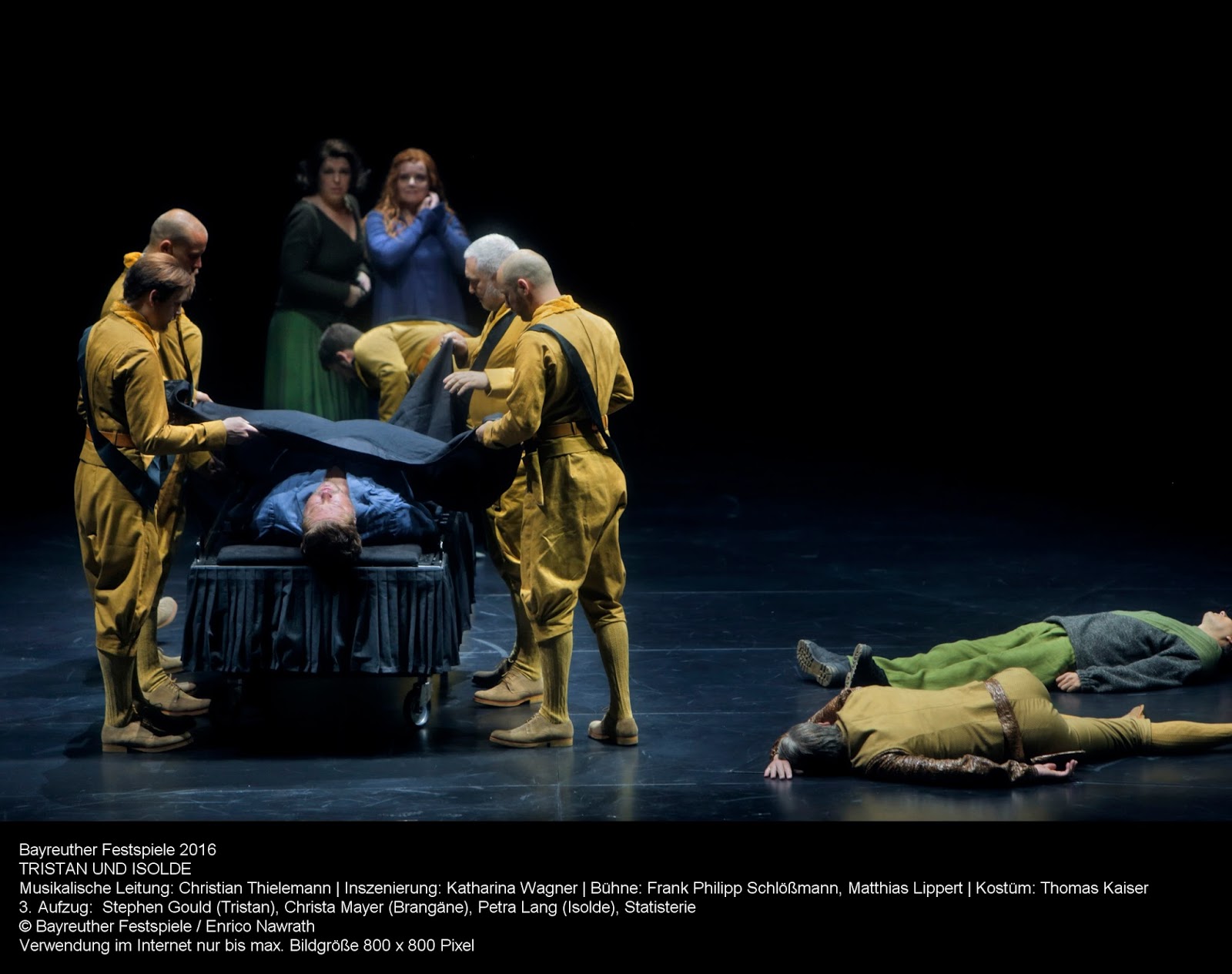
Bayreuth Festival (1) - Tristan und Isolde, 9 August 2019


Festspielhaus


Tristan – Stephen Gould
Isolde – Petra Lang
Kurwenal – Greer Grimsley
Melot – Raimund Nolte
Brangäne – Christa Mayer
Shepherd, Sailor – Tansel Akzeybek
Steersman – Kay Stiefermann

Katharina Wagner (director)
Frank Philipp Schlößmann, Matthias Lippert (set designs)
Thomas Kaiser (costumes)
Daniel Weber (dramaturgy)
Reinhard Traub (lighting)

Bayreuth Festival Chorus (chorus master: Eberhard Friedrich)
Bayreuth Festival Orchestra
Christian Thielemann (conductor)


A frustrating evening, this, as Tristan performances tend to be. Wagner, notoriously, wrote to Mathilde Wesendonck: ‘I fear the opera will be banned – unless the whole thing is parodied in a bad performance –: only mediocre performances can save me! Perfectly good ones will be bound to drive people mad, – I cannot imagine it otherwise.’ I used to sympathise with that melodramatic claim, the work having affected me so deeply, so frighteningly, even in performances that fell somewhat short, especially vocally. Now, however, following a series of disappointments, to which only one recent staging has proved (mostly) an exception, I think I might prefer to be driven mad, in this particular sense, once again.


Oddly, given my early experiences of the work and of Tristan’s role in particular, this had most to be said in its favour in vocal terms. I shall pass over those first Tristans I heard, other than to say that they had me wonder whether I should ever hear someone capable of singing the notes, let alone singing them well, someone capable of making it through the first act, let alone all three. There has never been a golden age of the Heldentenor; the beast has always been rare, even at times apparently extinct. We do not fare badly at the moment, though. Stephen Gould can certainly sing the role – and sing it he did, without audibly tiring. Tristan’s third-act agonies were underplayed in what was overall a relative sensible portrayal, but better that than the agonies of quite a different, unintentional kind to which many of us have frequently been subjected. Petra Lang’s Isolde, if often overacted – this may have been Katharina Wagner’s doing – offered impressive response throughout to music, words, and what is here their ever-mysterious union. Her voice is deeper than one generally hears, with more of the tone, at times clarinet-like, and character of a mezzo-soprano (her original Fach). That, it seems to me, is all to the good. She certainly had one listen to the performance in the here and now, not to some all-too-readily (mis)remembered ‘great recording’ of the past, from which anything actually existing would doubtless fall short. Though a mezzo, Christa Meyer sometimes sounded more soprano-like than Lang. Again, no harm was done by this, slightly disconcerting though the initial impression may have been. Her performance and Greer Grimsley’s as Kurwenal were both marked by similar virtues, and less by strange melodramatic gesture. Georg Zeppenfeld’s Marke could hardly be bettered. It is a gift of a role – to those with the necessary instrument and intelligence. Those Zeppenfeld has in spades; here he left us in no doubt of that. Tansel Akzeyebek shone both as the Young Sailor and Shepherd: sweetly pleasing of tone, his singing recalled to us, at least to me, fine performances as Froh in Frank Castorf’s Ring.


What, then, of Katharina Wagner’s production, which I previously saw three years ago, in 2016? (I shall not re-read what I wrote until after posting.) It has some ideas to it: some of them odd, even perverse, ones, but good can come of it. How they cohere into anything not considerably less than the sum of its parts remains, I am sad to say, beyond me. Incessant insistence on activity, often for nothing more than its own sake, or so it seems, detracts from them – and is surely out of place in this of all operas, whose dramatic stuff is metaphysical or it is nothing. (A partial exception would be the previously trailed production by Dmitri Tcherniakov for the Staatsoper Unter den Linden: unique, in my experience, for attempting and, in large part, succeeding in its presentation of something different.) Whatever is going on here – truth be told, I am not entirely sure – it is certainly not metaphysical. Fair enough: let us try something materialist instead. Materialism, after all, is a strong current not only in nineteenth-century history but in our own time too. But whose materialism is it anyway? Feuerbach’s? The natural sciences’? That of Friedrich Albert Lange’s once-influential History of Materialism and Critique of its Present Importance? Unclear, I am afraid. It veers all over the place, less eclectic than in need of an editor.


Madness – recall Wagner’s caution to Mathilde Wesendonck – comes to the fore in the first act and never quite leaves us. It is a construction, of course; surely we are all to that extent Foucauldians now. Set designs often make that clear: a cruel, constantly changing labyrinth in the first act, brutal, Marke-directed surveillance in the second. Perhaps Isolde’s outsize, ‘operatic’ gestures are a reaction to that. Perhaps – but frankly, they seem more a decision to do something, pretty much anything. Dramatic confusion over what the couple may be doing rather than drinking the love potion can doubtless be justified: I have come up with a few tentative explanations myself. However, none of them feels justified, anything more than a post hoc justification of a directorial decision to have people faff around for a while, be it with knives, with portentously spilling the potion, or with shredding Isolde’s veil into tiny pieces, like children playing with napkins at the dinner table.


Likewise, the emphasis on darkness and light – night and day, in Wagner’s terms – augurs well for the second act. Tristan and Isolde attempt to hide from the searchlights, to little or no avail. But why, then, does Tristan start fixing fairy lights to the makeshift tent Brangäne has offered them as a shield? It may, I suppose, be to undercut the metaphysics, or even the physics, but again it comes across as activity for its own sake. There is masochism here too: intriguingly at first. Tristan clearly derives ecstatic pleasure from cutting himself on the sharp ends of a cage of incarceration. That, in some sense at least, is and must be different from death and a death-wish. An attempt to examine the relationship between the two, though, goes sadly missed, as does any attempt to explore the implications of Melot, at Marke’s instruction, stabbing Tristan, rather than having Tristan, here blindfolded, fall on Melot’s sword (here, I think, a flick knife such as Isolde has played around with for much of the preceding drama).


Then, suddenly, in the third act, we find ourselves back to ‘normal’: to a dark, gauze-obscured staging, replete with shapes, symbols, imaginary doubles, and so on a little too close to comfort to other productions for comfort. Quite why some of Tristan’s hallucinatory Isoldes appear, beckoning to him, to have morphed into Isolde/Iseult of the White Hands I do not know. Again, I could speculate: an alternative, marital path, for instance? Once more, perhaps; once more, however, it comes across less as mysterious than arbitrary. One of them falls from her triangle as the ship arrives: it is a reaction of sorts, I suppose. After the action, Marke, like a brutal Wotan, albeit one married to his Brünnhilde-Isolde, drags her off, unpityingly. Undercutting his noble compassion in the name of an attack on patriarchy could be a fascinating idea, if prepared, pursued, and examined. In this case, it is more the final thing that happens – in a drama that is really not about things happening at all.


There is something of the materialist, perhaps more thorough-going, but also infuriatingly arbitrary in application, to Christian Thielemann’s conducting too. There is no doubting Thielemann’s command of his craft. He can have the Bayreuth Festival Orchestra do anything he wants – well, almost anything, for there were a few rough edges when it seemed he stretched things a little too far even for them. It was a fascinating display, but ultimately a display is what it felt like: a conscious display of virtuosity, even narcissism. The opening Prelude’s phrases were made to swell as if a strange mixture of ‘period’ parody and a highly talented child having delightedly learned how to operate the organ swell pedal. There were times when everything came together: the aftermath of the potion-taking (or –spilling!) Here a veritable Adornian phantasmagoria worked wonders such as can rarely have been heard before, though even that had something, as phantasmagoria would suggest, of the astounding conjurer’s trick to it rather than the workings of Schopenhauer’s Will. At other times, Katharina Wagner’s insistence on activity for its own sake seemed strangely mirrored, if rarely at the same time, by Thielemann’s play with ‘his’ orchestra. The end of the second act came close to the interminable: because he could.


Oddly, the score as a whole came across as more number-oriented, more in the line of Hans von Bülow’s quip concerning Wagner’s bel canto opera, than I have heard: at least from someone who knows what he is doing, rather than from incapable of doing otherwise. There were highly sophisticated connecting passages in between, but connecting passages was ultimately what they were: testament, it seemed, to a conception of unendliche Melodie as solely horizontal, rather than vertical too. Surely the Tristan-chord itself should give the game away in that respect. The moment of the ship’s arrival – surely one of the most exhilarating in all Western art music, on a par with the advent of the finale in Beethoven’s Fifth Symphony – went likewise for almost nothing, though all was present and correct. Of Wagner’s all-determining bass line, we heard surprisingly little: either toned down, or simply an object of beauty. Thielemann’s way could not have stood further from Furtwångler or Barenboim (Tcherniakov’s conductor); but nor did his conception of the score have anything in common with a more Schoenbergian way, such as Esa-Pekka Salonen’s. For many years, Thielemann’s Strauss has seemed to me considerably more convincing than his Wagner. (His earlier Wagner was quite different – and, to my mind, preferable.) This, however, went far beyond what he might have done with Strauss, whose forms he tends to project with extraordinary, sometimes superlative, understanding. This was more akin to a parody of Strauss by his detractors. Or, perhaps, even to the Wagner of those Nietzsche damned as ‘Wagnerians’. It might conceivably have formed the basis of a critique, just as the production might. Neither, alas, seemed willing or able to do so.


Saturday, 20 May 2017

L'incoronazione di Poppea (arr. Elena Kats-Chernin), Komische Oper, 19 May 2017

Komische Oper, Berlin


Images: Iko Freese
Arnalta (Thomas Michael Allen), Amor (Peter Renz)
 

(sung in German, as Die Krönung der Poppea)


Poppea – Alma Sadé
Nerone – Dominic Köninger
Ottavia – Karolina Gumos
Otho – Maria Fiselier
Seneca – Jens Larsen
Arnalta – Thomas Michael Allen
Nurse – Tom Erik Lie
Valletto – Tansel Akzeybek
Druislla – Julia Giebel
Damigella, Fortune – Talya Lieberman
Amor – Peter Renz
Virtue – Katarzyna Włodarczyk
Liberto – Adrian Stooper
 

Barrie Kosky (director)
Felix Seiler (revival director)
Katrin Lea Tag (designs)
Katharina Tasch (costumes)
Ulrich Lenz (dramaturgy)
Alexander Koppelmann (lighting)


Orchestra of the Komische Oper, Berlin
Matthew Toogood (conductor) 

The drowning of Seneca (Jens Larsen)

Monteverdi in German, with an orchestra containing saxophones, vibraphone, and castanets, and a continuo group including various electric (and acoustic) guitars and theorbo, directed by Barrie Kosky: definitely not one for Sackbuts R Us and whatever its splinter groups might be calling themselves at the moment. Farewell, then, to those whose smelling salts did the trick a little too well, or who are too busy clutching their pearls to read further. You will, alas, miss the bit when I say that my problem – not to be overstated – with Elena Kats-Chernin’s realisation (or whatever we wish to call it) of L’incoronazione di Poppea was that it did not go further, or perhaps rather that it sometimes went far enough, but not quite in the right (or the better) direction.

Nerone (Domink Köninger) and Poppea (Alma Sadé)
 

This is a revised version, premiered this year, of the version given in 2012 of all three Monteverdi operas (in a single day!), at the beginning of Kosky’s tenure here as Intendant. It seems that there was some dissatisfaction with what came of this part of the trilogy, Kosky, in a typically revealing programme interview, speaking of Poppea having sounded as though it were not quite finished, Orfeo (Orpheus) and Ulisse (Odysseus) having received very much their own soundworlds whereas Poppea had sounded ‘a little pale and vague’. That certainly did not seem to be the case here. There were, though, times – especially earlier on, so maybe it was a case of my ears becoming accustomed – when I felt there was a certain prettifying gilding of the lily, or a ‘busyness’ almost for its own sake, not least with unwanted (to my ears) complication of extra passing notes, suspensions, and so forth: not unlike, perhaps ironically, what one often hears in certain, allegedly ‘period’, interventionist continuo playing. On the whole, though, and despite those passages that sounded somewhat oddly as if they had an air of the Christmas medley to them. There was an especially attractive – and attractively played – oboe obbligato at some point. (I am afraid I cannot remember quite where.) What I missed was the real sense of a truly modernist reinterpretation. Henze’s Il ritorno d’Ulisse in patria remains an exemplar in that respect, to my ears (and to Thomas Allen’s) more redolent of the Mediterranean than any other. This was perhaps more jazzy Respighi – which may or may not be to everyone’s taste, but such will always be the case with recreation of a Monteverdi opera. A great ‘what might have been’ was the Poppea Berio was said to have been at work on when he died; perhaps, however, even that may be better off in the imagination of our minds.

Amor
 

For reference, the orchestral forces were two oboes, two saxophones (alto, and one covering alto, tenor, and baritone), two trumpets (second also on flugelhorn), cimbasso, percussion (vibraphone, maracas, castanets, glockenspiel, cymbals, bass drum, and ‘others’), nine violas, four cellos, two double bass; the continuo group was made up of two guitars (electric, and acoustic, also playing banjo, mandolin, dobro, 12-string steel guitar, ukulele, jazz guitar, Hawaii guitar, slide guitar), cello, synthesiser, and theorbo). There was much in the way of atmosphere, perhaps more when it came to the continuo instruments (arguably closer to a ‘modern’ interpretation of the Monteverdian ensemble). Conductor Matthew Toogood is credited with the ‘concept and arrangement of continuo parts’ – so presumably part, at least, of the credit for that should go to home. He generally paced the action well, and with variety, although there were a few occasions – usually no more than a bar or two – in which the tension sagged: more, it seemed, a matter of rhythms needing tightening up than anything grievous in the longer term.


Kosky speaks of the music’s temperature of a sweltering summer, even when (yes, even in this realisation!) we are down to just a couple of instruments. Katrin Lea Tag’s set designs thus suggests, rather than pedantically represents, a volcanic landscape: ‘hot stone boulders in a dry and desolate expanse’. The characters bring, as it were, the juice, the refreshment, but it is a decidedly acidic variety, just as it should be. One has to take the general Kosky æsthetic, but it seems pretty well suited in any case. Explicit eroticism and the high camp of nurses in drag are, after all, very much part of the work and of seventeenth-century Venetian opera more generally. Raymond Leppard spoke of a certain degeneration at some point later on in the works of Cavalli et al., in which the cross-dressing and so on became ends in themselves. That is certainly not the case here, either in work or production.

Valletto (Tansel Akzeyebek) and Nurse (Tom Erik Lie)
 

And so, we had a Poppea in Alma Sadé who was much more than mere ‘sex kitten’, although there was no doubting the far from overstated eroticism of her performance. She was determined, resourceful, adaptable, and beauty lay as much in her voice as elsewhere. The dangerous Nerone of baritone Dominik Köninger, utterly in thrall to his senses, his seemingly unlimited power, was perhaps more overtly sexual. In the chilling scene just after the interval, in which he and Poppea gouged out the eyes of a sexual plaything, he took the lead, although she did not demur. Much more, however, was suggested, and it was perhaps noteworthy that we never saw either of them naked. Nor did we see Karolina Gumos’s dignified, yet unswervingly cold, Ottavia. Jens Larsen’s Seneca, on the other hand, met his end sad, lonely, denuded in every sense: exposed as a fraud, or at least severely questioned, not only by Nerone, but also by Tansel Akzeybek’s vain, thrusting Valletto. Maria Fiselier’s Otho proved duly sympathetic, utterly lost to his/her passions, although not unambiguous in that respect. Tom Erik Lie and Thomas Michael Allen were properly outrageous, again not unsympathetic, if just as scheming as everyone else, as the pair of old nurses. Peter Renz, uncannily reminiscent of Betty White, strode the stage, effortlessly, starrily – like an evil Fairy Godmother –stirring up mischief, heartache, and death, as Amor.


As ever at the Komische Oper, there was an excellent sense of company; all contributed to a drama considerably greater than the sum of its parts. The immediacy of the vernacular German – even to me, an Englishman – in Susanne Felicitas Wolf’s translation for the most part justified itself; I missed Busenello’s Italian far less than I could ever have imagined. It was, moreover, little less than a masterstroke to have Ottavia’s final ‘Addio’ in the original: not just in itself, but since it was followed by the ‘continuo’ echo of three gunshots by the deranged Emperor: Ottavia, Drusilla, and Otho were no more. Quite a musical coup de théâtre!

 
Arnalta triumphant

‘One cannot emphasise the incredible radicalism of this opera enough,’ Kosky rightly says. ‘It is,’ he continues, ‘a through and through sarcastic piece about political intrigue and the cold, calculating instrumentalisation of emotions in the intrigues of power. In this piece, there is essentially not a single truly positive figure. All are deeply ensnared by general moral corruption.’ That is perhaps not telling us anything we do not know, but the point is that that is very much what Kosky shows us on stage, at least as clearly as in that admirable summary. That seems to me an ‘authenticity’ worth lauding. And yes, the radicalism remains as incredible as ever, at least as extreme as in the operas of Berg, and yet nearly three centuries earlier. It is not, I hasten to add, that we should be surprised at radicalism from ages other than our own: such is the arrogance and stupidity of those with no sense of history. It is, perhaps, worth noting, though, that it speaks to us as directly as ever – with or without, I think, the accoutrements of ‘historicism’ or ‘modernity’. The glory here remains that of Monteverdi, of Busenello, and of the performers who continue to bring their genius to performative life.


Tuesday, 23 August 2016

Bayreuth Festival (3) - Tristan und Isolde, 22 August 2016


Bayreuth Festspielhaus

Tristan – Stephen Gould
Isolde – Petra Lang
Kurwenal – Iain Paterson
King Marke - Georg Zeppenfeld
Melot – Raimund Nolte
Brangäne – Christa Mayer
Shepherd – Tansel Akzeybek
Steersman – Kay Stiefermann

Katharina Wagner (director)
Frank Philipp Schlößmann, Matthias Lippert (set designs)
Thomas Kaiser (costumes)
Daniel Weber (dramaturgy)
Reinhard Traub (lighting)

Bayreuth Festival Chorus (chorus master: Eberhard Friedrich)
Bayreuth Festival Orchestra
Christian Thielemann (conductor)


Let me summarise the case for Katharina Wagner’s defence; in this production, that is, rather than more generally. It is certainly better than her Meistersinger, although its problems are not dissimilar in quality. Nothing is downright embarrassing: remember those shoes being thrown all over the place for several minutes, because, well, because Hans Sachs is a cobbler (who nevertheless does not wear shoes himself), or a child-from-the-Stolzing-future requiring a lavatory break during the Quintet? This time, at least, it seems that the characters are doing what they are supposed (by the director) to be doing; there has clearly been progress made in terms of the director’s craft.


There are, moreover, several visually striking aspects to the mise-en-scène, for which designers Frank Philipp Schlößmann and Matthias Lippert certainly deserve credit. In some cases, although not all, they point to engagement with and a welcome critical standpoint with respect to the drama. The first act’s setting in a labyrinth, full of dead ends and other pitfalls, persistently – yet not entirely successfully – preventing the lovers from meeting presents a striking metaphor. That for the second act, in which Tristan and Isolde are constantly under King Marke’s surveillance, cruel, harsh spotlighting directed from above, initially makes its point well, taking on board Wagner’s Day/Night antithesis, and extending it, even questioning it. This is clearly a cruel world indeed; it may be understood politically, psychologically, or in both ways. The darkness of the third act is again visually attractive, and the images in which Isolde appears – I wondered to begin with whether something was being done with the white hands of legend, but then thought not – are again striking, even if their framing stands perhaps a little too close for comfort to Herbert Wernicke’s Covent Garden triangles. Tristan’s interaction with these empty ragdolls of his imagination is sensitively accomplished, although somewhat repetitive after a while. And the revisionist view of King Marke – yes, of course it is at odds with the surface of the text, but is it so very wrong to question, from time to time, its ideological basis and assumptions – is in itself welcome. His dragging Isolde off at the close, transfiguration clearly an idle, Romantic delusion, duly chills.


For the fundamental problem, however, is not so dissimilar to that of the hapless Meistersinger. Whilst there are striking images and ideas – in some instances at least, one presumes, dramaturge, Daniel Weber should at least share the credit for the latter – very little, at least until that striking conclusion, is really done with them; or, in some cases, too much of little import is done with them. I am all for an audience having to do some thinking for itself; a production that fails to accomplish that is unworthy of the name. Nevertheless, it seems to me, that there is a world of difference between, say, Frank Castorf’s Ring (at least so far, in revised fashion, as seen in 2016) and a staging (which may well, of course, undergo significant revision of its own in the future) in which the first act is made up more or less entirely of people running around, platforms being raised and lowered, and, on a couple of occasions, Tristan and Isolde are all over each other. Similarly for the stylised torture-medical (?) paraphernalia of the second act. Melot’s murder of Tristan, entirely without agency on the part of the latter, might have been suggestive; as it was, however, it came across as merely ‘different’ for the sake of it. If it were not for the striking designs – less happily striking in the hideous yellow costumes of Marke and his men – it would not be so very different from the most conventional, ‘traditional’ production. Although the screams of one audience member as I left the theatre – ‘They’ve changed the ending! You can’t change the ending! You can’t change the ending!’ – left me feeling more sympathetic with Katharina Wagner’s production than I might otherwise have done, having upset a person seemingly possessed of no critical abilities whatsoever is not in itself enough.


There is not really very much being said, then, whilst, at the same time, Wagner’s insistence – and I have yet to see it properly contradicted, on stage, in practice – that this is a metaphysical drama, majestically unconcerned with the ephemera of external representation, goes sadly unacknowledged. For, when condensing the action of Tristan und Isolde into a few words for Mathilde Wesendonck, the composer, in full Schopenhauerian flow, did not even mention Marke’s forgiveness (which is perhaps not so very important, then, to undercut). The action, he suggested, as much by omission as by commission, was not really of this phenomenal world at all; even Tristan’s agonies went unmentioned upon the way to ‘redemption: death, dying, destruction, never more to waken!’ (Erlösung: Tod, Sterben, Untergehen, Nichtmehrerwachen!) Now that need not be taken on trust, although this drama seems curiously, almost uniquely, resistant to attempts to question it on stage; the dots, however, need to be joined up a good deal more convincingly than they are here. Ultimately, what we see becomes tedious – and not in a self-critical, ‘let us consider tedium’ manner.


Fortunately, we were on much, much surer ground musically, permitting metaphysics a not insignificant re-entry to the proceedings. Hearing Christian Thielemann, in the finest Wagner I have heard from him for quite some time, made me realise that I had, in fact, been bending over backwards to excuse the shortcomings of Marek Janowski’s handling of the Ring scores (so far). De facto music director Thielemann has, of course, a huge advantage over Janowski: he has been dealing with the peculiarities of the Bayreuth acoustic – and pit! – for many years; indeed, he conducted Die Meistersinger here on my first visit, in 2000. And so, that fabled Bayreuth sound, more or less entirely absent, whether by design or otherwise, from Janowski’s performances, was once again a real presence amongst us. Perhaps I should say a variety of that fabled sound, for Thielemann tends perhaps to a slightly glossier, even more Straussian, sound than, say, that other fabled Bayreuth Straussian Tristan-master, Karl Böhm.


Beneath the surface, though – and what a glorious surface it was, all the more so for Thielemann’s not un-Barenboim-like willingness to let Debussy-tilting woodwind have their say too – there was undoubted rigour. Not only did the orchestra twist and turn, growl and gloat, speak and dissent as his fabled Oper und Drama successor to the chorus of Attic tragedy; it constituted, at least as much as merely representing, the Handlung of Wagner’s designation for the work. It was, I think, a reading of avowedly tonal understanding, such as would have pleased Wagnerian colleagues as distant ideologically from one another as JPE Harper-Scott and Roger Scruton. Schenker would have been proud. In the agonies of the third act, I might prefer something more Schoenbergian, more prepared at least to consider the air of another planet and the way it might criticise the (admittedly) iron-clad tonal structure of the work as a whole. (I think, for instance, of a performance Esa-Pekka Salonen gave with the Philharmonia in 2010.) Not every performance, not even one by Furtwängler, can present all of the potentialities of a Wagner score, though; no one would have been disappointed, or indeed anything other than thrilled, by the work of Thielemann and his orchestra, now back on superlative form.


It is unusual indeed not to find oneself making excuses for a Tristan cast, but there was no need to do so on this occasion. Bayreuth should be in the business of engaging casts to challenge, at the very least, those to be found anywhere else in the world; here it succeeded in doing so. ‘Untiring’ is often, in the Heldentenor world, a part-euphemism for ‘unpleasant, wildly out of tune, but he kept going’; not so in Stephen Gould’s case. Gould was able to put that ability to pace himself to thoroughly musical use, shaping his phrases with care, with dramatic meaning, in most cases equally careful with his words. The clarity of Petra Lang’s diction came and went, but hers was a powerfully dramatic reading, in which the somewhat unusual – for the role – colouring of her voice was relished. Her first-act sarcasm towards Brangäne, flouncingly acted as much as sung, was very different from that of, say, Birgit Nilsson, but made its point. I was less keen on the broken phrasing of the opening of her (non-)Verklärung, but it seemed to be part of a genuine effort to point to words as well as music.


Christa Mayer was as fine a Brangäne as I can recall hearing, wide of dynamic range and colour, unfailing sympathetic (perhaps especially when Isolde did not wish to hear). Iain Paterson seemed more at home with Kurwenal than the Rheingold Wotan, not that there was anything to complain about in his portrayal of the latter. This was a trustworthy, kind, unfailingly human servant and (failed) friend. Georg Zeppenfeld’s Marke proved as distinguished, at least, as his Hunding the previous night, exhibiting many similar musico-dramatic virtues. Zeppenfeld’s delivery of the second-act monologue was in no sense hampered by the director’s unsympathetic view of his character. Quite the contrary; potential difficulty was transformed into meaningful dramatic counterpoint. Tansel Akzeybek, whose Froh I had previously found uncommonly sweetly sung, offered similar pleasures in the twin roles of the Young Sailor and the Shepherd; I hope to hear more from him. Music, then, redeemed the work, or rather the production. Nietzsche’s opus metaphysicum was, more or less, reinstated as such.


Wednesday, 8 April 2015

Gianni Schicchi and Bluebeard's Castle, Komische Oper, 5 April 2015


Komische Oper, Berlin

Gianni Schicchi – Günter Papendell
Lauretta – Kim-Lillian Strebel
Zita – Christiane Oertel
Rinuccio – Tansel Akzeybek
Gherardo – Christoph Späth
Nella – Mirka Wagner
Gherardino – Kosma Foik
Betto di Signa – Stefan Sevenich
Simone – Jens Larsen
Marco – Nikola Ivanov
Ciesca – Anna Werle
Maestro Spinellocio - Bruno Balmelli
Amantio di Nicolao – Philipp Meinhöfer
Pinellino – Ezra Jung
Guccio – Tim Dietrich
Buoso Donati – Bernd Guthmann 

Bluebeard – Gidon Saks
Judit – Ausrine Stundyte

Calixto Bieito (director)
Rebecca Ringst (set designs)
Ingo Krügler (costumes)
Pavel B Jiracek (dramaturgy)
Franck Evin, Rosalia Amato (lighting)

Orchestra of the Komische Oper, Berlin
Henrik Nánási (conductor)


Images: Monika Rittershaus
 

Easter Sunday in one of the most strongly atheist cities in Europe: it must be time for Calixto Bieito’s double-bill of Gianni Schicchi and Bluebeard’s Castle. And whilst it was difficult to find much prospect of resurrection, let alone Resurrection, what an enthralling evening it turned out to be. Both works were premiered in 1918, but beyond that, have little in common, contrast being more the order of the day. But the production, especially its designs, and those too-oft-unsung heroes of the opera house, the stagehands, did a magnificent job in bringing them together – if only ultimately to keep them apart. Performed without an interval, there is only a very short break. Little, apparently, has changed. The curtain rises to reveal the room in which Gianni Schicchi, the Florentine ‘trickster’ has comedically triumphed, following the death of Buoso Donati. Bluebeard and Judit seem initially to have triumphed, only for all to turn inexorably to tragedy.


The first opera fully inhabits an updated spirit of commedia dell’arte, ‘Europe’s oldest tradition of comedy,’ as Bieito comments in a programme booklet discussion. It is difficult to imagine any sense in which the work is fundamentally ‘about’ fourteenth-century Florence; its import is certainly more universal here. There is riotous earthiness, much as one expect from both director and company. So there is in the tradition in which it partakes. And whatever Puccini may have been, he was no prude. A gloriously bad-taste view of modern Italy – Bieito cites the ’60s and ’70s Spanish and Italian films, loved by his father, of Alberto Sordi, Vittorio Gassman, and Alfredo Landa – reigns, but as a frame rather than unwanted determinant, for the equally bad-taste antics of the squabbling relatives. As ever with this director, whatever one thinks of his ideas, there is no doubting the mastery of his craft; everything is clearly as it should be, and indeed there is probably too much to take in on a single viewing, just as there would be in ‘real life’. The filmic – or indeed ‘stagey’ – falling still of the characters in ‘O mio babbino caro’ shows it not as the fly in the ointment I once took it to be, but as a wry send-up of the sentimentality of a tradition that ensnared Puccini at least as much as it inspired him. The notary’s stamping of each clause of the will upon the back of his assistant, and the latter’s outrageous expressions of pain and anal pleasure is but one vignette; Rinuccio’s enjoyment of Lauretta (later clearly tempted by the aforesaid assistant) outside the window before they climb back in is another. You will either love or hate it, but cannot doubt the brilliance of the accomplishment. I found it more enthralling than any other staging I have seen.


At first, one thinks that there will merely be clever re-use of Rebecca Ringst’s set, dark, brooding emptiness substituted for Italian religious tat and ‘valuables’. But the conception is better than that. As the tragedy deepens, as Fate does its terrible work, walls move and new scenes present themselves, the mechanics dealt with superlatively. We do not see what lies behind each door; such would only lead to the gravest disappointment. In that sense, and despite my regret that I had long thought the work stood in little need of staging, this remains theatre of the imagination. Certainly ours, and maybe theirs. Yet we see a good deal of the castle, itself surely an important ‘character’ in its own right, although quite rightly, secondary to the antagonists. The castle is a setting, but also an intensification, of the searing struggle we witness, one of the most compelling psycho-dramas I have ever seen. Sado-masochistic, soaked in blood, a deadly serious game: I am not sure that any description can come close. Suffice it to say that Bieito penetrates to the very heart of what is going on in this extraordinary work, screwing up the tension like none – at least in my experience – before him and never letting go. One small example: the way they hide and exchange clothes, seeking to learn something, yet only adding to the sanguinary descent into madness and beyond. Nothing is added, but somehow the drama is set free.


That would be nothing, of course, without singers able to inhabit the roles as overwhelmingly as we saw and heard. Gidon Saks’s Bluebeard was not especially impressive in purely vocal terms; in a concert performance, one would have thought him underpowered, although his diction was beyond approach. Yet he somehow managed to project above the orchestra, perhaps at least in part by virtue of his stage presence. One felt the terror he felt as much as that he projected; one knew, almost before the text, whether verbal or musical, told us, that he had nobler intentions, yet was incapable of fulfilling them. As for Ausrine’s Judit, no praise could be too high. Hers was a complete portrayal, as distinguished vocally as on stage. She took the role to places I had no idea it could go: this was a woman driven by mysterious forces to do something she knew would end in tragedy, yet had no choice but to do. She exulted, she cowered; above all, she assumed the role – Bartók’s, Bieito’s, and hers – in every sense.


Gianni Schicchi is, of course, far more of a ‘company’ opera, and so it was here. There were powerful performances from the young lovers, an enthusiastic, puppyish Rinuccino, Tansel Akzeybek, and an adult-girlish Lauretta from Kim-Lillian Strebel. Günter Papendell proved wily and victorious in the title role. Everyone else contributed in his or her own way, the zany sum being still more than the sum of its numerous parts. Throughout, Henrick Nánási ensured an excellent contribution from the orchestra. Puccini’s scherzo’s followed by Bartók’s tragedy might sound ironically Mahlerian in the abstract, but it sounded very much of the two composers in the theatre. It was not, however, a performance which stood apart from what we saw on the stage; I heard it simply as part of the drama. That was not least the virtues of this unmissable double-bill (performed, I should note, in the original Italian and Hungarian).