Showing posts with label Deborah Warner. Show all posts

Saturday, 20 May 2023

Wozzeck, Royal Opera, 19 May 2023


Royal Opera House

Wozzeck – Christian Gerhaher
Marie – Anja Kampe
Captain – Peter Hoare
Doctor – Brindley Sherratt
Margret – Rosie Aldridge
Drum Major – Clay Hilley
Andres – Sam Furness
First Apprentice – Barnaby Rea
Second Apprentice – Alex Otterburn
The Fool – John Findon
Soldier – Lee Hickenbottom
Tenor Solo – Andrew Macnair
Marie’s Son – Jonah Elijah McGovern

Deborah Warner (director)
Hyemi Shin (set designs)
Nicky Gillibrand (costumes)
Adam Silverman (lighting)
Kim Brandstrup (choreography)

Royal Opera Chorus (chorus master: William Spaulding)
Orchestra of the Royal Opera House
Antonio Pappano (conductor)


Images: Tristram Kenton
Andres  (Sam Furness), Wozzeck (Christian Gerhaher)


Thirty years ago, in Sheffield, a teenage schoolboy saw his first opera in the theatre. It was Wozzeck, directed by Deborah Warner for Opera North. Quite an opera with which to begin, you might say, and indeed in many ways it was, yet why would you wish to begin with something that was not ‘quite an opera’? He knew a little more, though not much, opera not having been part of his childhood or more general homelife, nor indeed of his schooling. Plus ça change… By that time, he had just begun to explore the operas of Mozart, those you might expect: Figaro, Don Giovanni, and The Magic Flute. He had also, slightly clueless, speculatively bought a reduced, ‘historic’ recording of Tristan und Isolde from WH Smith and had watched a video, kindly lent by his music teacher, of Die Meistersinger. That, however, was it. He had not yet knowingly listened to music of the Second Viennese School, though that also was suddenly about to change. It is no exaggeration to say that those hundred minutes in the Lyceum Theatre changed his life. 

From 1993 to 2023: an avid (if, born perhaps of that initial experience, selective) opera-goer travelled across another English city for the first night of a new production of Wozzeck, also directed by Deborah Warner, now for the Royal Opera. Full circle? Not really; nothing ever is. Our protagonist has, for better or worse, had numerous experiences, music, dramatic, emotional, and intellectual, since; he is certainly no longer a boy. Yet Wozzeck, which for him ever since has had at least as strong a claim as any to be the single greatest opera of the twentieth century, exerts, if anything, a still greater fascination and admiration, certainly a greater love, than it did then, born of three decades of living with it. How, then, would Warner II fare in circumstances both old and new?
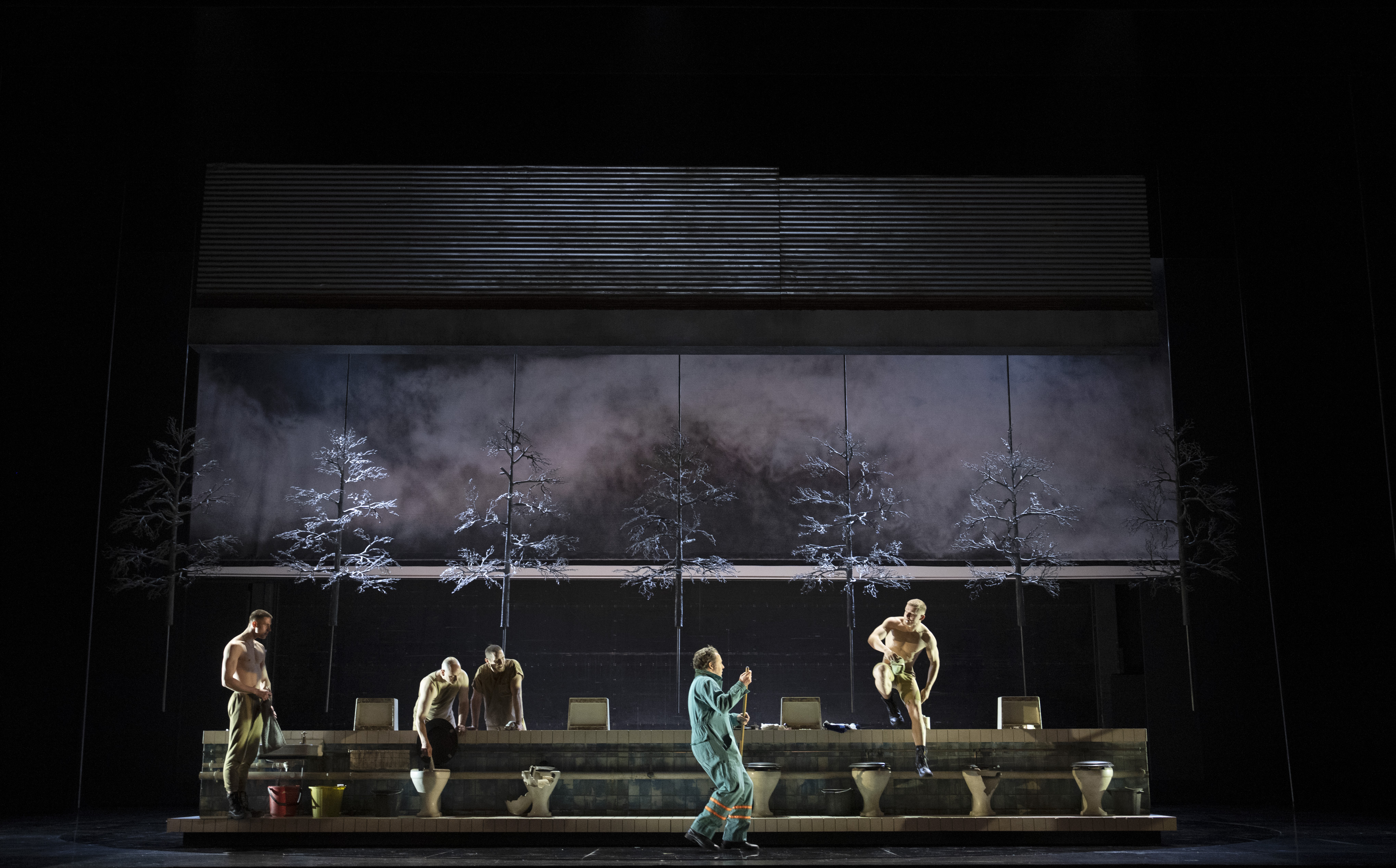


Truth be told, if you spend your time in Wozzeck thinking about a previous production or performance, something has gone wrong (either with you, what is onstage, or both). I did not. In any case, comparisons either with Warner’s first staging or with when I had previously heard Antonio Pappano conduct the work (twenty-one years ago for Keith Warner’s then-new production, in Pappano’s first season at Covent Garden) would largely be meaningless, given the vagaries of memory and my lack of a written record. Deborah Warner in 2023 does not seem to me especially to take a view or standpoint, at least not exclusively. This is not a Wozzeck that (over-)emphasises the brutality of military life and war, or expressionist experimentalism, or any one thing, though many such things are present. The action is already taking place as we take our seats, soldiers (an excellent troupe/troop of actors) relieving themselves in various ways, cleaning up, doing very much what soldiers do in barracks. That establishes an expectation of realism which is not entirely fulfilled, but rather is supplemented, so that as the action develops, as different standpoints are afforded by the work (and probably its creator), we have opportunity to take them too. Everything takes place more or less where one might expect, but there are always refreshing touches of set design, costume, lighting, or detailed Personenregie – let alone the musical performances – to enable us to take a fresh look and listen. The drama unfolds, with great immediacy, yet always it feels that this is ultimately Wozzeck rather than ‘Deborah Warner’s Wozzeck’, whether that feeling, even that possibility, be a fond illusion or otherwise. Different settings for different scenes – no fewer than fifteen of them – present themselves without fussiness or fetishisation: this is a light, enabling, generous realism that can shade almost imperceptibly into other, complementary aesthetics as required. Credit is surely due both to the design team and to the Royal Opera House’s technicians and actors, who accomplished this feat with such apparent ease. Rehearsal surely paid off.


Slightly stylised trees, Cross-like, hint at Wozzeck’s fate, albeit without redemption, but also at a natural world beyond that neither knows nor cares, yet in some sense frames tragedies that lie in stark contrast, being entirely the creation of man. There remains a Romantic desire to escape this miserable world, even if only to Berg’s family estate (Berghof) in Carinthia. Like so much else, though, it is not possible. The blood-red moon and the black, unfathomable lake dominate our vision and consciousness as natural and human boundaries. And finally, in that ultimate, heartbreaking scene of horror: the child turns to the wall in front of which the other children have just been playing, to see painted on it the news they have so cruelly, carelessly delivered. His mother is dead. He turns around and walks off, alone. The drama stops, silence cruelly denied by some idiot’s premature applause—but even that could not quite break the punch to the solar plexus. 

Much of that is, of course, a musical punch. Pappano really seems to be at his best right now. Shortly after thinking his Turandot perhaps the best I had heard from him, I found this Wozzeck at least close to equal, and in ways that surprised me. Without wishing to play that game of illusory comparisons, however tempting, I found this an infinitely more engaging experience than in 2002. Often quite extraordinary orchestral precision, for which one must of course above all credit the orchestra itself, laid bare the framework of closed forms in themselves, their multifarious musical procedures objects of an almost yet not quite Neue Sachlichkeit fascination, but also showed them to be the engines of a dramatic progression that, however Wagnerian it may often sound, is at least as much an alternative to Wagner’s method. There were wrenching, late-Romantic passages, of course, precisely where one would need and expect them, but this was also a musical drama that prefigured Hindemith, Weill, perhaps even Berg’s own teacher, Schoenberg. This was not always a Wozzeck that rose from the bass line, though sometimes it did, but it hinted more than usual at Berg’s later writing, whilst also suggesting an earlier, almost Mendelssohnian Romanticism. Like Warner’s production, it afforded different standpoints, without sounding merely sectional. 

I have been fortunate to see some extremely fine Wozzecks in those years since my first encounter (Andrew Shore on that first encounter included). Christian Gerhaher’s thoughtful, collegial approach, placing himself and his character at the dramatic hub, gaining meaning as much from interaction with colleagues as from his considered yet apparently spontaneous way with the text, has nothing to fear from any of them. His performance, worlds away, as is proper, from the beauties of his celebrated Wolfram, was yet equally well judged. Indeed, I wonder whether it heralds a new chapter in his career. For now, though, it will more than do in and of itself.


Wozzeck, Marie (Anja Kampe)

There was splendid chemistry with his Marie, Anja Kampe. I was about to say ‘we tend…’, but should really only speak for myself: I tend often somewhat to overlook the tragedy of Marie’s death, so overwhelmed am I by that of Wozzeck. Here I felt greater parity, doubtless a matter of Warner’s Personenregie but also of Kampe’s portrayal. (It is more or less impossible for an outsider to distinguish between the two.) This important corrective was brought into further relief by Anna Picard’s excellent programme note on ‘Maria and her World’, whose closing words seem very much to refer to what we saw and heard: ‘She is no Kundry. Neither is she a Judith or the hysterical Woman in Marie Pappenheim and Arnold Schoenberg’s monodrama, Erwartung. Her murder is not dressed up as a form of release for Wozzeck or a point of debate. It is simply a domestic tragedy of a very ordinary, and ever modern, kind.’ Which also brings us back to Gerhaher’s Wozzeck, for his very haplessness – what art lay in that – also contributed to that very non-release, felt (at least by me) more emphatically than I can recall.


Captain (Peter Hoare), Wozzeck

All in the cast contributed to the greater dramatic (and musical) whole, so much as to suggest unusually fruitful close collaboration between all concerned. Sam Furness’s Andres surprised me, not least because I often find myself wondering where the role went, thinking it smaller than I had expected. Not here: this was a character sympathetic to Wozzeck who yet had his own story to tell. Likewise Rosie Aldridge’s spirited Margret, whose spot in the second tavern scene almost had time stand still as the world disintegrated around her. Peter Hoare’s Captain and Brindley Sherratt’s Doctor made a sharply etched pair: guilty, yet not guilty, like all in the world we saw. Well, perhaps not quite all, for it is difficult to find any grounds to absolve the Drum Major, here given an appropriately nasty, bullying, yet finely sung performance by Clay Hilley. William Spaulding's Royal Opera Chorus was on outstanding form too. 

What, then, should a Wozzeck accomplish? There can be no definitive answer, no more than for any artwork in performance. Different productions, different performances, different audiences will all render such categorical statements in vain. If I have learned one thing over the past thirty years, it will be that. That said, if one does not emerge from a performance convinced that it is one of the greatest of all operas – ranking beyond that is a mere parlour game – it will have been in vain. My first experience was not; nor, emphatically was this: a searing and strangely refreshing Wozzeck, which I hope and intend to revisit soon.


Friday, 18 March 2022

Peter Grimes, Royal Opera, 17 March 2022

Royal Opera House


Images: ROH 2022 (c) Yasuko Kageyama
The Boy (Cruz Fitz), Peter Grimes (Allan Clayton)


Hobson – Stephen Richardson
Swallow – John Tomlinson
Peter Grimes – Allan Clayton
Ned Keene – Jacque Imbrailo
Rev. Horace Adams – James Gilchrist
Bob Boles – John Graham-Hall
Auntie – Catherine Wyn-Rogers
First Niece – Jennifer France
Second Niece – Alexandra Lowe
Mrs Sedley – Rosie Aldridge
Ellen Orford – Maria Bengtsson
Bryn Terfel – Captain Balstrode
The Boy – Cruz Fitz
Aerialist – Jamie Higgins

Deborah Warner (director)
Michael Levine (set designs)
Luis F. Carvalho (costumes)
Peter Mumford (lighting)
Kim Brandstrup (choreography)

Royal Opera Chorus (chorus master: William Spaulding)
Orchestra of the Royal Opera House
Mark Elder (conductor)

London has proved fortunate with recent productions of Peter Grimes (and doubtless with older ones too). David Alden’s 2014 production for ENO and Willy Decker’s for the Royal Opera (in its 2011 revival) both had considerable virtues and received performances. This new staging from Deborah Warner and the performances that brought it to life were nevertheless in a class of their own, showing the Royal Opera at the top of its game.


All three productions will have displeased the Campaign for Real Barnacles, and thank goodness for that. Warner takes us into the dark underbelly of a contemporary, down-at-heel seaside town, with neither room nor appetite for prettified nostalgia for an early nineteenth century that never was (and certainly never was in George Crabbe). I thought of a poorer version of Margate, somewhere perhaps in Essex—and lo and behold, had that confirmed in Warner’s programme reference to ‘some of the extremely poor and socially deprived towns of the Essex coast, namely Jaywick Sands’, testament not to any great acuity on my part but to Michael Levine’s sets, Luis F. Carvalho’s costumes, and to the entire ensemble of Warner’s production, sharply, meaningfully choreographed by Kim Brandstrup. There is poverty here, also reckless abandon; there are drugs, alcohol, and sleaze; there is a ‘community’ that rounds on an outsider and in the violence of that rounding discovers a nativist identity and ‘morality’ that chills and kills. It takes back control, polices its borders, and deals with outsiders in a terrifying march of intimidation, fire, and nihilism. This Borough is UKIP, even BNP, country, in which shirtless neo-Nazis mix with dealers such as Ned Keene, one of the more sympathetic townsmen if ultimately untrustworthy on account of his habit; and bigoted, ‘respectable’ rentiers such as Mrs Sedley. It is not, however, an amorphous mass: not everyone is like that, and everyone has his or her own story. Warner takes immense care, as do all of those participating, every member of the chorus clearly directed individually and coming to life both in that individuality and as part of a deadly, group identity. Not only do Grimes and his apprentices—one hauntingly portrayed as a just out-of-touch aerialist vision—have no chance; nor does Ellen Orford, herself a victim of Grimes’s physical violence. ‘The more vicious the society, the more vicious the individual.’


There is no sign that Grimes is homosexual, or Muslim, or Polish for that matter; but this is undoubtedly the rough justice that would be meted out to him if he were. It is a similar social tragedy to that one sees in parts of Brandenburg or Saxony, doubtless across the world. But it has a particularly English flavour. They do like to be beside the seaside, and they do not like others, with no place to be there, to attempt to join them. Britten’s fraught relationship to England and Englishness, his (partly) thwarted internationalism, and the parochialism of some of his devotees are set in implied counterpoint, but with the work rather than its critics ultimately setting the terms of examination. It is slightly odd—maybe more than that—that, in the contemporary setting, Grimes’s apprentice should be so young a boy, but even that serves to remind us of another aspect of the ‘Britten problem’, which this contemporary Borough would doubtless address with savage, summary justice. 

There could not, I think, have been a better choice to conduct this production than Mark Elder, who led the Orchestra of the Royal Opera House, on as fine form as I can recall, as if a man possessed. He clearly believes in every note of the score and, more to the point, revealed all manner of potentialities I had barely imagined were there. Musical processes are clear and generative, indicative of a serious attempt to address the problems of form that so often bedevil Britten’s music in work and performance. An account of titanic clashes and contrasts spanned, on the one hand, screaming echoes of Shostakovich’s Lady Macbeth and, beyond it, the Mahler of the Fifth Symphony; and, on the other, passages of translucent beauty that seemed to have all the time in the world, yet are fated to be cut short. Elder’s conducting was urgent, even when spacious, whipping up a sequence of storms of fatal consequence that not only framed, but incited, the action on stage. We were reminded that, here, the sea was a thing of danger as well as livelihood, a theatre of cruelty and redress far more than a picturesque landscape.

Another man possessed was Allan Clayton’s Peter. If I say it was the most beautifully sung account of the role I have heard that would unduly delimit its range, though in many respects it certainly was beautiful—and more youthfully vulnerable than the typical craggy old man. This, crucially, was a performance that dug deep psychologically, that suggested profound consideration of dilemmas and traumas faced by the character, and frankly admitted that not all could or should be answered. I could not help but think of Boris Godunov in Clayton’s final scene; the voice is different, as are music, drama, and almost everything else, yet psychological descent and devastation presented tragic parallels across the divide.


Ellen Orford (Maria Bengtsson), The Boy

Maria Bengtsson gave us a profoundly human, refreshingly unhackneyed Ellen Orford, a force for good whose goodness went so cruelly punished. Her ‘Embroidery Aria’ could not have been more touchingly sung, its difficult intervals navigated with ease and in perfect harmony with the orchestra. Jacques Imbrailo’s Ned Keene offered a fascinating study in ambiguity, perhaps beyond mere good and evil. Powerfully and, again, beautifully sung, so much more lay in the acting: a drug-addled hedonist who exerted a mysterious yet undeniable attraction, not an outside as such, yet never quite to be assimilated. Bryn Terfel’s Balstrode may well be the finest opera performance I have seen from him, fully in command of the role and its possibilities, throughout exuding deep humanity and a wisdom that again set him apart without excluding him. Catherine Wyn-Rogers gave us a world-weary yet lively Auntie of experience, Rosie Aldridge a properly vicious Mrs Sedley, more insidious than John Graham-Hall's nicely buffoonish Bob Boles. There were no disappointments in a strong supporting cast, which seemed to grow out of that minutely observed direction of the chorus: a community of individual and mass imperatives. Choral singing was likewise outstanding, the Royal Opera Chorus on better form than I have heard for a long time, fully engaged in portrayal of Britten, Warner, and Elder’s visions (as well, doubtless, as their own).


This enthusiasm comes from a place of ambivalence toward the work itself. I am not yet persuaded that swathes of the second act in particular are not a little dull, nor that the influence of Wozzeck at the beginning of the third is not a little too close for comfort, ‘Arias’ still seem to stand out awkwardly from the rest, and so on. If you are going to be influenced, though, you will struggle to find a better source of influence than Wozzeck, and not every opera can attain the perfection of Figaro or Tristan. This was an outstanding night of theatre, strongly to be recommended to everyone: to the Britten devotees who will not give two hoots about my reservations; to fellow Britten-agnostics, who may also find previous reactions challenged; and even to those more hostile, whose road to conversion may have its point of departure. Not to be missed.


Tuesday, 14 April 2015

Between Worlds, English National Opera, 11 April 2015 (world premiere)


Barbican Theatre

Shaman – Andrew Watts
Janitor – Eric Greene
Younger Woman – Rhian Lois
Realtor – Clare Presland
Younger Man – William Morgan
Older Man – Phillip Rhodes
Mother – Susan Bickley
Lover – Sarah Champion
Babysitter – Claire Egan
Wife – Susan Young
Security Guard – Ronald Samm
Firefighter 1 – Philip Sheffield
Firefighter 2 – Rodney Earl Clarke
Sister – Niamh Kelly
Child – Edward Green

Deborah Warner (director)
Michael Levine (set designs)
Brigitte Reiffenstuel (costumes)
Jean Kalman (lighting)
Tal Yarden (video)
Kim Brandstrup (choreography)

Orchestra of the English National Opera
Chorus of the English National Opera (chorus master: Stephen Higgins)
Gerry Cornelius (conductor)


An opera dealing with – or at least claiming to deal with – the events of 11 September 2001? I suppose it had to come, but that does not necessarily make it any more necessary. This co-commission from ENO and the Barbican seems, alas, founded upon a bad idea. One can make an opera out of almost anything, of course, but that does not mean that some subject matter is no more or no less suitable than any other. The problem with the highly fashionable – at least in some quarters – tendency to base operas upon recent(-ish) news stories is that, all too easily, their ‘documentary’ as opposed to artistic quality becomes the issue at stake. In the case of the bombing of the Twin Towers, there is also the question of attempting to put oneself beyond criticism, or at least of appearing to do so, by dealing with such portentous subject matter. Or, in the opposite case, of creating a controversy, when someone objects to the choice of subject matter.

But the problem lies more with the specific choices of Nick Drake’s libretto: which, frankly, is dire. What are we told? That some people, with differing personalities and differing personal and financial circumstances, went to work one day, not knowing what was to happen, and never came back. Not much more than that, really. As a friend said to me after the event, there is a reason why disaster films tend not to deal with actual disasters, but will have at least someone surviving. What is an undeniable tragedy in ‘real life’ does not necessarily transfer so well to tragedy on stage. Moreover, the banality of the words – which will doubtless be justified as ‘realistic’ – irritates and, worse than that, bores. There is a limit to how many times anyone wants to hear ‘What the fuck?’ repeated on stage. Snatches of ‘real-life’, if fictional, conversation, are heard from the chorus as well as the ‘characters’, presumably a nod to the celebrated telephone messages left by victims. What on earth the ‘Shaman’ character is doing is anyone’s guess. I assume he in some sense signifies Fate; to start with, I wondered whether we might have a guest appearance from Stockhausen; alas not. Anyway, he spouts gibberish, which at least offers verbal and indeed musical variety, which to some extent is taken up by other members of the cast, especially the Janitor. Then he disappears. That sits very oddly with the work’s ‘realism’, and not productively so. Might it not have been more interesting to deal with the creators of what Stockhausen so memorably called Lucifer’s greatest work of art? Or, better still, to create a more finely balanced, fictional story?

Tansy Davies’s score is better than that. I suppose one would describe it as ‘eclectic’. There is nothing wrong with that; indeed, as Hans Werner Henze put it, writing about The Bassarids, ‘with Goethe under my pillow, I’m not going to lose any sleep about the possibility of being accused of eclecticism. Goethe’s definition ran: “An eclectic … is anyone who, from that which surrounds him, takes what corresponds to his nature.” If you wanted to do so, you could count Bach, Mozart, Verdi, Wagner, Mahler, and Stravinsky as eclectics.’ What I missed, though, was any real sense of musical characterisation, or indeed of sympathy for voices. The score is atmospheric, and has a nice enough line in impending doom, ‘darkening’ in almost traditional ‘operatic’ style, but it tends more towards background, like a good film score, rather than participating in and creating the drama. That, at any rate, was my impression from a first hearing. Rightly or wrongly, music seemed subordinated not so much to ‘drama’, as to subject matter.

Deborah Warner’s production plays things pretty straight. What to do with the actual moments of impact? Stylisation is not a bad solution, so we see pieces of paper fall from the ceiling. Having a Mother sit at the front of the stage, looking ‘soulfully’ into the distance, at the close, risks bathos; but perhaps that is in the libretto. It does no particular harm. Insofar as I could discern, the ENO Orchestra and Chorus were very well prepared, incisively conducted by Gerry Cornelius. The cast is called upon more obviously to act than to display great vocal prowess, but its members all did what was asked of them. Andrew Watts’s counter-tenor Shaman stood out, but then, as mentioned, the role puzzling fizzled out. Susan Bickley’s talents seemed wasted, but as usual, impressed.

So then, I was happy to have gone, but cannot imagine rushing back. Apologists for new (alleged) conceptions of opera would ask where the problem was with that. Must everything, or indeed anything today, be a masterpiece? Well, clearly not everything will be, but I am not sure that I am willing to ditch the work concept or even the ‘masterpiece concept’ so emphatically, quite yet. Besides, this is clearly intended as a ‘work’, not as a ‘happening’, or some such alternative. ENO deserves credit for supporting and performing the work. Perhaps next time around, it will be luckier with respect to the outcome; this was, after all, the company that commissioned The Mask of Orpheus.

Saturday, 15 June 2013

Death in Venice, English National Opera, 14 June 2013


The Coliseum

Gustav von Aschenbach – John Graham-Hall
Traveller, Elderly fop, Old gondolier, Hotel manager, Hotel barber, Leader of the players, Voice of Dionysus – Andrew Shore
Voice of Apollo – Tim Mead
Polish Mother – Lauda Caldow
Tadzio – Sam Zaldivar
Tadzio’s sisters – Mia Anglian Mather, Zhuliana Shehu
Governess – Joyce Henderson
Jaschiu – Marcio Teixeira
Hotel porter – Peter van Hulle
Strawberry-seller, Strolling player – Anna Dennis
Strolling player – Adrian Dwyer
Guide – Charles Johnston
English clerk – Marcus Farnsworth
Glass-maker – Richard Edgar-Wilson
Lace-seller – Constance Novis
Beggar woman – Madeleine Shaw
Restaurant waiter – Jonathan McGovern
Lido boatman. Gondolier, Priest in St Mark’s – Paul Napier-Burrows
Hotel waiter – David Newman
Newspaper-seller – Lyn Cook
Gondoliers – Philip Daggett, Anton Rich
Ship’s steward – Gary Coward
Hotel guests from many countries – Allan Adams, Deborah Davison, Natalie Herman, Suzanne Joyce, Graeme Lauren, Lydia Marchione, Claire Mitcher, Ronald Nairne, Emily Rowley Jones, Paul Sheehan, Andrew Tinkler, Susanna Tudor-Thomas

Deborah Warner (director)
Tom Pye (set designs)
Chloe Obolensky (costumes)
Jean Kalman (lighting)
Kim Brandstrup (choreography)
Finn Ross (video)

Paul Brough (chorus master)
Orchestra of the English National Opera
Edward Gardner (conductor)

 
ENO is on fine form at the moment. Its recent Wozzeck deservedly received well-nigh universal acclaim. If Death in Venice did not have anything like the same dramatic impact, then that is more to be ascribed to the work than to the performances, which were generally excellent. In certain quarters, it is heresy to question Britten’s standing; for those with a greater sense of discrimination, it is patently obvious that his output is highly variable. The overrating of Peter Grimes offers an especially extreme example: a great story, with some memorable music, interspersed with some that is really rather dull. The Turn of the Screw stands head and shoulders above the rest of Britten’s operas, not least since it suffers less from the formal problems that so often beset his work. ENO, however, has served Britten very well, Christopher Alden’s riveting production, for instance, having elevated the slight, often tedious Midsummer Night’s Dream far above the intrinsic qualities of the work. Death in Venice is a better work than that, but it is not without tedium; an idea, at least as converted into this opera, which might have been better suited to a short one-act work, is drawn out far too long, seeming to take about as long as it would to read Thomas Mann’s novella. And if Britten’s display of his workings helps impart unity, that display, whether in terms of sonorities – the all too ready resort to gamelan echoes – or twelve-note process often sounds too obvious. It is difficult not to conclude that the opera would have benefited from wholesale revision, perhaps from a good editor.   

 
Edward Gardner necessarily conducted the score as if he believed in every note of it; there is every reason to think that he did. If there were a few occasions when greater tightness might have been achieved, that is a minor criticism of a performance as dramatic as orchestral writing that is sometimes more thin than spare would permit. The ENO Orchestra was an estimable collaborator without, fully playing as if this were a repertory work inside the composer’s idiom. If the percussionists inevitably deserve special mention, that is no reflection upon the standard of performance elsewhere in the pit, from which sinewy woodwind lines and dark brass punctuation emerged with equal conviction.

 
John Graham-Hall’s voice is not especially beautiful; nor does it need to be. Whatever claims one might make for Peter Pears’s artistry, that would be an eccentric place to start, and Gustav von Aschenbach is a Pears role par excellence. Graham-Hall offered something far more telling: elusive yet unmistakeable dramatic truth. One felt that this was Aschenbach’s story; one both saw it through his eyes and saw him through the eyes of the story, if that makes any sense. It is a strenuous role indeed, but Graham-Hall used its very difficulty to great effect. Beauty, after all, is to be espied from afar, as it was here, not only in the guise of Sam Zaldivar’s gracefully nonchalant assumption of Tadzio, not only even in the æsthetic contemplation and temptation of the Games of Apollo, but in the society as a whole of which Aschenbach both is and is not a part. Tim Mead’s beautifully sung – and acted – Apollo seemingly tilted the dramatic scales further, though of course it would be the Voice of Dionysus that would eventually, tragically capture him. (That tragedy is perhaps one of the weaker aspects of the opera, pushing it too far in the direction of melodrama; but again, that is not the performers’ fault.) Andrew Shore managed a serious of roles with equal facility, as convincing as the oleaginous Hotel Manager as the ludicrous Leader of the Players (his heightened absurdity perhaps a consequence of Aschenbach’s condition?) A plethora of small roles – is the cast not excessive, especially for an opera concentrating so heavily upon a single protagonist? – emerged with similar qualities of observance.

 
Deborah Warner’s production is perhaps the best I have seen from her. The action takes place when and where it ‘should’, but unlike, for instance her dull Eugene Onegin, that provides a frame for imaginative performance. The first, dark scene in Munich, Tom Pye’s excellent set weighed down by the writer’s words, gives way to a plausible journey to illusory, indeed deadly light. For Jean Kalman’s lighting – the initial view from the hotel a fine coup de théâtre – stands as central as Chloe Obolensky’s beautifully-designed period costumes to the often spellbinding success of the staging. Graham-Hall of course deserves the lion share of the credit for the dramatic truth of his descent, but Warner’s direction of him onstage, for instance in the tentativeness of his approaches to Tadzio, must also have played an important role. Kim Brandstrup’s choreography highlights the boys’ natural athleticism, highly successful in conveying its crucial non-reflective quality. Reflection, after all, is Aschenbach’s lot.  

Sunday, 13 November 2011

Eugene Onegin, English National Opera, 12 November 2011

Coliseum

Madame Larina – Diana Montague
Tatiana – Amanda Echalaz
Olga – Claudia Huckle
Filipievna – Catherine Wyn-Rogers
Eugene Onegin – Audun Iversen
Lensky – Toby Spence
Monsieur Triquet – Adrian Thompson
Zaretsky – David Stout
Prince Gremin – Brindley Sherratt
Captain – Paul Napier-Burrows
Peasant Singer – David Newman

Deborah Warner (director)
Tom Pye (designs)
Chloe Obolensky (costumes)
Jean Kalman (lighting)
Kim Brandstrup (choreography)

Chorus and Additional Chorus of the English National Opera (chorus master: Martin Merry)
Orchestra of the English National Opera
Edward Gardner (conductor)

Images: Neil Libbert

Was this ENO? Or had I nodded off and slipped into a living Met nightmare? Actually, ‘nightmare’ is too harsh, too interesting, for Deborah Warner’s production of Eugene Onegin, actually conceived, I discovered, as a co-production with the Metropolitan Opera, is just plain dull, a strange throwback to the 1970s or further back still, in which singers sing their lines against a pretty – to some – backdrop in ‘period’ dress that might well have come from a television serial. The ‘period’ in question seems to be slightly later than Pushkin, to no obvious end. Now there is nothing necessarily wrong with ‘traditional’ productions, but this one offered no discernible view upon the work, no discernible insight, save perhaps for a tired, slightly misandrist suggestion that the work might be better off entitled ‘Tatiana Larina’, into the characters and their development, and no discernible provocation or even invitation to think. It is, I think, the first time I have witnessed members of the audience even –  I assure you, I am not making this up – applaud a Coliseum set, in this case as the curtain rose for the third act, obscuring Tchaikovsky's Polonaise. (They indulged in plenty of disruption elsewhere too, a selfish couple seated behind me a particular menace, speaking throughout the performance, unresponsive to the iciest of glares.)

Even from a literalist perspective, there are problems beyond the slight ‘updating’. Once one engages upon such a path, fetishising costumes, scenery, and the like, any deviation tends to stand out like a sore thumb. Thus, whilst a more neutral or suggestive space would doubtless double up without too much trouble for the first three scenes of the first act, we are left wondering in literalist mode why Tatiana appears to sleep in a capacious barn. (It will doubtless be more capacious still in New York.) Child ‘extras’ running around for no particular reason are an irritant; they seem to be a favoured device of the director, her ENO Messiah a case in point. Are not the costumes for the celebration of Tatiana’s name day a little on the dour side for such an occasion? Why does the final scene not appear quite where it ‘should’?

Lensky (Toby Spence)

More serious is the problem alluded to above, whereby Warner’s sympathies seemed only to be elicited by the female characters. It used often to be a critical plaint that the opera should not have been entitled Eugene Onegin; this production, whether by design or by default, comes across as an attempt to revive that view. Everything is centred upon Tatiana. The subtext – at times, it is barely ‘sub-‘ – of Romantic friendship or more between Onegin and Lensky is ignored. Surely it does not take even a leap of the imagination to appreciate how Tchaikovsky would have understood Onegin’s rejection of Tatiana, herself of course in many respects a projection of male homosexuality. To take at face value without any further probing the description of Onegin as an ‘outsider’ seems in this context merely bizarre: would one not at least ask what is meant by ‘outsider’, just as one would in Peter Grimes? The following words surely speak for themselves:

If I had wished to pass my life
within the confines of the family circle,
and benevolent fate had decreed for me
the role of husband and father,
then I should most likely not choose
any bride other than you.
Krzysztof Warlikowski’s Munich production (reviewed here by Jens Laurson) made explicit what might though need not remain implicit. One can remain relatively reticent, though, and still address this central issue of the opera: take Steven Pimlott’s woefully underrated production for Covent Garden, ‘traditional’ in look, but so much more dramatically alert than Warner’s production. Had the action been centred upon Tatiana in especially dramatic, more revisionist, fashion, I am sure that would have been a valid approach, but Warner’s focus seemed more a default setting than anything else.


Onegin (Audun Iversen) and Lensky

There was considerable compensation, however, to be heard from Edward Gardner’s conducting: undoubtedly the best I have heard from him at the Coliseum. If I have been spoilt by my most recent two hearings of the work in the theatre, both conducted by Daniel Barenboim, Gardner nevertheless impressed, Shape and sweep almost unfailingly present. There was a fine swagger to the choral numbers and the dances (in which the dancers made a good impression), which the more intimate moments – insofar as the production permitted them to exist – were executed with tenderness and genuine sympathy. If Gardner’s reading did not quite scintillate in the way that some can, there is plenty of scope for intensification as the run of performances proceeds. He certainly has the ENO Orchestra on fine form, though a few more strings would have been welcome. The chorus, trained by Martin Merry, returned to form too, though all suffered from Martin Pickard’s clunky English translation: if we must do without the Russian text and its inimitable sonorities, then we need a superior substitute.


Toby Spence shone out from the cast. (Lenskys often do.) Though his ardent sincerity was somewhat robbed of context by the production, it nevertheless left its mark. Audun Iversen was likewise hamstrung in the title role, though earlier on, fine English diction notwithstanding, he rarely seemed truly to get inside the part even in musical terms. His performance in the third act heated up nicely, however, so maybe first night nerves were a factor. Amanda Echalaz merely seemed miscast as Tatiana. Her high soprano often seemed thin and disengaged; attempts to compensate skirted dangerously close to Puccini-caricature. Claudia Huckle’s often blowsy Olga struck a discordant note in more than one sense. Adrian Thompson, however, made a fine impression with a sensitive rendition of Monsieur Triquet’s couplets, even if one could have done without the assumed 'French' accent. One dry patch apart, Brindley Sherratt shaped Prince Gremin’s aria well. Catherine Wyn-Rogers and Diana Montague contributed a focus to the roles of Filipievna and Mme Larina that was not always present elsewhere. I could not help wishing that they might be offered a little more to do.

Tatiana (Amanda Echalaz) and Prince Gremin (Brindley Sherratt)

For those weary, then, of Konzept-heavy productions, this Onegin might offer some balm; it is certainly worth hearing for Gardner and Spence. Yet there remains ample room for a more ‘traditional’ production that does not forego interpretation, of whatever variety.

The performance on 23 November will be recorded by BBC Radio 3 for subsequent broadcast.

Recommended performances on CD and DVD:


Saturday, 28 November 2009

Messiah, English National Opera, 27 November 2009

The Coliseum, London

Sophie Bevan (soprano)
Catherine Wyn-Rogers (contralto)
John Mark Ainsley (tenor)
Brindley Sherratt (bass)
Harry Bradford (treble)

Deborah Warner (director)
Tom Pye (set designs)
Moritz Junge (costumes)
Jean Kalman (lighting)
Leo Warner, Lysander Ashton, and Tom Pye (video)
Kim Brandstrup (choreographer)

Orchestra of the English National Opera
Chorus of the English National Opera (chorus master: Martin Merry)
Laurence Cummings (conductor)

Just when I had begun to wonder whether ENO had gained a certain edge over its Covent Garden neighbour, along came this. Deborah Warner’s staging of Handel’s Messiah does not, as she admits in the programme, entail ‘turning it into an opera’. Apparently, she has introduced ‘a visual element which is a quite different process to dramatising it’. I am not sure what she means by this; more importantly, I am not at all sure what it was that we saw on stage. The ‘narrative thread ... woven clearly through the three parts of the evening’ – does Handel’s work not already possess a narrative thread of some import? – eluded me, though, goodness knows, I tried. What I saw was an extraordinary mixture of pretentious irrelevance and bizarre literalism, united only by their common thread of banality. Much to my astonishment, what remained of the audience seemed to love it.

The first part I found straightforwardly incomprehensible. Opening with some metropolitan video footage – all of the filming was very well presented, though its end remained dubious, to say the least – the first ‘scene’, as I suppose we should call it, appears to show John Mark Ainsley leaving orders of service on some makeshift pews, whilst other people in everyday dress go about their daily business. Somehow having a woman do the ironing and someone else look at a computer screen is held to illuminate ‘Comfort ye ... Ev’ry valley shall be exalted’. Lots of other people in everyday dress – all different, attesting to considerable effort on Moritz Junge’s part, however dubious the end... – come on to mill around for the first chorus. And I must not forget the hyperactive child who runs around for a great deal of the proceedings. Whether he is doing Warner’s bidding or his own thing, I neither know nor care. Doubtless some people, sentimental at the very mention of children and animals, found this winning; I wished I had a revolver to reach for. For some reason, the child collects in the pieces of paper almost as soon as Ainsley has handed them out. Perhaps this signals that we are not going to proceed along the usual track; perhaps it signifies nothing at all. We see a photographed scene from a school nativity play for the nativity itself. From time to time, depictions of Christ and other ‘ordinary’ faces appear on screen. Nothing seems to bear any relation to anything else. I can only assume that these are various facets of the ‘community’ to which the programme makes repeated reference: good for New Labour-style ‘inclusivity’, ‘access’, and other such buzzwords, I suppose.

The second part is worse still. Banal dance routines become more common. (Again, they seem very well delivered by the dancers; it is certainly not their fault.) The opening numbers feature a strangely literalistic, albeit bloodless, representation of scourging and so forth, whilst members of the ‘community’ look on. ‘All we, like sheep,’ displays lots of people scurrying up and down escalators at what appears to be Liverpool Street station. ‘Thou shalt break them with a rod of iron’ appears to show a camp display of conjuring: more ‘community entertainment’ perhaps? After that, the ‘Hallelujah’ chorus simply has people walk around and hug each other, as if it were a particularly lame Home Counties celebration of New Year’s Eve, before all coming together – ‘community’? – at the front of the stage, to face the audience. To have ‘I know that my Redeemer liveth’ sung from a life-support machine is risible enough, but then slowly to have the sun rise and other people get up from their hospital beds, as we hear of the Resurrection of the dead, is downright offensive in the banality of its ‘response’ to the text: a bizarre form of secular, content-free televangelism. People I had not seen before venture on stage towards the end of the final ‘Amen’ chorus. One resembles the late Bea Arthur; another, I was unsure whether this ‘character’ were male or female, is a Clare Short lookalike.

Is there any good news (let alone Good News)? The singing was better than the staging. Catherine Wyn-Rogers was excellent, even if I missed a deeper contralto sound, such as one used to hear. Sophie Bevan was very good too: singing ‘I know that my Redeemer liveth’ lying in a hospital bed was, in its way, impressive. Ainsley, however, was underpowered – try Jon Vickers for size here – and his feyness in the aforementioned ‘Thou shalt break them’ was merely embarrassing. Brindley Sherratt made a reasonable job of the bass part, though he could sometimes sound constricted, and struggled with ‘The trumpet shall sound’. (Unfortunately, its middle section was included, as were many of the traditionally ‘optional’ numbers.) Treble Harry Bradford was a most welcome addition, taking on the ‘Nativity’ numbers with musical intelligence and winning purity of voice. All soloists displayed excellent diction. The choral singing was often surprisingly ragged, especially amongst the female voices. Thus what should be the real location of ‘community’ amounted to very little.

Last and, in a way, least was the lamentable conducting of Laurence Cumming. Never have I heard the slow introduction to the Overture sound so lacking in import and, indeed, rhythmically slack. Tempi were either rushed or drawn out almost beyond endurance, with no apparent justification in either sense. The ‘Pastoral Symphony’ sounded unrecognisable, over in less than the twinkling of an eye. To make the ‘Hallelujah’ chorus so underwhelming requires a perverse skill, I suppose, but not one deserving of wider dissemination. Perhaps most infuriating of all was the reduction of what has so often proved to be a fine orchestra to the sound of an especially malnourished ‘period’ band. I could not see how many musicians were in the pit, but they sounded few; what managed to emerge was thin gruel indeed. Devotees of ‘period style on modern instruments’ will doubtless hail this achievement; I cannot understand what the point of using modern instruments would be, if one is intent upon ignoring or suppressing their manifold advantages. Weird kettledrums and short-breathed, out-of-tune brass sounded as if they actually were period instruments. The difficulties experienced by the trumpeter in ‘The trumpet shall sound’ seemed to confirm that beyond reasonable doubt.

Recently, Warner seemed entirely to miss the point of Brecht in her National Theatre production of Mother Courage. The weird rock-star presentation of the anti-heroine was embarrassing enough, but the attempt, magnificently realised by Fiona Shaw, to render her sympathetic was at best misguided. Again, a largely middle-aged, middle- class audience lapped it up. Now Warner seems entirely to have missed the point of Messiah, the clue perhaps lying in the work’s title. Strangely enough, the opening curtain displayed dictionary definitions of the word and a brief etymology; perhaps the director might have taken the trouble to read them, or even, perish the thought, the text and the score. Warner says that she is ‘not someone who would be queuing for the choral society’s annual performance in the local church’. Perhaps if she had shown a little respect for what used to be, and perhaps still is, a true sense of ‘community’, she might not have gone so wildly astray. I know which queue I shall join next time.