Wednesday, 8 February 2023

Salome, Vienna State Opera, 4 February 2023


Images: © Wiener Staatsoper / Michael Pöhn 


Herod – Gerhard Siegel
Herodias – Michaela Schüster
Salome – Malin Byström
Jochanaan – Wolfgang Koch
Narraboth – Daniel Jenz
Page – Patricia Nolz
Jews – Thomas Ebenstein, Andrea Giovannini, Carlos Osuna, Katleho Mokhoabane, Evgeny Solodovnikov
Nazarenes – Clemens Unterreiner, Attila Mokus
Soldiers – Ilja Kazakov, Stephano Park
Cappadocian – Alejandro Pizarro-Enríquez
Slave – Daniel Lökös
Executioner – Alexandre Cardoso da Silva
Cameraman – Benedikt Missmann
Little Salome – Margaryta Lazniuk
Little Salome (Dance/Video) – Anna Chesnova

Cyril Teste (director)
Céline Gautier (artistic collaboration)
Valérie Grall (designs)
Marie La Rocca (costumes)
Julien Boizard (lighting)
Mehdi Toutain-Lopez (video design)
Rémy Nguyen (video design (live camera))
Magdalena Chowaniec (choreography)
Sergio Morabito (dramaturgy)  

Vienna State Opera Orchestra
Philippe Jordan (conductor)


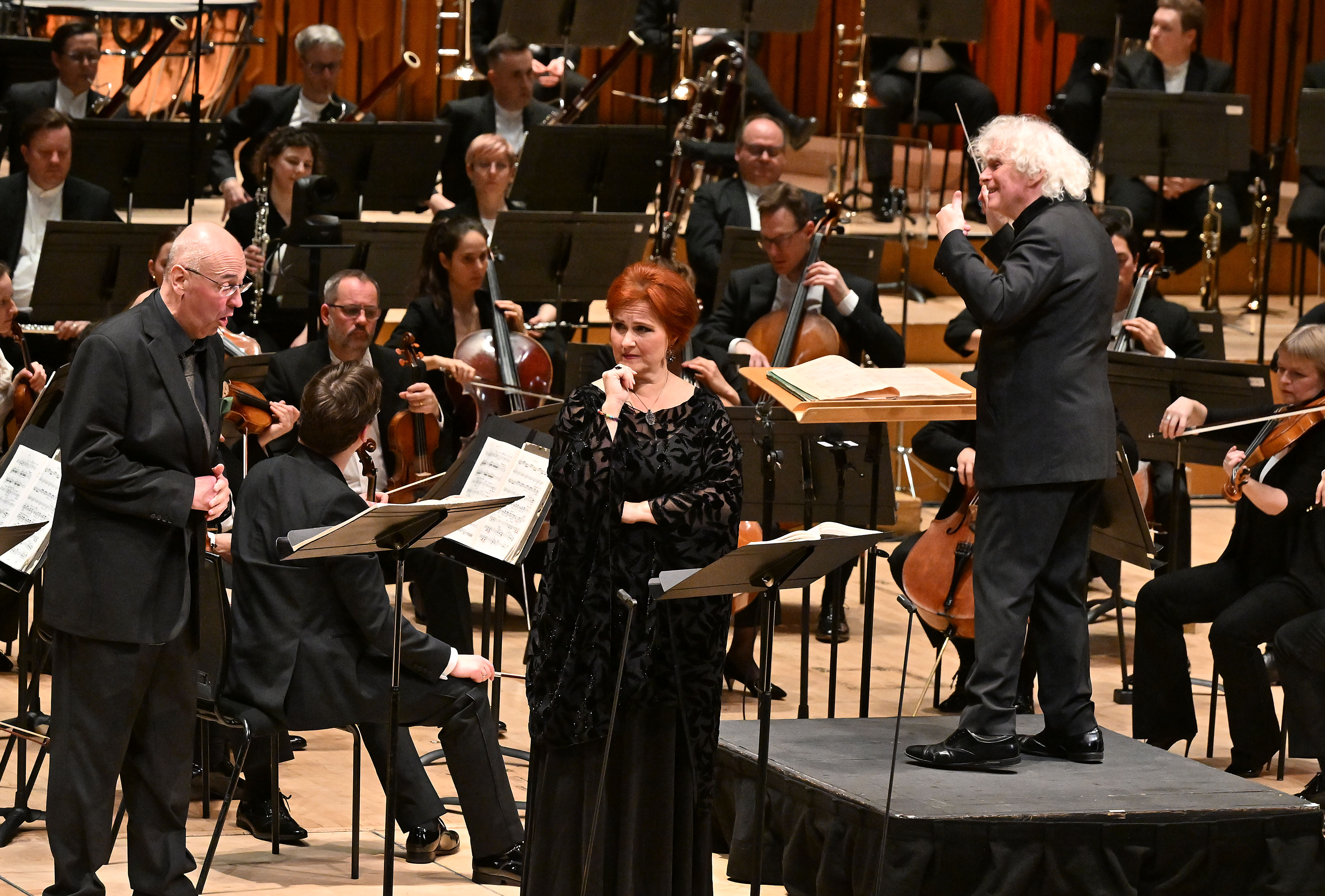
At last, a new Salome comes to Vienna, Boleslaw Barlog’s venerable (1972!) staging finally having been retired. Cyril Teste’s new production has much to recommend it, both in itself and as realised by cast and orchestra. At first sight, all is as one might expect from a contemporary staging. Herod’s court has a mix of modern(ish) civilian evening dress and military uniforms. Guests are seated at a long table and champagne flows. We see them not above, as in David McVicar’s long-running Covent Garden production, but behind. But we see greater detail through live video. Herod’s leering obsession with Salome is already apparent. A state banquet is the setting, but the tragedy for Teste is familial; in a programme interview, he sees parallels with Hamlet. I am not sure I see it that way, really. The aestheticism of both Wilde and Strauss seems, at least in Teste’s spoken outline, somewhat shortchanged. In practice, though – and this is surely more important – the production is open enough to allow one to approach it from one’s own standpoint and not feel disappointed, quite the contrary.


© Wiener Staatsoper / Michael Pöhn 


There is commendable attention to atmospheric detail, contributing considerably to a more detailed whole. Curtain movement chillingly – in more than one sense – conveys the sinister evening wind. More fundamentally, the detail of camerawork not only brings to life more that is going on, more than one can reasonably take in on a single viewing, but also enables Herod’s pornographic intent to reveal itself. For this Salome is not only a family tragedy; it is a tragedy of an abused girl/young woman. Salome’s dance is closely filmed, split between her and a memory of her still younger self. Initially parts of it seem odd, bizarrely awkward, as when she flexes her muscles, but one realises that is the point. Salome is both too knowing and not knowing enough; a part of her is shockingly, even heartbreakingly, innocent. And yet we must watch. Even the Tetrarch finds it impossible to watch some of it, head in hands toward the side of the stage, though that does not subtract from his glee at its close. He would probably prefer a private viewing. Aestheticism, then, comes here after all; we should always beware rulers who also think themselves artists.

I am (nearly) always surprised how most productions put entirely to one side Salome’s explicit reference to homosexuality; it is not even a subtext, but a text, Salome promising Narraboth a green flower if he will do her bidding. In my experience, only Hans Neuenfels’s brilliant Berlin staging has taken the opera at its word here (assuming we do not count David McVicar’s gratuitous nude executioner). The production certainly does not lack other sexual content, though, culminating in a gripping collision between Salome, the executioner, and the head of John the Baptist he has brought up from the cistern employed as a mask. Ultimately the executioner, at Herodias’s bidding, withdraws, but not before he too has had his piece of the girl. Moreover, the now common portrayal of Herodias’s page, sung by a female voice yet unquestionably a male role, as an androgynous woman poses, or at least suggests, further questions of gender, even as it takes us further from Wilde’s green carnation.


© Wiener Staatsoper / Ashley Taylor

This would count for relatively little, were it not for a host of outstanding performances onstage. Malin Byström fully inhabited the title role from beginning to end, in as fine a performance as one could hope to see and hear. Gerhard Siegel did not mistake grotesquerie of behaviour for a licence not to sing. His Herod was all the more plausible, as well as all the creepier and more sinister, for its vocal qualities. Michaela Schüster was surely destined for Herodias, her portrayal effortlessly iconic – for once, the much-abused word seems fitting – in its small observations as in its effortless hauteur. Ultimately, rule is hers, at least until eclipsed all too briefly by her daughter. Wolfgang Koch’s Jochanaan is a typically intelligent portrayal: necessarily direct in its prophecy, yet subtle in its interplay of words and music. The finest Narraboths always leave one wishing for more, that the officer’s tragedy might be averted. Daniel Jenz was no exception, his Narraboth sweetly sung, imploring and bewitched. Cast from seemingly endless depth, this Salome had everyone, however small the role, contribute to a greater whole. For me, the two Nazarenes, Clemens Unterreiner and Attila Mokus, especially caught the ear, but it may well have been others—and surely was for others in the audience.


© Wiener Staatsoper / Michael Pöhn 


The Vienna State Opera Orchestra was on excellent form too, full of rich, warm tone in which to luxuriate, yet ever precise and directed. It may not be quite the period instrument here, Salome having reached the house as late as thirteen years after its 1905 Dresden premiere; one might nonetheless have been forgiven for thinking so. That precision owed much, of course, to Philippe Jordan’s thoughtful conducting. If this were not a Salome on which he stamped an indelibly personal mark – one might think here of, say, Karajan’s Salome – that was surely not Jordan’s intention. In permitting the score, after the necessary cliché (and illusion), to speak for itself, he was less neutral than responsive to the particular requirements of the stage.


Tuesday, 7 February 2023

Don Giovanni, Vienna State Opera, 3 February 2023


Don Giovanni – Kyle Ketelsen
Commendatore – Ain Anger
Donna Anna – Hanna-Elisabeth Müller
Don Ottavio – Dmitry Korchak
Donna Elvira – Kate Lindsey
Leporello – Philippe Sly
Zerlina – Isabel Signoret
Masetto – Martin Häßler

Barrie Kosky (director)
Katrin Lea Tag (designs)
Franck Evin (lighting)
Theresa Gregor (costumes)
Sergio Morabito, Nikolaus Stenitzer (dramaturgy)

Vienna State Opera Chorus (chorus director: Thomas Lang)
Orchestra of the Vienna State Opera
Antonello Manacorda (conductor)


Images: © Wiener Staatsoper / Michael Pöhn
Donna Anna (Hanna-Elisabeth Müller) and the Commendatore (Ain Anger)


One of Barrie Kosky’s great virtues as a director is that he does not impose a one-size-fits-all approach, or aesthetic, to his work with opera. There will sometimes, of course, be visual similarities – doubtless in part his, in part his design team’s – but they are intermittent and rarely, if ever, determining factors for the conceptual framework. (An especially vexing misconception of the AMOP crowd is that designs ‘are’ the production. No wonder they fail to understand anything they see.) And that framework, like it or otherwise—I have regularly fallen into either camp—is usually pretty clear. 

What puzzled me most about this Don Giovanni was a relative lack of clarity—whether in my perception or intrinsic. I think I managed to piece a bit more together afterwards, but much of it seemed, at least to me, a little undercooked: not a characteristic I readily associate with the director. Is that perhaps a by-product of its first outing having been at the height of the pandemic, when restrictions may have inhibited certain types of action? Characters certainly seem to spend a good deal of time, though far from all of it, some distance apart on a large stage. It is a rocky, rather grim landscape, many miles (literally, I suspect, as well as conceptually) from early-modern Seville (or the Venice Da Ponte’s libretto often seems fundamentally to suggest). Nothing is hidden, or concealed, in a wasteland that is anything but labyrinthine. It sprouts flora in the final scene of the first act, as do the chorus (who, whatever I said earlier on, resemble strikingly the chorus in Kosky’s Komische Oper Monteverdi Orpheus). But then it is back to the grey, rocky landscape—and latterly, a pool of water. 

That literal flowering seems to suggest some sort of Bacchic ritual, it would seem, albeit curiously shortlived. Perhaps that is the point: what does Giovanni do when things are not flowering, when the wine is not flowing—which does not even seem to happen at his feast, nor indeed ‘Finch’ han del vino’? He waits, it seems: a curious undermining of the kinetic energy that makes up his dramatic – in music and words alike – persona. Again, I imagine that is the point. Indeed, after, though only after, the performance, I sensed that, especially later on, this had been for Don Giovanni and Leporello, perhaps for the others too, a performance of Waiting for the Commendatore. Or had it? The idea of a Beckettian Don Giovanni is intriguing, but not very much more seems to be done with it. 


Don Giovanni (Kyle Ketelsen) and Masetto (Martin Hässler)

The other principal theme, perhaps related, is a centring of Leporello, who seems (not unreasonably, I suppose, given a standpoint of psychological realism) quite traumatised by his experiences with Don Giovanni. Is there a sense of abuse there? One might argue that that is intrinsic to the master-slave dialectic, though I am not sure that is quite how Mozart and Da Ponte see it. I think so, but more strong, again especially towards the end, is a sense of an ersatz father-and-son relationship. Perhaps, according to standpoint, that is intrinsically abusive. One might, truthfully yet not necessarily revealingly, observe that all of Don Giovanni’s relationships, if one may call them that at all, qualify as such. I sensed, though, that Kosky is saying more than that, without being quite clear (in my mind) what that ‘more’ is. Donna Elvira seems to be behaving rather unusually too. 


Don Giovanni and Leporello
(Philippe Sly)

Another Kosky virtue is that he knows his music. As with any director, indeed any musician, one might disagree with his response, but it would be unfair to claim that he has not considered it. A case in point here would be the concatenation of dances Mozart presents as a society of orders stands on the libertine – perhaps even revolutionary – precipice. For once, not only do we have the different bands of musicians on stage; the characters dance the appropriate dance, lending visual realisation of an extraordinary moment whose import may not always be recognised by a twenty-first-century audience. Too often, directors impose trademark silly dancing for all-comers. (There is a bit of that too, but not here.) I could not help, though, but wish that Kosky had interpreted the music, or at least how I hear it, a little more. It is not that music need always be doubled on stage, any more than the libretto need, but in the absence of a stronger conceptual lead, it might have helped. Herbert Graf’s Salzburg Felsenreitschule ipproduction for Furtwängler continues to score here. 

I am wary, as anyone should be, of saying it would have been better to have done x than y. It seems more fruitful in general to concentrate on y, though consideration of x may have some heuristic use in sharpening critique of y. For me—surely also for Mozart and Da Ponte—Don Giovanni is unquestionably a religious, indeed a Catholic, work, profoundly concerned with sin and damnation. That does not mean it must be presented as such, but it suggests performance would do well at least to find a satisfactory alternative to doing so, rather than simply ignoring the issue. That may be why, assuming God rather than Nietzsche to be dead, Kosky steps, surprisingly tentatively, toward the Theatre of the Absurd and, perhaps, beyond it to Artaud’s Theatre of Cruelty, though neither comes across so starkly as it might. But then, perhaps neither is supposed to; if something is a context, it is not necessarily for me to say that it should become something more than that. Is it, though, for an audience member to voice bemusement concerning what, if anything, the message might be? Surely it is; for if not, not only criticism but theatre itself must be dead. And, whatever Kosky’s message may be, whatever the strange intermittent lack of theatricality to a production that yet strains hard to be theatrical, I strongly doubt he would wish to propose that particular death. 

As it was, a strong cast of singers worked hard to bring theatrical as well as musical values to the stage. Kyle Ketelsen was an energetic, charismatic Don Giovanni, owning the stage when he needed to, yet not without a sense of the chameleon when musically as well as dramatically called for. Philippe Sly’s wounded yet spirited Leporello offered a tour de force in the service of Kosky’s strangely compelling conception. Hanna-Elisabeth Müller, an initial announcement notwithstanding, and Dmitry Korchak both shone as the unambiguously seria pair, Donna Anna and Don Ottavio. They understood how coloratura works dramatically—and made us feel that. Kosky’s Donna Anna is certainly no unwilling participant: a more controversial idea now than it might have been twenty or even ten years ago, but certainly not without warrant in the score, let alone Romantic tradition. Kate Lindsey’s ‘Mì tradi’ was worth the price of admission alone; not that the rest of this captivating artist’s performance was not similarly excellent. If I were unsure quite what Kosky was trying to suggest here, there was no doubting Lindsey’s dramatic and musical capabilities of doing so. Ain Anger’s Commendatore was intelligently sung, paying commendable attention to the words as well as to overall aura. Isabel Signoret and Martin Häβler’s spirited Zerlina and Masetto likewise made much, though never too much, of their words, marrying them with sweet satisfaction to melody and overall characterisation. 

Antonello Manacorda and the Orchestra of the Vienna State Opera (to all intents and purposes the Vienna Philharmonic) seemed neither at odds, nor completely of one mind. There was no discernible attempt made to stymie the Vienna sound, commendably full on occasion, and anything but puritanical. (Imagine: puritanism in this of all works!) Yet whilst generally choosing sensible tempi – I still cannot come on board with the fashionable alla breve for Overture and Stone Guest, however ‘correct’ it is held to be – Manacorda often seemed to remain somewhat on the surface: more, perhaps, of orchestra than score. He was supportive of the cast, though, and I cannot imagine anyone being seriously disappointed. I doubt use of the all-too-familiar conflation of Prague and Vienna versions was his doing. Whoever made that decision really should have known better, but no one ever does (well, hardly ever). The outcome, save in the most blistering, powerful of performances, is always dramatically unsatisfactory; this was no exception. Prague is, of course, the answer; it would be a good start were someone occasionally to ask the question.

Thursday, 2 February 2023

Tannhäuser, Royal Opera, 1 February 2023


Royal Opera House


Images: Clive Barda / ROH

 
Hermann, Landgrave of Thuringia – Mika Kares
Tannhäuser – Stefan Vinke
Wolfram von Eschenbach – Gerald Finley
Walther von der Vogelweide – Egor Zhuravskii
Biterolf – Michael Kraus
Heinrich der Schreiber – Michael Gibson
Reinmar von Zweter – Jeremy White
Elisabeth – Lise Davidsen
Venus – Ekaterina Gubanova
Young Shepherd – Sarah Dufresne
Elisabeth’s Attendants – Kathy Bathko, Deborah Peake-Jones, Louise Armit, Amanda Baldwin
Dancers – Matthew Cotton, Camilla Curiel, Donny Ferris, Evelyn Hart, Liudmila Loglisci, Risa Maki, Sean Moss, Andrea Paniagua, George Perez, Thomas Kerek, Hobie Schouppe, Juliette Tellier

Tim Albery (director)
Jasmin Vardimon (choreography, Venusberg scene)
Michael Levine (set designs)
Jon Morrell (costumes)
David Finn (lighting)
Maxine Braham (movement)

Royal Opera Chorus (chorus director: William Spaulding)
Orchestra of the Royal Opera House
Sebastian Weigle (conductor)


‘R. slept well and has decided to have a massage only once a day,’ writes Cosima Wagner in one of her last diary entries, from Venice, only twenty days before Richard’s death (when Cosima’s world and thus her diary came to an end). The day took its course, via Cosima’s characteristic desire ‘not to thwart or overburden the cherished workings of his mind,’ a ride to the Piazzetta during which Wagner extols Bach’s fugues, luncheon, visitors, R. yet again reading Gobineau, to: ‘Chat in the evening, brought to an end by R. with the “Shepherd’s Song” and “Pilgrim’s Chorus” from Tannhäuser. He says he still owes the world a Tannhäuser.’

With those celebrated words—and the tantalising prospect of hearing Wagner, even at that stage in his life, playing from his Grosse romantische Oper at the piano, perhaps singing along—the composer pointed not only to ongoing dissatisfaction with the form Tannhäuser, revisions notwithstanding, had yet reached. He also drew attention to the potential he believed his material, musical and dramatic, still had to reach a more satisfactory, perhaps more ‘finished’ state. Should one agree with Wagner—a sizable contingent has long preferred to shun changes made for Paris and Vienna, adhering to something close to what was originally given in Dresden—these twin, related issues will inevitably inform musical performance and staging alike. (Arguably, even if one returns to Dresden, less easy than some claim, one cannot forget what comes after, and that will continue to colour in one way or another the approach one takes. ‘Authenticity’ is always an illusion and usually a pernicious one.) Whether problem, opportunity, or both, it was difficult not to sense such questions hanging over what was seen and heard in the second revival of Tim Albery’s production for Covent Garden, now conducted by Sebastian Weigle.


It is certainly difficult to imagine a Tannhäuser in which the dichotomy between Venusberg and Wartburg does not loom large—some might say damagingly so, crushing the prospects for more plausible psychological motivation. (Some, equally might say this is Wagnerian myth, not Ibsen; psychological realism is hardly at issue here, at least not straightforwardly so.) Take the opening Venusberg scene, where the greatest difference between ‘Dresden’ and ‘Paris’—whatever qualifications we can and should add, still the fundamental distinction between versions—will always be seen and heard. It is rare, though not quite unheard of, in my experience not to regret the loss of the additional music written for Paris, should director and/or conductor opt for Dresden. In many ways, the Overture and Bacchanale were promising. Weigle’s way with the former, in particular, seemed to look (listen) back, a more Mendelssohnian Wagner than one often hears, with what at times sounded like—though surely were not—more chamber orchestral forces. What, surely, one then should hear is an invasion from the realm of Tristan; one—or I—never quite did. The stylistic incongruity of later material, such as it is, should be enabled to present immanent critique. Here, I am afraid, it simply seemed to go on for a bit too long: surely missing one of several points. It was, to a certain extent, made up for by the excellence of the dancers, strangely choreographed by Jasmin Vardimon, in a way that more often suggests school PE lessons than something more conventionally erotic. (Maybe that is the point, but it is probably better not to go there.) The dancing itself, though, deserves credit as first-rate; without that, it would have been a long trudge, and without the excuse of being a pilgrimage.

Albery’s production itself has its moment of greatest promise here—probably not coincidentally. The opera house, however many times we have seen this before, is fruitfully reflected onstage. Whether Tannhäuser has made it as artist and stands in need of a fresh, perhaps less sticky, challenge, or whether he was mad to leave is left to us, which is fair enough. But the conflation of Venusberg, Royal Opera House, and, in couplings with dancers, the Paris Jockey Club too has something to be said for it—if only its implications had been pursued. For, apart from when it necessarily returns close to the end, the idea of Tannhäuser as artist seems pretty much to be dropped. The proscenium arch lies as a ruin in the second act, but why we are in what seems to be a guerrilla war zone—Bosnia, we originally thought, perhaps now Ukraine—I have no idea. I cannot imagine the idea is that, without Covent Garden, love it as we may, there will be civil war, but who knows? No one I have spoken to, at any rate. Much of what unfolded seemed barely directed at all, as if the singers had been left to fend for themselves; perhaps they had.


Weigle proved more variable. The first act increasingly dragged. I do not know how long it actually lasted on the clock, but it seemed to last longer than any I could recall. Part of that, doubtless, was the production, but there was a near-fatal lack of inner, musical tension, recovered, albeit fitfully, during the second and third acts. What was ultimately lacking, though, was any real sense of the musical architecture. This can, arguably should, be understood in various ways. It need not all be Klemperer (though what I should give to hear that putative performance), nor for that matter Furtwängler (likewise). Likewise, it need not all be Wagner’s various musical inheritances, grand opéra included, just as it need not all be aspiration towards music-drama proper. But some sense of being more than number opera joined up is surely essential, or at the very least strongly desirable. The orchestra, likewise, came and went, strings sometimes sounding scrawny, at others blooming nicely. Offstage brass, however, was magnificent. There were many pleasures to be heard from vernal woodwind too.

Another, more prosaic, type of problem was presented by Stefan Vinke in the title role. Four nights previously, on the first night, he had withdrawn through illness. This time, he sang, but his voice and, with it, the drama came close to being lost altogether in the Venusberg scene. He rallied and, a similar yet less extreme example in the Rome Narration notwithstanding, showed great professionalism in doing so. It was not a great omen, though, and seemed to unsettle audience and cast alike—maybe, to be fair, it did the conductor too. Otherwise, Vinke’s straightforward way with the role had much to be said for it: no great revelations, but capable of despatching it, clear of words and musical line, and physically enthusiastic. Lise Davidsen, though, was the true star of the show, as she was when I saw her previously in this role, at Bayreuth in 2019. She strikes a wonderful balance between Nordic cool (a reprehensible yet perhaps inevitable cliché) and warm humanity, as indeed she has in everything in which I have heard her. There is no doubting her ability to sing Elisabeth; that is a given. But she does much more with it too, whilst leaving the character open to our own thoughts. Arguably, Elisabeth will always remain something of an enigma, and that is no bad thing; or, alternatively, for her to be more than that, Wagner would have to have rewritten the part, and he did not.


Anyone daring to succeed Christian Gerhaher as Wolfram as his work cut out, but Gerald Finley succeeded in making the role his own through song; not, I hasten to add, that this was not a well-acted performance too, for it was, but rather that it was musically and, indeed, verbally conceived in the first instance. Ekaterina Gubanova’s Venus held the stage through abundant personality, of stage and vocal varieties. Mika Kares’s Landgrave cut a powerful presence. Sarah Dufresne’s beautifully sung Shepherd had one wish the part might be extended. The Royal Opera Chorus was on very good form, well prepared by William Spaulding.


Nevertheless, firmer hands on the ultimate rudders, both scenic and musical, would have lifted the evening considerably. Is Wagner, as sometimes I have heard claimed, to blame, here, for still owing us his later thoughts on (and with) the work? That would be far too easy a get-out clause. Tannhäuser may not be perfect; it may not even be finished, or capable of being finished. But I am not the only one to have seen and heard other, more convincing near-solutions to its riddles. From Barenboim to Thielemann, from Götz Friedrich to Tobias Kratzer, it can be done. Oddly, though, my impression is that a number of the shortcomings on offer here, as well as the virtues, may actually have set many in the audience thinking about the nature of the work and its problematical dramaturgy. Perhaps it is time to intone, affecting an Anglican rather than Catholic or Lutheran voice, that we all, ‘in a very real sense’, still owe the world a Tannhäuser.

Thursday, 26 January 2023

Osborne/LPO/Gardner - Coleridge-Taylor, Tippett, and Elgar, 25 January 2023


Royal Festival Hall

Samuel Coleridge-Taylor: Solemn Prelude (London premiere)
Tippett: Piano Concerto
Elgar: Symphony no.1 in A-flat major, op.55

Steven Osborne (piano)
London Philharmonic Orchestra
Edward Gardner (conductor)


Image: London Philharmonic Orchestra

Samuel Coleridge-Taylor’s B minor Solemn Prelude was written, at Elgar’s recommendation, for the Three Choirs Festival in 1899. It then went unperformed until a revival, likewise at Worcester Cathedral, for the same festival in 2021. It has now finally reached London, Coleridge-Taylor’s own city, in a fine performance from the London Philharmonic Orchestra and Edward Gardner. Its opening, in melody, harmony, scoring, and indeed the LPO’s performance sounded rather Tchaikovskian: surely a case of influence, though at the same time not to be reduced to that. Indeed, it was Russian symphonism more generally that came to my mind, Borodin too, than say the ‘solemnity’ of Wagner or Bruckner, one progression’s passing resemblance to Parsifal notwithstanding. It certainly qualifies as solemn, though, albeit in an amiable sort of way: a thoroughly professional piece of writing, that merits performance, especially with string sheen and generally rounded orchestral tone such as was heard here. 

Michael Tippett’s Piano Concerto followed: a welcome outing for a piece rarely heard, yet likewise worthy of revival. Gardner, the LPO, and soloist Steven Osborne took us immediately to an imaginary landscape, in an imaginary (quasi-dramatic) context. Its first movement sounded very much as if a scene from an opera without words, yet not necessarily without action. The Midsummer Marriage naturally came to mind, but it was a world of its own we heard, inviting and full of fantasy. The piano part is anything but easy, yet rarely if ever showy; this is not the conventional (post-)Romantic battle of piano against orchestra, and did not sound that way. One delighted instead in the scene painted, almost as much by woodwind and celesta as by the undeniably brilliant soloist, celesta and piano almost equals in the cadenza. The slow movement was equally well-shaped, playing out in a related yet different world, as if a scene that followed. It was darker, a notturno given with an apt air of mystery, even ritual. Bearing in mind Tippett’s inspiration for the work as a whole, Beethoven’s Fourth Piano Concerto (which he heard Walter Gieseking rehearse), it was difficult not to think of Tovey’s evocation of Orpheus taming the Furies. The finale meanders at times, perhaps, but I doubt anyone minded much. It was sharp, bright, ultimately decisive—and it danced. 

The onward tread to the opening to Elgar’s First Symphony, hesitant then sure(r), ever imbued with ineffably Elgarian sadness and nobility, can be traced in many ways. Gardner’s way convinced, as did the response to it. A degree of Brahmsian sentiment could be perceived through a related yet different orchestral kaleidoscope; crucially, sentiment was never confused with sentimentality. Passages of hushed inwardness, especially in this first movement, combined with wounded swager to captivate and propel. If an occasional rough edge intruded, as with Tippett, it was nothing of importance. Far more important were liminal passages of an almost Straussian, yet more subtle phantasmagoria—and where they took us. The second movement’s opening material, somewhere between diabolical and furious, was followed by a lifting of clouds closer to the new vistas of Mahler than one might have expected. Music between these poles combined their tendencies as well as having them do battle: a matter of performance almost as much as of composition. A rich, even ripe Adagio was perhaps a little indulged for my, arguably also for Elgar’s, taste, yet it was difficult to resist the glorious LPO sound. Inflected by other material that yet did not deflect the music from its path, there remained much to admire here. Ghostly unease and lost recollections laid bare the compositional mastery of the finale. It was a turbulent journey, in search of a home that was perhaps never quite reached. The ‘cyclical’ qualities of Elgar’s writing were vividly communicated here by Gardner, bringing it closer to César Franck than often one hears. Was it ultimately a little hard-driven? Perhaps, but arguably it held to its own logic.

Saturday, 14 January 2023

Bode/Levit - Schubert, 13 January 2023


Wigmore Hall

Die schöne Müllerin, D 785

Simon Bode (tenor)
Igor Levit (piano)

Die schöne Müllerin, Schubert’s first song-cycle, is two centuries old this year. As Frankie Perry points out in her illuminating programme note to this Wigmore Hall recital, it has ‘inevitably been heard and understood differently’ over that period; it was first performed in public in its entirety as late as 1856. Now, of course, it stands as a pillar of the song repertoire, if sometimes suffering a little by comparison with the later Winterreise. It need not, should not; it is a different work with different challenges and rewards. One might expect Igor Levit, whose re-examinations of, say, Beethoven piano sonatas, always founded in the text yet always offering something fresh, to have something interesting, powerful, and in some sense new to say about these songs. That he did, in just that vein. Likewise his established Lied-partner, tenor Simon Bode. Again, there was no sign of novelty for its own sake, but of considered, intelligent, highly dramatic performances that took wing in the heat and light of the moment. 

Youthful impetuosity marked the piano introduction to the opening ‘Das Wandern’, a call to journey, Levit’s articulation startling whilst sounding right. Bode followed suit, likewise startling with such vivid communication of the words, a hallmark of his performance throughout. A surprising hush to the final stanza’s beginning, broadening to climax, was but one instance of illuminating detail that helped unlock the puzzle of what is perhaps the cycle’s principal challenge: how does one honour the strophic nature of its songs, as opposed either to attempted concealment or, perish the thought, veering into monotony? ‘Wohin?’ naturally went deeper, more obviously metaphysical in conception; yet, as with the rest of the cycle, nothing was laboured. This was not straining (and failing) to be Winterreise. Here, again, repetitions were never mere repetitions; the nixies beneath the brook’s surface will never quite sing the same way twice. 

Levit’s piano-playing, in its way as developmental as if this were a sonata, yet certainly not ‘abstract’, propelled music, verse, and yes, drama. Music seemed to give rise to words, as much as vice versa. In ‘Am Feierabend’, for instance, this might almost have been Schubert transcribed by Liszt: not that it did not sound like Schubert, nor that it was unduly romanticised; but rather, the introduction was so communicative that one felt little need for the voice. Until, that is, it entered, and one felt every need for it. In that song’s second stanza, Bode varied his tone with such quicksilver intelligence—colour, vibrato, and much else—that song and story sounded as if invented before our ears. 

There were certainly character and line to the whole. When we reached the central (so it seemed) ‘Pause’, brought to our consciousness with a deep sadness that again was never laboured, lightened by keen chiaroscuro in piano and voice, one felt all had led here—and it had. By the same token, all that had led there could never be determined in advance; there was no one size to fit all, just as every imploring ‘Dein its mein Herz’ in the butterflies of ‘Ungeduld’, whilst ever familiar, was never identical. That said, the closing line of the following ‘Morgengruss’, putting into words the care and sorrow that already are love’s hallmark, made its point: all had changed. 

For the sublimated, post-Mozartian pain one felt in the lines, vocal and instrumental, and harmonic progressions of ‘Tränenregen’ became very much our world: our journey, not simply a journey observed. When it went further, toward expressionist effect, if not expressionist means, in ‘Der Jäger’ and ‘Eifersucht und Stolz’, this had been prepared, fatally, though without stepping onto an inappropriate, proto-Winterreise stage. Was that, in the latter song, perhaps a hint of Sprechgesang? Perhaps, yet if so, just a hint; Schubert’s lyricism remained its guiding force. Anger spent, the desolation of ‘Die liebe Farbe’ was similarly consequent, the frightening eloquence of the piano’s left hand a dramatic masterclass in itself, only for fury to return at the close of the cleverly responding song in (metaphorical) mirror image, ‘Die böse Farbe’, green’s colour and all it signified transformed from love into hate. 

No wonder Bode’s wan tone and ultimately triumphant yet embittered irony in ‘Trockne Blumen’ so shocked; no wonder the final two songs so haunted, the resolution or completion of the brook’s lullaby hypnotically horrifying simply, or so it seemed, by being itself. Levit seemed already to be in the world of the late piano music, yet continued to play with all the delicacy of Mozart. Bode continued to resist any temptation to drag us into a world beyond Schubert, the lyricism of ‘Des Baches Wiegenlied’ all the more haunting for it. Both musicians proved outstanding guides not only to the journey, but to its landscape, physical and metaphysical. Heartbreaking.


Thursday, 12 January 2023

Katya Kabanova, LSO/Rattle, 11 January 2023


Barbican Hall

Katěrina Kabanova – Amanda Majeski
Marfa Ignatěvna Kabanova (Kabanicha) – Katarina Dalayman
Varvara – Magdalena Kožená
Boris Grigorjevič – Simon O’Neill
Váňa Kudrjáš – Ladislav Elgr
Tichon Ivanyč Kabanov – Andrew Staples
Savël Prokofjevič Dikoj – Pavlo Hunka
Kuligin – Lukáš Zeman
Glaša, Fekluša – Claire Barnett-Jones

London Symphony Chorus (chorus master: William Spaulding)
London Symphony Orchestra
Simon Rattle (conductor)


Images: Mark Allan

Perhaps the most perfectly proportioned of Janáček’s operas, certainly one of the most emotionally and dramaturgically correct—which, in Janáček’s case, is saying quite something—Katya Kabanova has not wanted for recent performances in Britain. That is no cause for complaint, quite the contrary. That Janáček’s operas are still not at the heart of every major opera house’s repertory says nothing about the operas and, alas, a great deal about our houses and some of their audiences. Concert performances are less common: these are very much works for the stage. This current project from the London Symphony Orchestra and Simon Rattle to present a number of his operas in concert—I assume it is not all, though should be delighted if it were—is most welcome, not only for introducing new audiences to these fine operas, not only for affording the LSO (and Rattle) the chance to perform them, but also for giving us the opportunity to hear their orchestral writing in all its detail and power, such as might in part be lost when played in the pit.

Rattle certainly seemed to have conceived his reading with this in mind. It is doubtless fruitless to speculate, but I suspect some of the more extreme passages, whether with respect to dynamic contrast or tempo (at the slower end), would have been less so in the theatre. The LSO and an excellentcast responded in kind. Indeed, the glowing, dare I say Central European, tone of the opening bars promised—a promise finely delivered—a performance in which the orchestra was at least as much changed by its encounter with the score as vice versa. Doubtless, Rattle’s work with the Czech Philharmonic contributed to what we heard, but this was a Rattle rethinking at its best, nothing taken for granted, the fury of the later orchestral response again taking one by surprise, yet firmly in the spirit of composer and work. Where later I might have expected the full orchestra to sound a little cramped by the Barbican acoustic, that was not at all to be the case; in the absence of a new London concert hall, killed by Theresa May alongside so many of our hopes, conductor and orchestra have found new ways of living with it.


Climaxes were built and tended, singers included too—no one more so than Amanda Majeski in the title role. Her vocal line and all too clearly Katya’s hopes soared, preparing for a fall, when in the first act she sang to Varvara of her childhood imagination of angels flying heavenwards, continuing prophetically of the sin that threatened her. Likewise in the next act, when she resolved to see Boris and thus fully to set her tragedy in motion. A lack of stage business made such passages more conversational: perhaps neither for good nor ill, but rather just how it was. All the while, Rattle and the orchestra brought out telling detail without having it overwhelm greater line, musical and narrative. What intrigued me—I am not sure I can put my finger on why—was that this Katya seemed less saintly, more intent on pursuing her own happiness, more relatable perhaps, if less of a quasi-religious example. Given her fate, why after all should she present an example?


Much could be read from Majeski’s face too; as it could from that of Andrew Staples as her husband Tichon. He felt shame, as did his voice, yet still he did what his mother said. Katarina Dalayman’s Kabanicha was no mere caricature; if hardly sympathetic, perhaps she embodied a more comprehensible than usual desire for order in a community she saw threatened, rightly or wrongly, with breakdown. Her relationship with Pavlo Hunka’s sharply characterised Dikoj was likewise less caricatured than would often be the case, perhaps not merely a case of jaw-dropping hypocrisy. Simon O’Neill’s Boris was intelligently conceived, often ardent. There was likewise plenty of intelligence, and a wonderful animating spark, to Magdalena Kožená’s Varvara. She seemed veritably to brin Ladislav Elgr’s Kudrjáš to life, his second-act song delivered with verve and no little charm, Rattle splendidly highlighting the pizzicato accompaniment to help bring it to life. Claire Barnett-Jones and Lukáš Zeman both impressed in their smaller roles, making much of them in collaboration with their fellow artists. I look forward to hearing more from the latter, a new voice to me.


And yet, this was above all an orchestral drama. The poignancy of the brief, all-too-brief, Puccini-plus afterglow to the second act, eliciting a sadness quite different from anything one might hear in Puccini, offered another splendid, affecting example. Likewise, tellingly, the sheer strangeness of the early storm music of the third, especially from the LSO woodwind. If there were times, slightly to my surprise, when I found myself missing the completion of action that would have been achieved by a staged production—Janáček leaves much to that crucial pillar of operatic experience, knowing not only what to write but also what not to write—this was a compelling evening. If some listeners might have felt Rattle’s more spacious tempi went to far at times, for me they worked well in context. There seemed little doubt they had the assent of orchestra and cast alike.

Saturday, 7 January 2023

Ferschtman - Bach, 5 and 6 January 2022


Wigmore Hall

Partita no.1 in B minor for solo violin, BWV 1002
Sonata no.1 in F minor for solo violin, BWV 1001
Sonata no.3 in C major for solo violin, BWV 1005

Partita no.3 in E major for solo violin, BWV 1006
Sonata no.2 in A minor for solo violin, BWV 1003
Partita no.2 in D minor for solo violin, BWV 1004

Liza Ferschtman (violin)

George Enescu called them the Himalayas for violinists. At the same time, he played them throughout his life, a regular, almost daily foundation for his work. Perhaps that apparent contradiction—does even the most avid of Sherpas climb every day?—has something to tell us about Bach’s Sonatas and Partitas for solo violin, or at least about our own attitude, as performers and listeners, toward them. They offer simplicity and complexity, inwardness and heroism, modest integrity and an ultimate Bachian tour de force; like Everest, they are there. What better way, then, to start a musical year with the renewal of such exercise, spiritual, intellectual, and for violinist Liza Ferschtman, technical too? And what better message of renewal might there be to receive than to realise at the close that all, listening included, might have been done quite differently, that there is never, least of all in music such as this, one way? 

Ferschtman performed the works over two consecutive evenings: a wise decision, I think, though I have heard the Cello Suites (perhaps more immediately ‘approachable?) in a single night. First up was the B minor Partita. Ferschtman’s performance had much to commend itself to my ears from the outset, the Allemande light and airy, yet without a hint of the puritanism that alas too often accompanies such characteristics. Vibrato was varied, not absent. Dance character was present and felt, yet not a straitjacket/ Bach’s harmonic exploration was fundamental, as it were, to Ferschtman’s approach, which above all permitted the music to speak. She took her time, but to allow the music to breathe, not to be ‘slow’. The movement’s Double, like those throughout the Partita, took its leave from its predecessor, kinship and contrast at the heart of its performance; here, it often felt a little more inward, even introverted. A delicately ebullient Courante proved nicely shaded. The Sarabande’s dissonances revealed much, without exaggeration. And a rhythmically buoyant ‘Tempo di Borea’ and its Double imparted a proper sense of completion, quite rightly in a different sense from later-eighteenth- let alone nineteenth-century tonal journeys toward a finale. Perhaps, that said, I missed a little of what might yet bind the movements together, but this was early in my journey as listener too; the fault, if indeed fault there were, may have been mine. 

At any rate, the first movement of the G minor Sonata sounded more settled. (Perhaps I am more immediately comfortable with its sonata da chiesa structure.) Its tonality sounded more ‘modern’ too; that is, it certainly did not jettison an older sense of Affekt, but it was far from restricted to it. Ferschtman presented—or I heard—the Fuga almost as if a concerto movement in itself. It bore an intensity born within, matched to a richer tone than that heard in the preceding Partita. Repose in the Siciliana preceded a fine, more finale-like sense of release in the concluding ‘Presto’. 

Placing of the interval arguably heightened the sense of the C major Sonata opening with a movement quite unlike anything heard previously. The obstinacy of its construction, melodic, harmonic, and rhythmic, fascinated in a performance searchingly traced. That apparent contradiction between modesty and tour de force—resolved, at least in part, in Bach’s ultimate craftsmanship—was to be heard in the following Fuga, which blossomed and, yes, borrowing from the future, developed, Ferschtman our understanding, selfless guide. A lyrical, detailed, and again concerto-like ‘Largo’ led us to an ‘Allegro assai’ revealed as an exploratory duet with the self. There are many paths to the tour de force.

The second recital opened with the E major Partita, its bright tonality immediately announcing different mood and thought. (However much we imagine we hear this in the Well-tempered Clavier, and perhaps we do even on the piano, it is surely less ambiguous or at least fraught an idea on the violin.) Brilliant, translucent, and intelligently variegated, this performance’s excellent shaping was just the thing for our second instalment. Plaintive double-stopping enhanced the noble pathos of the Loure. An infectious ‘Gavotte en Rondeau’, dancing Menuetts, and sharply etched Bourrée and Gigue completed the set. 

The A minor was the last of the Sonatas to be heard. Ferschtman spun a compelling line in its opening ‘Grave’, its thread quite properly distinctive from any of those sampled before. There was swing to the fugue that followed: first as release, then as something to extend itself in a way that would surely have impressed, indeed inspired, Beethoven had he known it. Poise, dignity, and an underlying nervous energy that might have surprised yet was just the ticket characterised the ‘Andante’, every bit as absorbing in its way. The ‘Allegro’, duly substantial in conception, took us on quite a tonal journey, again questioning our historical ideas of final movements. 

And so we came to the D minor Partita, perhaps inevitably placed last. Its opening Allemande was finely centred, both with respect to intonation and to tonic harmony. A grittier Courante, a graceful, ruminative Sarabande, and a detailed, well-shaped Gigue, took us to the movement for which, on one level, we had surely all been waiting. The Chaconne was taken a little more swiftly than I had expected, yet immediately convinced. It was beholden to no particular ‘school’: neither vegan, nor in any meaningful sense ‘Romantic’. It danced and sang in equal measure, yet harmony was of at least equal importance—arguably still more so. Bach’s great imagination, heavenly and ever practical, embraced variety and unity so as seemingly to prefigure so much of the German (and not only German) music that would come for two centuries and more in its wake. Above all, Ferschtman’s performance invited me to listen, which invitation I gratefully accepted. This gripping performance of the Chaconne crowned, without sentimentality or complacency, two recitals that had indeed renewed and, it is to be hoped, prepared violinist and audience alike for the musical year to come.


Thursday, 22 December 2022

Tally of performances attended, 2022


I had a curtailed season this year, on account of illness: last night and tonight should have been my final concerts of the year. No one needed my bronchial insights, I am sure.

As ever, calculation offers a blunt instrument, showing a little more than what has interested me—I cannot go to a performance if it does not take place—but how much more is open to debate; for by the same token, I am unlikely to go out of my way to attend performances of music that does not interest me. Likewise, as in previous years, I have counted one appearance in a programme only, so a Mahler symphony counts for the same as a Schubert song. Anything else becomes too complicated. Operas are both staged and in concert, and include anything treated as an opera in that performance, e.g. Handel’s Theodora and Schoenberg’s Pierrot lunaire at the Royal Opera House. The apparent oddity of Kurt Weill having one concert and one opera, yet one overall, is owed to The Seven Deadly Sins having been part of an all-Weill programme. 

I added a couple of events I recalled having attended but not reviewed (an all-Mozart concert and Opera North’s concert Parsifal). Lovely to see Xenakis at three concerts, even if they were all on the same day, forming part of a Southbank Centre centenary tribute. It would be lovelier still to see him on three next year, but somehow I doubt it. Wagner tends to do well in years when I visit Bayreuth; had I actually attended the six performances there I had intended, rather than having to cancel two, he would have emerged first overall. As it was, Mozart just pipped him to the post.


Concerts


7 Mozart
6 Beethoven, Brahms, Schumann
5 Liszt
4 Messiaen, Strauss, Wagner
3 Bartók, Busoni, Janáček, Mahler, Schubert, Xenakis
2 Chopin, Debussy, Dvořák, Elgar, Pavel Haas, Haydn, Ravel, Scarlatti, Schoenberg, Stravinsky, Vaughan Williams
1 John Adams, Julian Anderson, CPE Bach, JS Bach, Sally Beamish, Berio, Birtwistle, Arthur Bliss, Silvie Bodorova, Lili Boulanger, Boulez, Britten, Byrd, Francisco Coll, Louis Couperin, Tansy Davies, František Domažlický, Hanns Eisler, Cheryl Frances-Hoad, Fauré, Morton Feldman, Franck, Goehr, Dieter Gogg, Helen Grime, Reynaldo Hahn, Handel, WH Harris, Henry VIII, Fred Hersch, Hindemith, John Ireland, Ives, Joel Järventausta, Zoltán Jeney, Gideon Klein, Hans Krása, Oliver Leith, Scott McLaughlin, Mendelssohn, Tristan Murail, Parry, Poulenc, Juta Pranulytė, Rameau, Rimsky-Korsakov, Nikolai Roslavets, Hans Rott, Erwin Schulhoff, Scriabin, Jack Sheen, Valentin Silvestrov, Antonio Soler, Turnage, Viktor Ullmann, Galina Ustvolskaya, Varèse, Aleksandr Vustin, George Walker, Jennifer Walshe, Walton, Webern, Weill, Judith Weir, Wolf

Operas


7 Wagner
5 Mozart, Puccini
3 Britten, Janáček
2 Monteverdi, Purcell, Strauss, Stravinsky
1 Bartók, Berg, Bizet, Blow, Laura Bowler, Tom Coult, Delius, Clemens von Franckenstein, Handel, Kurtág, Rimsky-Korsakov, Saint-Saëns, Schoenberg, Ethel Smyth, Tchaikovsky, Viktor Ullmann, Freya Waley-Cohen, Weill 

Overall

12 Mozart
11 Wagner
6 Beethoven, Brahms, Janáček, Schumann, Strauss
5 Liszt, Puccini
4 Bartók, Britten, Messiaen, Stravinsky
3 Busoni, Mahler, Schoenberg, Schubert, Xenakis
2 Chopin, Debussy, Dvořák, Elgar, Pavel Haas, Handel, Haydn, Monteverdi, Purcell, Ravel, Rimsky-Korsakov, Scarlatti, Vaughan Williams
1 John Adams, Julian Anderson, CPE Bach, JS Bach, Sally Beamish, Berg, Berio, Birtwistle, Bizet, Arthur Bliss, Blow, Silvie Bodorova, Lili Boulanger, Boulez, Laura Bowler, Byrd, Francisco Coll, Tom Coult, Louis Couperin, Tansy Davies, Delius, František Domažlický, Hanns Eisler, Cheryl Frances-Hoad, Clemens von Franckenstein, Fauré, Morton Feldman, Franck, Goehr, Dieter Gogg, Helen Grime, Reynaldo Hahn, WH Harris, Henry VIII, Fred Hersch, Hindemith, John Ireland, Ives, Joel Järventausta, Zoltán Jeney, Gideon Klein, Hans Krása, Kurtág, Oliver Leith, Scott McLaughlin, Mendelssohn, Tristan Murail, Parry, Poulenc, Juta Pranulytė, Rameau, Nikolai Roslavets, Hans Rott, Saint-Saëns, Erwin Schulhoff, Scriabin, Jack Sheen, Valentin Silvestrov, Ethel Smyth, Antonio Soler, Tchaikovsky, Turnage, Galina Ustvolskaya, Varèse, Aleksandr Vustin, Freya Waley-Cohen, George Walker, Jennifer Walshe, Walton, Webern, Weill, Judith Weir, Wolf

Sunday, 18 December 2022

Goerne/Ólafsson - Schubert, Schumann, and Brahms, 9 December 2022


Royal Festival Hall

Schubert: Der Wanderer, D 489; Wehmut, D 772; Der Jüngling und der Tod, D 545; Fahrt zum Hades, D 526; Schatzgräbers Begehr, D 761; Grenzen der Menschheit, D 716
Schumann: Meine Rose, op.90 no.2; Kommen und Scheiden, op.90 no.3; Die Sennin, op.90 no.4; Einsamkeit, op.90 no.5; Der schwere Abend, op.90 no.6
Schubert: Des Fischers Liebesglück, D 933; Der Winterabend, D 938; Drei Gesänge des Harfners, D 478
Brahms: Vier ernste Gesänge, op.121

Matthias Goerne (baritone)
Vikingur Ólafsson (piano)


Image: Arnaud Mbaki

A marvellous song recital from two great musicians made clear that there is much more to musical life—and life in general—in December than Advent, narrowly considered, although perhaps ultimately there was a light here to be discerned, shining in the greater darkness of mood and content. Whilst it would have been quite a treat to hear either Matthias Goerne or Vikingur Ólafsson, to hear both, in so productive a partnership, was special indeed. I hope it will not be the first of several such occasions. 

There was little light, at least in the sense of hope, in the opening set of six Schubert songs, though there was plenty of chiaroscuro, etched, painted, chiselled—for Ólafsson’s piano playing, one might say all three, at least—to their performance. The opening of Der Wanderer had one in no doubt that this was no conventional ‘accompanist’; the song began, as if the opening of a sonata: with just such purpose, shaded exquisitely and meaningfully, though far from in abstract. This was, in short, tone poetry—and how it elevated still further Schubert’s art. Goerne, in turn, sang of descending from the mountains, the valley dimming, the sea roaring, and that is just what he seemed to do, a descent as dramatic as if it had been staged, accomplished by voice alone. He spoke, or sang, it seemed with the wisdom of ages: a primaeval scene, from which, in the third stanza, an unmistakeable Viennese lilt could yet emerge. 

That attention to text, not only from Goerne but from Ólafsson too, marked every aspect of this recital: not in a pedantic way, but illuminating, alert to what words can accomplish, what music can, and what both can together (as well as to what both musicians can do together). Der Jüngling und der Tod opens with the sinking of the sun, heard and, crucially, felt from voice and piano alike, the latter’s chords almost Lisztian (as also in the preceding Wehmut), yet propelled by Schubert’s easy, almost profligate way with melody. The sweet beauty of death, or Death, could chillingly be felt at its close. Piano line in Fahrt zum Hades was just as crucial to the song’s course as the vocal line, almost as if this were a vocal sonata. And the piano’s response to Mayrhofer’s dread words ‘dein alter Fluss’ said as much as Goerne’s, finely judged rubato and all. Piano figuration and tone again worked together with voice in Schatzgräbers Begehr, the Lisztian chordal future (‘Il penseroso’, perhaps) returning in Grenzen der Menschheit: a special partnership with Goerne’s declamatory reading of Goethe. 

We turned then to Schumann, to five Lenau songs (nos 2-6) from the Sechs Gedichte und Requiem, op.90. ‘Meine Rose’ set the new scene perfectly from the piano: externally fragile, albeit with inner strength and vitality. Vocal delicacy and security contributed likewise in equal measure. Rankings are inane, yet it was difficult not to be reminded, however fleetingly, why sometimes one feels impelled to elevate Schumann even over Schubert as a song-composer. At any rate, here was a different, later, arguably more complete Romanticism. The magic of the postlude is common to both, of course, though there is something particular to Schumann’s artistry here, as we heard in the closing bars of ‘Kommen und Scheiden’. The expectancy of ‘Die Sennin’, the portrait of loneliness as total condition in ‘Einsamkeit’, and the heaviness, physical and metaphysical, in the air of ‘Der schwere Abend’ were all caught to near-perfection. 

Returning to Schubert, Des Fischers Liebesglück bore renewed witness to the partnership, visible and audible, onstage. These were two performances infinitely responsive to one another, with all the resulting subtleties that engenders, but also the unmistakeable directness of purpose. A robbed moment in time, a dynamic inflection spoke volumes—because it was acted on, part of a whole for both musicians and indeed for the audience too. Piano melodies, in whichever voice, in Der Winterabend had the magic of a Schubert impromptu: infinitely touching, and pregnant of so much poetic promise. The three Harper’s Songs from Wilhelm Meister proved in turn ardent, sorrowful and angry, and something close to chamber music with words, line in both parts supremely well judged. 

And line, if anything, proved still more the guiding thread to Brahms’s Four Serious Songs, here sounding as if Schubert and Bach had joined together to prepare a path new, yet old: which, in a way, is very much what they had. (Not to forget Schumann either.) The compelling flow of the first song, ‘Dann es gehet dem Menschen wie dem Vieh’ seemed to recall the world of Ein deutsches Requiem, albeit here the more finely distilled. Its form was grasped and communicated perfectly, third stanza prepared by its two predecessors and incorporating their insights and experience into a true return. ‘Ich wandte mich’ was delivered as if by the Preacher himself, Goerne in his element. The bell-like quality to Ólafsson’s final chord said just as much. ‘O Tod, wie bitter bist du’ was as dark as the verses themselves; yet, in typical Brahmsian fashion, captured to a tee by Goerne and Ólafsson alike, it revealed a myriad of colours as soon as one truly listened. ‘Rousing’ is perhaps not quite the right word for ‘Wenn ich mit Menschen und mit Engelszungen redete’, but it was perhaps not so far off. It made for a fine conclusion in so many ways, seeming to have the full measure of this extraordinary song both in itself and as the last of four. This was distinguished music-making indeed.

Saturday, 17 December 2022

Gloriana, English National Opera, 8 December 2022

Coliseum


Queen Elizabeth I – Christine Rice
Robert Devereuz, Earl of Essex – Robert Murray
Frances, Countess of Essex – Paula Murrihy
Charles Blount, Lord Mountjoy – Duncan Rock
Penelope, Lady Rich – Eleanor Dennis
Sir Robert Cecil – Charles Rice
Sir Walter Raleigh – David Soar
Henry Cuffe – Alex Otterburn
A Lady-in-Waiting – Alexandra Oomens
The Recorder of Norwich, A Ballad Singer – Willard White
A Housewife – Claire Barnett-Jones
The Spirit of the Masque – Innocent Masuku

Ruth Knight (director)
Sarah Bowern (costumes)
Corinne Young (wigs, hair, make-up)
Ian Jackson-French (lighting)
Barbora Šenoltová (video)

English National Opera Chorus (chorus director: Mark Biggins)
Orchestra of the English National Opera
Martyn Brabbins (conductor)


Images (c) Nirah Sanghani
Frances, Countess of Essex (Paula Murrihy), Queen Elizabeth I (Christine Rice)

Britten’s Gloriana is a strange work, both in itself and considered as a ‘coronation opera’. It is no Clemenza di Tito, idealising, instructing, and even gently warning a king, at least in Mozart’s version, that affairs of state must always have precedence over those of his own heart. Or is it, even if not by intent? The first Queen Elizabeth, as presented here by Britten and William Plomer, after Lytton Strachey, does not exactly prosper by indulging her favourite, the Earl of Essex. It is not, however, difficult to understand why many thought the presentation of an ageing monarch inappropriate as a way to greet the new reign of Gloriana’s twentieth-century successor. In many ways, The Crown has nothing on this—save for superior dramaturgy. If the strangeness of Gloriana’s (verbal) archaisms can be explained, perhaps even understood, the awkwardness of its first act in particular surely would have merited revision, had opportunity presented itself. Plomer certainly did Britten no favours. 

Similar things may be said, though, of many operas. We have what we have, and ENO did it proud, in just the sort of performance the company and its supporters alike needed to hear. Electrified by the moment of the Arts Council’s latest disgraceful philistinism—scrapping its grant altogether and bundling it off to Manchester, without so much as a word of consultation with venues, existing companies, or local government—this felt like a true coming together, to bless a problematical work more completely than may have been the case upon its first outing and, in my opinion, when revived at Covent Garden in 2013, sixty years after its premiere. Martyn Brabbins and the ENO Orchestra proved at least the equals of Paul Daniel and the Orchestra of the Royal Opera House. If anything, I think they may have been more incisive, still more committed. There was certainly a strong sense of grounding in Britten’s music; one could draw many a comparison with other of the composer’s dramatic music, dating back past Billy Budd and The Rape of Lucretia at least as far as Peter Grimes, yet sometimes also peering into the future. There is not a huge amount that can be done about some of the duller passages, and a masque without dancing is not ideal, but there remained enough at least to intrigue. Ruth Knight’s direction and the ‘concert staging’ in general were obviously limited in what they could achieve, yet as a framework for something considerably more than a concert performance worked well: perhaps something of a model for further revivals, should ENO fare better than Essex in escaping the executioner’s axe. 

There was much to enjoy and admire in the singing. In the title role, Christine Rice offered imperious and internally conflicted as very much two sides to the same Elizabethan coin. Robert Murray’s Essex seemed particularly at home with the particular blend of verbal and musical line required here, not least in the lute songs with which he would seduce his queen. Paula Murrihy proved an affecting Frances, doubtless in part a reflection of the more interesting standpoint of her role, although it remains necessary for an artist to grasp that opportunity—here accomplished in captivating fashion. Duncan Rock, a memorable Don Giovanni, presented a splendidly rutting Mountjoy; if the role fizzles out somewhat, there is very little that can be done about that. Eleanor Dennis’s Penelope complemented him and the other intriguers nicely. 

Earl of Essex (Robert Murray), Countess of Essex,
Charles Blount (Duncan Rock), Lady Rich (Eleanor Dennis)

There was no weak link in the cast, and crucially a strong sense, even in this single performance, of a company coming together as more than the sum of its parts. Two ENO Harewood Artists (Alexandra Oomens and Innocent Masuku) shone, a nice symmetry since Lord Harewood, the second Elizabeth’s cousin, according to some accounts cajoled her into accepting the dedication—and had her and Prince Philip attend a prior dinner-party run-through, at which the royal couple may not have been entirely amused. So too did two former Harewood Artists: Alex Otterburn and the wonderfully spirited Claire Barnett-Jones as a housewife in the penultimate scene. Will someone with power and influence take note? Who knows? Someone certainly should—and fast, before ENO’s death warrant is executed.


Sunday, 4 December 2022

Hewitt - Mozart, 3 December 2022


St John’s Waterloo

Fantasia in C minor, KV 396/385f
Sonata in C major, KV 330/300h
Fantasia in D minor, KV 397/385g
Sonata in A major, KV 331/300i

Angela Hewitt (piano)

 
Image: Matthew Johnson

Angela Hewitt returned to Spotlight Chamber Concerts and St John’s Waterloo with a beautifully prepared and performed all-Mozart recital (to coincide with her new series for Hyperion). A fantasia was followed by a sonata twice over—but not necessarily the fantasia or sonata one might have expected. 

The C minor Fantasia, KV 396/385f, has been rather overshadowed by Mozart’s later fantasia in the same key. There are good reasons for this, among them the earlier work’s unfinished status, though we shall probably never know quite how much Maximilian Stadler’s completion owes to Mozart, and the fact that it was conceived as a movement for violin and piano. It works very well as we heard it here, though—and certainly did under Hewitt’s fingers. Her opening (and Mozart’s) offered a fine sense of ‘preluding’ extemporisation, even tending a little towards the Gothic-to-come (which naturally had roots in what had already come). This was music ‘in search of…’ and eventually it found what it needed, coalescing strongly around the relative major, E-flat, at the close of the exposition. The Sturm und Drang of the development might have come from one of the piano concertos. Above all, this was a rich, spacious performance that was yet full of life. 

The C major Sonata, KV 330/300h, received a detailed, lively performance. The opening of the first movement, and much else in it, can readily sound fussy, but not here. Hewitt’s shading of dynamics and articulation trod that tightrope with security and conviction. There were a few times when I wondered whether greater dynamic contrast might have been in order, not least in the development, but that is more a matter of taste than anything else. Taking the second repeat emphasised the seriousness of Hewitt’s approach; it is difficult to imagine anyone wanting to have done without in context. The Andante cantabile was beautifully sung, at a well-chosen tempo. It went deeper than its predecessor, which is probably right. Hewitt voiced a properly Mozartian sadness for the central F minor episode. I occasionally missed the greater flexibility some pianists might have brought here, but that was not her way, which had an undeniable integrity of its own. That relative straightforwardness certainly paid off one more in the finale: again, not a hint of fussiness, though there is much going on. Hewitt traced a judicious path of detail without pedantry. She also conveyed suggestively and engagingly Mozart’s implied contrasts of solo and tutti.

The D minor Fantasia benefited from a dark, rich opening, Hewitt’s performance imbued with great dramatic immediacy here and throughout. The pianist used silences and phrase endings with great intelligence, just as much as the notes ‘themselves’. The short D major concluding section (almost certainly Stadler) gave the strong impression of originating in what had gone before. 

To follow it with the A major Sonata, KV 331/300i, was a surprise well conceived and executed. Its first movement, the well-known theme and variations, also proved finely detailed: full of variation even before the variations themselves. Once more, Hewitt used the piano to suggest an orchestra beyond it, whilst remaining true to her (and Mozart’s) instrument. This was definitely Mozart, not Mozart-straining-to-be-Reger. Each variation possessed its own character, yet formed part of an intelligently planned greater sequence. One felt (as well as saw and heard) the sheer delight of crossing hands. Hewitt, moreover, offered some light, stylish ornamentation of her own. The second movement emerged in similar spirit: a minuet for piano, not a minuet that happened to be played on piano. Likewise its mellow, euphonious trio, at times but a stone’s throw from Schubert, yet at others distant indeed: always in Mozart’s spirit. The Turkish Rondo seemed in turn to respond to what had preceded it, which is far from always the case. Its ‘Janissary’ style was relished, but as means to a musical, rondo-finale end rather than an end in itself. It was charming, fun, and at times not a little whimsical. 

As an encore, we were treated to the slow movement of the A minor Sonata, KV 310/300d. A direct yet similarly detailed performance included a markedly turbulent central section. Always, the music flowed.


Friday, 2 December 2022

Gerhaher/Huber - Schubert, 1 December 2022


Wigmore Hall

Sei mir gegrüsst, D 741
Dass sie hier gewesen, D 775
Lachen und Weinen, D 777
Du bist die Ruh, D 776
Greisengesang, D 778
Schwanengesang, D 957

Christian Gerhaher (baritone)
Gerold Huber (piano)

This memorable Schubert from Christian Gerhaher and Gerold Huber opened with five settings of Friedrich Rückert, well chosen and ordered. Sei mir gegrüsst’s opening piano lilt was taken up just as keenly by Gerhaher, signalling a meeting of musical minds and practice. From the very outset, one might readily have taken dictation, verbal and musical, so clear was every aspect of the performance, that clarity never a goal in itself but means to an expressive end. Unity and variation in an initially strophic setting that then sets out along new paths were equally apparent, inspiring and comforting in similar measure. The almost Lisztian sensibility of Dass sie hier gewesen offered nice contrast, the set’s culmination in a declamatory, richly expressive Greisengesang calling Fischer-Dieskau to mind. No more than anywhere else, though, did one size fit all, a silvery, surprisingly tenor-like reading of Du bist die Ruh finely complemented by Huber’s voicing of harmony and counterpoint. 

Seven Schwanengesang settings of Ludwig Rellstab took us to the interval. The ‘Bächlein’ of ‘Liebesbotschaft’ set the scene and underlay it, in figurative as well as locational terms. A deeply touching ‘Kriegers Ahnung’ took in several moods, not least the proto-Wagnerian; likewise the later ‘In der Ferne’, its world-weariness prefiguring Wagner’s Dutchman, the final stanza deeply—in more than one sense—ambiguous, whispering breezes performing their magic whichever way they or fate chose. Gerhaher’s ardent ‘Ständchen’ really felt like a serenade, in essence and progress, ‘Aufenthalt’ a tragic pendant from the world of Winterreise. The pounding of the protagonist’s heart as the high treetops swayed in the wind had us feel altitude and grief alike. ‘Abschied’, the last of the set, effected after ‘In der Ferne’ a perfect transformation of mood, in a reading both animated and detailed, yet never remotely fussy. 

Six Heine settings followed the interval. A darkly resolute ‘Der Atlas’ offered a fascinating study in pride. ‘Ihr Bild’ proved duly haunting, nothing taken for granted, the miracles of Schubertian modulation heard as if for the first time; likewise the composer’s major/minor oscillation. Prefiguring ‘Die Stadt’ and its chill wind, we found ourselves once again emphatically post-Winterreise. ‘Der Doppelgänger’ went further still, as it must, technically in its ghostly withdrawal of vibrato and much else, yet also emotionally in its defiance. This, quite properly, marked the climax to the entire recital. After that, ‘Die Taubenpost’ worked its charms to perfection, a delightful, lingering goodbye.