Sunday, 30 January 2022

Jerusalem Quartet - Beethoven, 29 January 2022

Wigmore Hall

String Quartet no.1 in F major, op.18 no.1
String Quartet no.7 in F major, op.59 no.1
String Quartet no.12 in E-flat major, op.127

Alexander Pavolvsky, Sergei Bressler (violins)
Ori Kam (viola)
Kyril Zlotnikov (cello)


We lost so much in 2020: above all, the lives of people across the world, more than 70,000 in this country alone. Even if the deaths were to stop right now—they will not—the trauma as well as the long-term physical consequences will haunt many of us for the rest of our lives. The social and cultural consequences seem likely in anything other than the longest term, notwithstanding hopes that may have been expressed, to be deeply negative too. As we try to rebuild our lives and our ways of living, stymied at all points by those wielding power over us, we continue to grieve the loss of Beethoven in his anniversary year. The world went deaf to his music, to all music, and stands only at the beginning of an eminently reversible process of recovery. Beethoven’s music has long been synonymous with hope. To begin 2022, then, with a series of his string quartets from so fine an ensemble as the Jerusalem Quartet offers hope, meaning, and the prospect of spiritual nourishment when still we need it most. 

All of that would be to no avail, of course, were the performances not illuminating. This first instalment suggested strongly that they would be. There is no one way to play Beethoven: what would be the point of choosing between Furtwängler and Klemperer, Pollini and Barenboim, the Busch Quartet and the Végh? We need not, should not, and in this case heard something creditably determined, however illusory the idea, to permit Beethoven’s music to take new directions, not for their own sake, but simply by virtue of particular musicians taking, being inspired by, and rejoicing in decisions they took, in a particular place in front of a particular audience at a particular time. We have no way of knowing what they might have done in 2020, or what they will do in 2027. More to the point, we had no interest. Beethoven, music-making, and music-listening were back—and, as violist Ori Kam said at the beginning, it was a wonderful thing to see the Wigmore Hall full once again. 

The first programme offered three quartets: one early, one middle-period, and one late, to my mind a better or at least more interesting idea than taking them in chronological order, not least since one cannot assume listeners will attend more than one concert. In this case, moreover, we heard the first (of those recognised as canonical), the first of the middle period, and the first of the late period. Conventional periodisation is only part of the story, of course, but what better way to hear how that might be deconstructed, or at least questioned, than by such a programming construction? 

The F major Quartet, op. 18 no.1, immediately set up a number of dialectical oppositions (and potential unities), always the best evidence that we have reached the territory of the Hegel of Music. Quizzical yet certain in its direction, open to possibility yet inevitable, urgent yet expansive, this first movement showed composer and performers alike flexing their muscles and simply delighting in music, both in general and in particular. (The audience seemed to do so too, for that matter.) The intensity of the opening of its development section set out a stall to develop, and to develop as Beethoven; the threat, though only the threat, of chaos both led inevitably to the moment of return and kept us on the edge of our seats. The ‘Adagio affetuoso ed appassionato’ had a sad tread rather than trudge, its pathos rooted in harmony and counterpoint rather than applied to them, its contours, melodic, harmonic, and emotional, authoritatively traced. Vibrato was varied, especially by violins, to highly expressive effect. There followed a true scherzo, airborne yet grounded, gruffly humorous yet serious of purpose. Cross-rhythms delighted in themselves and propelled its progress. The trio called all into question and confirmed it. Perhaps similarly, the finale gathered up a good few of the aforementioned threads and unpicked a few more. It is not an easy movement, but I wondered whether there might have been here a clearer sense of direction. Better an enigma, though, than any attempt to smooth its edges. It was full of winning surprises. 

With the advent of the first ‘Razumovsky’ Quartet, in the same key, mastery had long since been proved. ‘So now what?’ we were asked. Beethoven’s ease with the genre and the imperative to expand it played out with welcome humour, the tonal universe his oyster of exploration. Paradoxically perhaps, there was at times a greater Classicism here than earlier on, the first movement development’s counterpoint neither too effortful nor too effortless. Above all, once more, it developed. Moreover, the moment of return had an almost Mozartian rightness to it, though the joy of further development was to come. The second movement offered an absorbing, involving narrative, singular yet characteristic (not only of movements from a similar mould in Beethoven, but also of early Romantics such as Schubert and Mendelssohn). The temperature of clashes in motivic working out was entirely Beethoven’s own. And the players’ suavity of sign-off spoke of unmistakeable, unquestionably merited confidence. The slow movement’s richness of outpouring was grief-struck yet remarkably varied, the closer one listened. Eloquent, with no easy answers, it was the archetypal Beethovenian journey. Following a finely judged transition, the finale proffered transformation of mood that was yet rooted in what we had heard before. Sunny yet stormy, it restored or rather renewed that vital good humour. 

Following the interval, we heard op.127 in E-flat major. The sound of those E-flat chords announced something very different: not only tonal relief, though certainly the contrast was welcome, but also a different, if related, compositional world. The paradox and/or dialectic of the terse and the expansive, of Romanticism and (neo-)Classicism was immediately apparent in the first movement, ‘late’ pressure toward fragmentation likewise unmistakeable. Here, if one does not sense an enigma, an intellectual struggle, one is doing it wrong (or the performers are). We were in good hands, though. The variations of the second movement, still more so its theme, seemed to take their leave from the ‘Sanctus’ and ‘Benedictus’ of the Missa solemnis. This was holy ground, without undue preciosity. The transformations of the third and fourth variations spoke as if directly from Beethoven to us: a little crotchety, as it were, yet with ineffably good-humoured eloquence; complex, yet with a mediated simplicity that enabled us to appreciate the wonders of that complexity. In that, they functioned as keys to unlock the form and meaning of the whole—and not only of this movement. The scherzando’s quizzical concision, possessed necessarily both of fragility of strength, prepared the way for a trio according the impression of turning material upside down and inside out, in a battle more overt yet allied. Webern would surely have understood. As, I think, would Schoenberg the unquestionably ‘late’ willpower exercised in the finale to make its material cohere. It was an intellectual effort, yes, undeniably so, but at least as much an emotional one. And what material, what will, what character this is. In a heterodox Haydn-cum-Bartók finale, Beethoven transcended both.


Prégardien/Teztalff/Vogts - Janáček, Schumann, and Brahms, 26 January 2022


Wigmore Hall

Janáček: Pohádka
Schumann: Two Ballads, op.122; Liederkreis, op.39
Brahms: Cello Sonata no.1 in E minor, op.38
Schumann: Dichterliebe, op.48

Tanja Tetzlaff (cello)
Isabelle Vogt (narrator)
Julian Prégardien (tenor)
Lars Vogt (piano)

Hasty programme reorganisation proved necessary when another musician, violinist Christian Tetzlaff, fell victim to the dread virus. An all-Schumann programme, including one of the piano trios, became a feast of Janáček, Schumann, and Brahms; if one regretted the loss of such careful, thoughtful planning, it would have been difficult to feel short-changed by so generous and resourceful a new programme. Janáček’s Pohádka, for cello and piano, made for a splendid intrada from Tania Tetzlaff and Lars Vogt. Tension and its increase were finely gauged in an account as lyrical as it was lively, quite without sentimentality. Composer’s and performers’ eloquence imparted an impression, as so often with Janáček, of heightened, even at times ecstatic, speech.

An absorbing account of Schumann’s rarely heard Two Ballads followed, Isabelle Vogt a gripping passionate narrator. It was easy to imagine her recounting these tales around a crackling winter fire, the second, ‘Die Flüchtlinge’ (Shelley, in translation), the more evidently musical a work, daemonic in a manner close to that of the young Brahms. Julian Prégardien then joined Lars Vogt for Schumann’s Liederkreis, op.39. It was instructive to hear the varying balance between singer and pianist, the latter sometimes holding back somewhat, so as to make his fuller presence, as in the second song, ‘Intermezzo’, felt in heightened fashion. In the opening ‘In der Fremde’, by contrast, it was Prégardien’s imploring lyricism that introduced, that set the scene and led us by the hand. There were many transformations of mood, even of persona, as for the elfin ‘Die Stille’, the aptly silver-toned ‘Mondnacht’, or the unsettling half-lights of ‘Zwielicht’, its colours, shadows, and patterns seemingly the bedrock of music, words, and their fusion. Prégardien and Vogt could be declamatory too, as in ‘Im Walde’. The ghostly stillness of ‘Auf einer Burg’ took us back to the storytelling of the op.122 Ballads: canny programming and performance. 

In the second half, Dichterliebe opened not dissimilarly, Prégardien touching in the sincerity of his longing, Vogt etching the piano frame for the tenor’s ardent memories and intentions, leading inevitably to the breathlessness of ‘Die Rose, die Lilie, die Taube, die Sonne’. When, in the following, ‘Wenn ich in deine Augen she’, the protagonist was moved to declare, ‘Doch wenn du sprichst: Ich liebe dich!’ the moment’s infinitely touching nature was felt as such not least because it had been so well prepared. The piano postlude, of course, said just as much. There were sterner moments, for instance in the first stanza of ‘Im Rhein, im heiligen Strome’. The close of ‘Ich grolle nicht’ showed Prégardien unafraid not to sound beautiful, Heine’s serpent gnawing at his heart. Ghostly, well-nigh Mahlerian irony in ‘Das ist ein Flöten und Geigen’ and ‘Ein Jüngling liebt ein Mädchen’ was unmistakeable, as was an Innigkeit born of Schubert, yet ultimately quite different, in the intervening ‘Hör ich das Liedchen klingen’. The dangers of Schumann’s musico-poetic world, anything but Biedermeier, were not only apparent but experienced. As we reached the close in the mood swings of ‘Die alte, bösen Lieder’, we had learned much, properly chilled. We felt it had meant something—as, assuredly, did the encore, Schubert’s Schwanengesang ‘Ständchen’. 

In between the two song cycles, Tetzlaff and Vogt gave us Brahms’s First Cello Sonata. The first movement spoke, not entirely unlike Janáček had, with a rhetorical eloquence that confirmed Mendelssohn’s adage about music expressing things not too indefinite, but too definite, for words. Balance and direction were finely judged, so much so as rarely to be noticed in themselves. It was dark but with many shades, modernist as well as Romantic, travelling a finely constructed emotional arc. The second movement was captivating in its courtliness; it is marked, after all, ‘quasi menuetto’. It benefited from a delightful lyricism that knew not to push, not to exaggerate, which in turn contrasted with raw, passionate irascibility for the finale, abjuring cleanness where necessary for something more immediate, even primal. But it was a movement of many contrasts; that was only its opening. It could equally be subtle too. Most important, there were no easy answers.


Tuesday, 25 January 2022

Total Immersion – Music for the End of Time, 23 January 2022


Barbican Hall, Milton Court Concert Hall

The Music of Terezín, dir. Simon Broughton

‘The Theresienstadt Orchestra’
Hans Krása: Overture for Small Orchestra
Pavel Haas: Study for String Orchestra
Erwin Schulhoff: Symphony no.5


BBC Symphony Orchestra
Alpesh Chauhan (conductor)

‘Songs in Time of Distress’
Viktor Ullmann: Two Hebrew Pieces for choir; Songs of Comfort for low voice and string trio
Gideon Klein: String Trio; Folk Songs for male chorus
Silvie Bodorova: Terezín Ghetto Requiem for baritone and strong quartet: ‘Lacrimosa’
Pavel Haas: String Quartet no.2: ‘Wild Night’
Dieter Gogg, arr. Iain Farrington: Als ob; Theresienstadt, der schönste Stadt der Welt
František Domažlický: Song without words for string quartet
Ullmann: Yiddish Songs for choir; Der Kaiser von Atlantis: ‘Komm Tod, du unser werter Gast’ (arr. Farrington)


Simon Wallfisch (baritone)
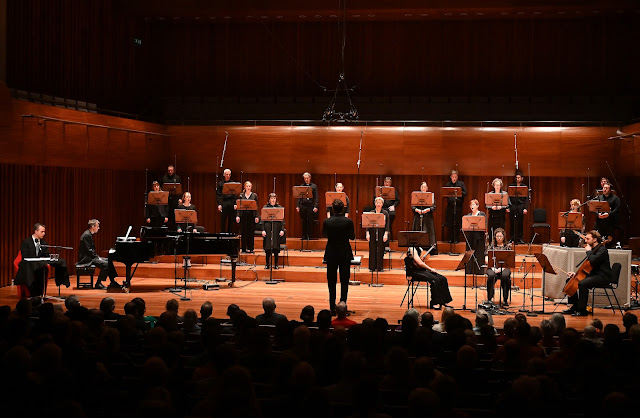
Guildhall School Musicians
BBC Singers
Nicholas Chalmers (conductor)

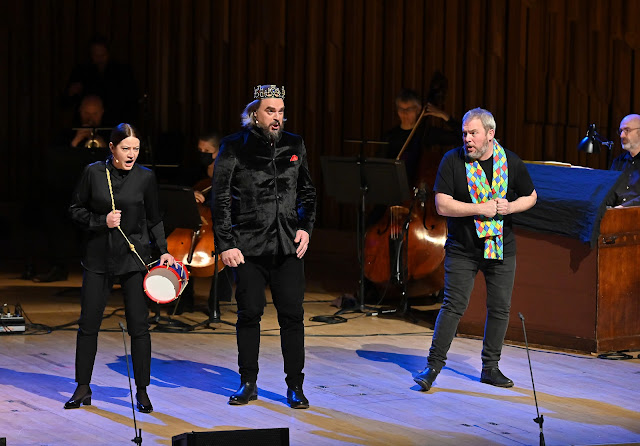
Ullmann: Der Kaiser von Atlantis, dir. Kenneth Richardson
Messiaen: Quatuor pour la fin du temps

Kaiser Overall – Thomas Johannes Mayer
Loudspeaker – Derrick Ballard
Soldier – Oliver Johnston
Harlekin – Robert Murray
Bubikopf – Soraya Mafi
Death – Henry Waddington
Drummer Girl – Hanna Hipp


BBC Symphony Orchestra
Josep Pons (conductor)
Guildhall School Musicians


Images: BBC/Mark Allan

Holocaust Memorial Day falls on 27 January, thus poignantly entwined—forever?—with the birthday of Mozart. Much could and doubtless should be said about that dialectical relationship, but let us leave that for another time, perhaps when I am once again able to travel to Salzburg and its Mozartwoche is once again able to take place. The BBC/Barbican annual Total Immersion day or weekend—this year a day—was, however, able to do so, offering much food for thought and contemplation. This year, we approached a commemoration that calls into question, many would say irrevocably denies, the possibility of historical ‘normalisation’, by way of music (mostly) from Nazi prison camps, above all the ghetto of Theresienstadt/Terezín. Simon Broughton’s 1993 documentary film offered an excellent introduction: informative, evocative, and, through its interviews with and performances from survivors, touching too. It is difficult to imagine the BBC making such a film now, but thank goodness it did then. 

Two of the three composers featured in the first of three concerts also featured in that film. Hans Krása and Pavel Haas were joined by Erwin Schulhoff, who met his end at another of the camps, Wülzburg in Bavaria. It was unclear why the concert was named ‘The Theresienstadt Orchestra’, since Schulhoff’s Fifth Symphony was not performed there, nor indeed anywhere else until 1965; but never mind. The BBC Symphony Orchestra under Alpesh Chauhan gave sharp, committed performances of all three works, though the spiritual sense of a memorial seemed strangely absent. Krása’s Overture for Small Orchestra, the ensemble essentially a matter of what was available to him, was light, at times sardonic, almost a Central European response to French neoclassicism, with an especially virtuosic piano part. It was nothing adventurous, yet well crafted and performed, with a nice twist for its sign-off. Where Krása had offered an ensemble of many soloists, Haas gave us massed strings in a more substantial piece whose fugal writing and more general counterpoint brought us closer to contemporary Hindemith than to Haas’s teacher, Janáček. Lively cross rhythms perhaps suggested otherwise. During its relatively short span, it packed in a considerable amount of material and invention. There was moving fragility and resolve to its ultimate contrapuntal restoration. 

Schulhoff’s symphony opened with great promise, its first movement ominous, full of foreboding, as if the walls of his incarceration-to-come were already closing in. The tread of a march in slow motion, deliberate in both senses, seemed as though it might go on forever—then suddenly stopped, which I assumed to be the point. A slow movement somewhere between Franz Schmidt and Prokofiev, with some of the former’s post-Bruckner tendencies, and some of the latter’s harmonies, nonetheless looked at times to a different, darker, and perhaps more cinematic world. If it perhaps went on a bit long, many of us are used to forgiving that failing in other music. A furious and frenetic scherzo, its repeated frustration apparently imbued with definite, even fatal meaning, seemed still more intent on bearing witness to its time, courting comparisons with a contemporary piece such as Martinů’s Double Concerto for Two String Orchestras, Piano, and Timpani. This was a tremendous performance, driven in a good way, and above all brutal, in what came across as a forceful if not overtly complex work. Alas, its finale hovered on the edge of incompetence (as composition, rather than performance). Its opening intrigued, suggesting grim nobility to a chorale that might ultimately triumph or, knowingly going through the post-Mahlerian motions, not. It never quite hung together, though, more damagingly extending for what seemed an unmerited eternity. I could not help but wonder whether it would be better given as a three-movement work, omitting the finale entirely. 


The second concert, for which we crossed over the road to Milton Court, was perhaps the most successful of all. The brainchild of baritone Simon Wallfisch, who not only briefly sang but devised the programme and read from letters and diaries more properly to remember those who lost their lives, it offered not only a touching memorial but also a valuable conspectus of artistic production, performed by the BBC Singers, young instrumentalists from the Guildhall, and Nicholas Chalmers. What might not seem the most intrinsically interesting of choral music was transformed by our knowledge of its educative role at Theresienstadt, where education was prohibited but keeping children busy was not, singing falling into that category. And what one could learn by singing, as one of the readings reminded us. Here the determination to bear Jewish witness was one of the many things experienced, for instance through by Two Hebrew Pieces and Yiddish Songs by Viktor Ullmann. Gideon Klein’s String Trio, concise and almost shocking in its mastery, received a fine, comprehending performance, every bit as involving in more ‘purely’ musical terms as it was in remembrance. Cabaret was present too. An arrangement of the closing chorale from Ullmann’s Kaiser von Atlantis looked forward to the evening. But this finely planned selection was so much more than the sum of its parts. It is to be hoped that Wallfisch has opportunity to give it elsewhere.

And so, to the evening, where we saw a resourceful concert staging of Ullmann’s celebrated opera. It was haunted not only by the opening pageant of characters walking on stage, Death laying down a suitcase (of course), others picking up props from it, but later by a shocking interpolation of sound from without the camp: a sound of actual war, and then of crowds hailing Hitler (for whom, read the Emperor). But it was the early parody of Mahler, the ‘Trinklied vom Jammer der Erde’, life both overflowing and fundamentally tragic, that hit home most strongly for me, fruitfully, fatally overshadowing what was to come. A fine cast, the BBC Symphony Orchestra, and Josep Pons, captured our attention and never let it wander. This is not Brecht-Weill; nor should it attempt to be. It breathed a sadder, more unmediated, yet undoubtedly sincere air: not a work one wishes to encounter often, but which one definitely should from time to time. Quite what Messiaen’s Quartet for the End of Time was doing in this company, I do not know. Musicians from the Guildhall gave an impressive performance, especially so during its passages—movements—of slow ecstasy. A prison camp, whilst no fun, was not, however, a concentration camp. Messiaen’s compositional mastery seemed to accentuate the divide further, giving an unfortunate impression of climax upon the day’s towering (acknowledged) musical masterpiece. Audience whooping at the close only made matters worse. It was a pity, but we had heard—and learned—much of very different value before.


Saturday, 22 January 2022

LPO/Canellakis - Boulanger, Wagner, and Scriabin, 22 January 2022


Royal Festival Hall

Lili Boulanger: D’un soir triste
Wagner: Tristan und Isolde: Prelude to Act I and ‘Liebestod’
Scriabin: Symphony no.4, op.54, ‘Poem of Ecstasy’

London Philharmonic Orchestra
Karina Canellakis (conductor)


London Philharmonic Orchestra, Principal Guest Conductor Karina Canellakis, (c) Benjamin Ealovega

Disappointment was palpable when a pre-concert announcement informed us of a change to the programme. Ravel’s Left-Hand Piano Concerto would no longer be played, Cédric Tiberghien having been indisposed at very short notice. All of two hours, I learned later, had made it impossible to find a substitute or indeed to offer an alternative work, and the pianist was understandably frustrated by the experience. Wagner, initially slated to preface the Ravel, now came second, Lili Boulanger’s D’un soir triste moving to the first half. Scriabin’s Poem of Ecstasy remained last, but now with the second half to itself. It may not have been the programme anybody wanted, but it received an excellent, in many ways outstanding, set of performances from the London Philharmonic Orchestra and Karina Canellakis. As ever right now, we gratefully made the best of a less than ideal situation. 

D’un soir triste proved something of a revelation to me. I do not think I had heard it before; if I had, it cannot have been in a performance as impressive as this. Its opening reminded me, perhaps oddly, of Puccini’s Il tabarro: above all in the marriage of particular, dark orchestral colouring to other aspects of Boulanger’s writing (harmony and rhythm). It was built otherwise, quite otherwise, although that impression returned at the end of a finely turned symphonic poem (both as work and performance). Debussyan and Wagnerian roots were unmistakeable, but only a small part of a more richly post-Romantic canvas. On occasion, I fancied there might even be a little of something more Expressionist, giving a piece such as Schreker’s Vorspiel zu einen Drama a run for its money. Although ardent, indeed passionate, this remained far from the hothouse. The abiding impression was clean yet dark, with a keen sense of narrative, propelled by excellent wind and later strong solos. There was decided unease too, evoked as much through timbre (pizzicato, for instance) as harmony. A powerful, yet ambiguous climax was just as well traced as its preparation and aftermath. Fascinating. 

The intensity of the opening to the Prelude to Act I of Tristan was welcome enough; still more so were Canellakis’s unerring pacing and the LPO’s depth of tone and, later, fine orchestral balance. There was unfussy variegation too: chiaroscuro that never drew attention to itself, never seemed present for its own sake. Again, Canellakis built the music to a splendid climax, its trumpets already presaging Scriabin. There was true Wagnerian melos here—and this from someone far from unexacting when it comes to Wagner. The so-called ‘Liebestod’ (properly ‘Isoldes Verklärung’) does not belong tonally with the Prelude, but an excellent performance such as this can allay such qualms. This was an alert, comprehending performance, which might perhaps have had greater breadth, but did not drag. Crucially, it glowed. On this evidence, Canellakis may turn out to be a Wagnerian to be reckoned with. The LPO’s recent experience with Wagner at Glyndebourne could not have been put to better use. 

Scriabin’s Poem had many of the same virtues, albeit, quite rightly, with greater languor. Again, Canellakis offered a poised, clear account, as well balanced as it was well directed. She is evidently a conductor who has music flow without ever making the experience about her. One inevitably heard fragments of Tristan throughout, yet as a springboard, not a cage. In this work, journey and frustrations are surely more the thing than arrival. There was assuredly no doubting the sexual charge of its ebb and flow. Climaxes can hardly be subtle, nor is there much point in trying to make them so; they made their point in vivid, enjoyable fashion. To hear a full orchestra at something close to its best in so fine a performance was magnificent reward. As for the rest, one can but admire Wagner’s economy.


Saturday, 15 January 2022

Bavouzet/Shishkin: Debussy, Liszt, Bartók, and Ravel, 13 January 2022


Wigmore Hall

Debussy, arr. Ravel and Kocsis: Nocturnes
Liszt: Concerto pathétique, S 258
Bartók, arr. Kocsis: Two Pictures, op.10
Ravel: La Valse

Jean-Efflam Bavouzet, Dmitry Shishkin (pianos).

A difficult choice, this: Jean-Efflam Bavouzet and Dmitry Shishkin in a fascinating programme of two-piano music at the Wigmore Hall, or Lise Davidsen and Leif Ove Andsnes in Grieg, Strauss, and Wagner at the Barbican. It is difficult to imagine those attending the latter having been disappointed; at any rate, having tossed a coin in favour of the former, I was not. 

First, we heard Debussy’s Nocturnes. I honestly would never have guessed the opening of ‘Nuages’ had not been written for two pianos, rather than transcribed by Ravel, had I not known: testament, surely, both to arrangement and performance. (I am not sure we need worry in this context about differences of meaning between ‘transcription’ and ‘arrangement’.) We heard a wonderful freedom within metre. Darkness of ambiguity seemed, if anything, enhanced by the sound of two Yamahas rather than orchestra. Dynamics, tempo, balance, shaping: all convinced and had one think they could not have been improved on. ‘Fêtes’ sounded more different from the original, more ‘transcribed’, but that was surely the nature of the material, rendered into piano monochrome. It was a sharp, lively performance, occasionally percussive, having me think at times of Bartók. ‘Sirènes’, which Ravel also transcribed but which he admitted to having found especially difficult, was here given in a transcription by Zoltán Kocsis. I did not realise this until afterwards, but I admit to having first found the arrangement sound closest to Ravel himself (so much for my ears!) and thereafter the most enigmatic of all, which is doubtless as it should have been. In performance, there was languor enough, though it always sounded directed. 

The genesis of what we heard from Debussy, Ravel, and Kocsis was not entirely straightforward. Essentially, Ravel transcribed ‘Sirènes’ first, to accompany the first two movements, as already transcribed by Raoul Bardac. Then, eight years later, Ravel added his own versions of ‘Nuages’ and ‘Fêtes’, whilst Kocsis’s ‘Sirènes’ dates from seven decades later. However, Liszt’s Concerto pathétique is arguably more complicated (not atypical, for a composer who tended to move on quickly, creating multiple versions, rather than chiselling away at a single work). At any rate, having passed through two solo piano workings of this material, the latter far closer to the two piano version than the first, Liszt rightly settled on two pianos as offering the superior medium for the concerto contrasts of this material. Such was clear from the grand, even grandiloquent, virtuosic opening dialogue; but it was also readily apparent in melting towards more tender sounds. The sheer weight of sound impressed at times, though even then it was never monolithic. Bavouzet and Shishkin imparted a strong sense that Liszt’s music might readily have been orchestrated, but also kept one happy that it had not. It sang too, as only Liszt can. If the roulades sometimes stand on the edge of absurdity when heard for two pianos, they were despatched with conviction, glitter, and crucially, heart. Sometimes, it was difficult to credit that there were only two pianists at work. From a pianistic standpoint, this was little short of stupendous, Liszt’s rhetoric harnessed and sublimated. 

Bartók himself arranged his Two Pictures, op.10, for solo piano. Kocsis extended the idea to two pianos. It was quite a revelation to hear: imaginative and faithful, above all pianistic. ‘In Full Flower’, the first picture, sounded, just as much as in orchestral guise, as though it were well on the way to Bluebeard’s Castle, in a performance of sad nobility. Both muscular and tender, often both, it did Bartók and Kocsis proud. ‘Village Dance’ was thrillingly responsive—and responsorial. This performance captured to a tee so many facets, melodic, harmonic, metrical, and more, of Bartók’s style and meaning. Lisztian and other inheritances were refracted, remoulded, even bent to new ends. ‘New wine demands new bottles,’ as Liszt once put it.

La Valse rumbles in a different yet no less ‘authentic’ way in its two-piano version. It was fascinating to hear that opening in the aural light of Bartók. Bavouzet and Shishkin conveyed with relish Ravel’s inflections of Viennese lilt, not necessarily as one would expect with an orchestra, but on their pianos’ own terms. Perhaps there was greater extremity here; there were certainly different sounds and implications. And what a feast, again, of pianism. As an encore, we heard Ravel’s early Sites auriculaires in two short movements. A slinky ‘Habanera’ prefaced a barnstorming ‘Entre cloches,’ its spatial qualities splendidly realised.


Tuesday, 11 January 2022

LSO/Rattle - Anderson, Mahler, Rott, Webern, and Dvořák, 9 January 2022


Barbican Hall

Julian Anderson: Suite from Exiles
Mahler: ‘Blumine’ movement for Symphony no.1 in D major
Hans Rott: Symphony in E major: Scherzo
Webern: Six Orchestral Pieces, op.6
Dvořák: Symphony no.7 in D minor, op.70

Siobhan Stagg (soprano)
London Symphony Chorus (chorus director: Simon Halsey)
London Symphony Orchestra
Simon Rattle (conductor)


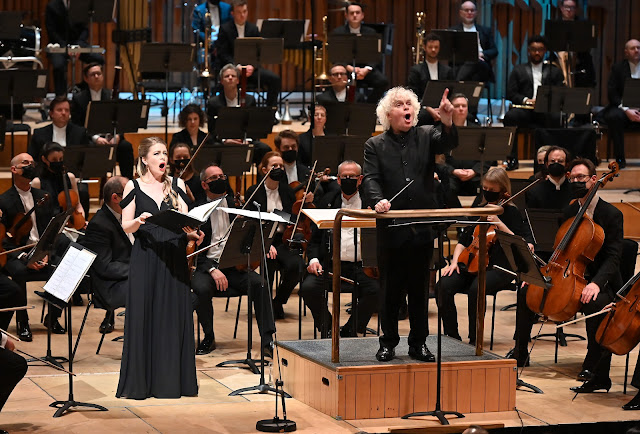
Images: Mark Allan


Two or three weeks ago, it did not seem especially likely this concert would happen. It did—and very well it went too. To hear as large an orchestra as that fielded by the LSO here under Simon Rattle remains unusual during our current troubles. We now perhaps ascribe greater worth to every artistic and social occasion, all too well aware of general precarity. I certainly relished the sheer richness of orchestral sound, the unquestionable commitment from all on stage and (London Symphony Chorus) up in the balcony, and something close to a full house for an appreciative audience.

It seems that Julian Anderson’s Exiles has, one way or another, been a victim of the dread virus. Two of its five movements were given by the LSO and Rattle in September; here they were joined by ‘La République des Lettres’ for soprano and a cappella chorus, then impossible to perform. When the final two will come is unclear, yet on the basis of this ‘Suite’ and its reception, they will be eagerly awaited by many. The new movement—to the world, that is; all were new to me—pays tribute to the American diplomat Varian Fry who assisted many under threat from Nazism into exile. Here, several of them are named, from Bohislav Martinů via Darius and Madeleine Milhaud and Betsy Jolas to the Hungarian animal photographer Ylla (Camilla Koffler). That was the work of half the chorus, initially syllabic, though not in a ‘difficult’, Nono- or Lachenmann-like way. The other sang from Psalm 46: ‘God is our hope and strength: a very present help in trouble…’. Dialogue between soprano Siobhan Stagg and choir added to the responsorial sense. If the writing were largely homophonic, there was a splendid, again psalm-like freedom to its metre, Rattle finely shaping an heroic performance from all.

First we had heard ‘le 3 mai’, Anderson’s setting of an e-mail from the Moroccan-French composer Ahmed Essyad to other composers from 3 May 2020, telling of his coronavirus isolation and nonetheless greeting them: ‘internal’ exile. The soprano I head first, followed by orchestral sounds that to me evoked a sense of electronic communication—latterly both bane and saviour of our lives. Anderson’s orchestration here and later proved typically ‘French’ in sonority, bells perhaps evoking an inheritance from Messiaen as well as Debussy and Ravel. The darker turn taken upon ‘Je vous embrasse tous,’ leading to climax at the end of the same line of the text, ‘sans covid’, repeated, would doubtless have moved irrespective of the words set; however, we heard it with them, and could hardly fail to think ‘if only’. The sign off ‘Ahmed’ returned us to the exile of electronic communication. 

‘Tsyion’, heard last, sets for chorus words from Psalm 137, the Jews in Babylonian exile, by those famous waters, and from Horatiu Rădalescu on that archetypal exile Ulysses, whilst the soprano sang other words above, from Rădalescu on ‘Exile’ itself. Stagg’s exultant melismata again provoked memories of Messiaen, but Anderson’s music throughout offered a compelling harmonic language and, more broadly, combination of that with melody, rhythm, and timbre never to be reduced to mere ‘influence’ or parallels. Solo horn at one point seemed to encapsulate the wistfulness of exile; there was more to it than that, though. Anderson’s fantastical imagination suggested to me opportunity and, at the close, through a mass of solo violins, a secularised chorus of birds. There is hope out there, as Essyad realised in contemplating a mountain he could not yet visit.

Next up was the discarded ‘Blumine’ movement from Mahler’s First Symphony. There could be no doubting the composer via sentiment or language, nor the specific identity of the Mahler of that symphony, though in many ways it sounded, quite rightly, earlier still: late Romantic rather than modernist, even ‘late early Romantic, Mendelssohn as well as Wagner apparent, Mahler taking his leave from the world of Das klagende Lied. Rattle had Mahler’s song sung with simplicity, never audibly moulded as has seemed the case with much of his more recent Mahler. There was darkness, but only moments of darkness in a fine, unexaggerated performance. And what it was to hear both the excellent solo trumpet and a full LSO at the movement’s climax. This was truly affecting music-making, all the way to a magical final harp chord.


The scherzo from the E major symphony of Mahler’s friend Hans Rott received here an outstanding, spacious, altogether generous performance, whetting the appetite for what one must hope will one day be a performance of the whole work. One need not be starry-eyed about it, as some are, to recognise its music, anticipations of Mahler and all (any ass can see that…) as intrinsically worthy of listening. The LSO’s sound hovered, like Rott’s music, somewhere between Bruckner and Mahler, with a little Berlioz at times too, not least in its trippiness. A sort of deranged jollity with disquieting echoes fascinates; and if sureness of direction is not altogether Rott’s thing, his music’s sheer originality offered something quite compelling both as work and performance. 

With Webern’s op.6 Orchestral Pieces we are in different territory: one of the supreme masterpieces of twentieth-century orchestral music. Rattle and the LSO offered them as the repertoire pieces they demand to be: without apology and through intimate knowledge and understanding. Free choice might not lead one naturally to the 1928 revision, but its smaller forces doubtless enabled the work to be performed at all. Heard after that first half of Anderson, Mahler, and Rott, the first movement’s lyricism emerged all the lovelier and more longing. Rattle ensured here and throughout a balance that invited comparison with conductors such as Abbado and Boulez. In this narrative, crucially, every note counted for a multitude in so much other music. The second movement’s response sounded as inevitable as I can recall, in a vision less haunted than propelled by anger, fear, violence, and yes, wonder. Longing was intensified in the third piece, here sounding intriguingly close to Berg. The German Sehnsucht came to mind. Ominous tread and progress through the funeral march fourth encapsulated a Mahlerian world in itself. Music lay between the notes as well as in them, in a requiem of defiant hope whose roaring climax duly shattered. Heard in aftershock, the fifth seemed to say, stealing from the future of Webern’s teacher Schoenberg’s Piano Concerto, that life must go on. It witnessed yet sparkled. And what expressive depth we heard in the closing ‘Langsam’ movement, each chord speaking as if it were a page or two at least of Mahler.


It is doubtless too easy to speak of performing Dvořák via Webern, but it was difficult, at least at times, not to hear it that way. An aural lens of motivic concision and well-nigh Schubertian melodic profusion did no harm at all to its opening ‘Allegro maestoso’. I was fascinated to hear the LSO strings sound more ‘old German’, akin to Daniel Barenboim’s Staatskapelle Berlin, than I ever heard the Berlin Philharmonic under Rattle. It worked, in any case, as the LSO really dug into Dvořák’s score. A purposeful yet flexible account of this first movement was far from deaf to the beauties and meaning of detail, yet integrated them rather than having them stand out. Here, again, music lay between as well as in the notes. The slow movement was taken slowly, surely more than the ‘poco’ of the composer’s ‘Adagio’ marking; a somewhat Tchaikovskian performance nevertheless worked well on its own terms. Rattle loved it doubtless, but not, I think, too much. There were rhetorical underlinings, yet they worked to shape a musical drama. The scherzo flowed via, rather than despite, its engineered tensions, metrical and more. Its trio was, I felt, moulded a little too much. Likewise the finale: impassioned, yes, but not always clear where it was going. That said, Rattle’s conception of something akin to an enigmatic tone poem in its own right had much to be said for it. His remains a questing musical imagination, as seen in programming and heard in performance.


Wednesday, 29 December 2021

Tally of performances attended, 2021

Another strange and, let us hope, highly unrepresentative year, if not quite so strange as last year. As usual, I have counted any composer once for any one event (i.e. Parsifal counts as one, as does a minute of Webern, as do four Beethoven sonatas in the same recital). Concert performances still count as opera. Interesting and heartening to see Janáček fare so well, but there was one very clear winner for 2021:


Opera

6 Mozart
3 Janáček
2 Gluck, Wagner
1 Darren Berry, Cavalli, Enescu, Humperdinck, Ravel, Strauss, Tippett, Alastair White

Concerts

6 Mozart
5 Beethoven, Schubert
3 Schumann, Stravinsky
2 JS Bach, Bartók, Brahms, Haydn, Janáček, Mahler, Messiaen, Purcell, Ravel, Sibelius, Strauss
1 CPE Bach, WF Bach, Martin Baker, Mason Bates, Benjamin, Berlioz, Berg, Georg Böhm, Joseph Bologne, Bruch, Byrd, Britta Byström, Chopin, Ann Cleare, Couperin, Debussy, Dvořák, Elgar, Brian Elias, Raquel García-Tomás, Gerhard, Gibbons, Gossec, Guerrero, Handel, Johann Wilhelm Hässler, Lisa Illean, Isaac, Betsy Jolas, Josquin, Lassus, Luise Adolpha Le Beau, George Lewis, Liszt, Kate Loder, Joan Magrané Figuera, Knussen, Johann Kuhnau, James MacMillan, Matthew Martin, Johanna Müller-Hermann, Sarah Nicolls, Pachelbel, Pärt, Anthony Payne, Charlie Piper, Enno Poppe, Poulenc, Rameau, Esa-Pekka Salonen, Saint-Saëns, Samuel Scheidt, Schoenberg, Mark Simpson, George Stevenson, Sweelinck, Vaughan Williams, Ryan Wigglesworth, Ayanna Witter-Johnson, Zemlinsky

Total

12 Mozart
5 Beethoven, Janáček, Schubert
3 Ravel, Schumann, Strauss, Stravinsky
2 JS Bach, Bartók, Brahms, Gluck, Haydn, Mahler, Messiaen, Puccini, Purcell, Sibelius, Wagner
1 CPE Bach, WF Bach, Martin Baker, Mason Bates, Benjamin, Berlioz, Berg, Darren Berry, Georg Böhm, Joseph Bologne, Bruch, Byrd, Britta Byström, Cavalli, Chopin, Ann Cleare, Couperin, Debussy, Dvořák, Elgar, Enescu, Brian Elias, Raquel García-Tomás, Gerhard, Gibbons, Gossec, Guerrero, Handel, Johann Wilhelm Hässler, Humperdinck, Lisa Illean, Isaac, Betsy Jolas, Josquin, Lassus, Luise Adolpha Le Beau, George Lewis, Liszt, Kate Loder, Joan Magrané Figuera, Knussen, Johann Kuhnau, James MacMillan, Matthew Martin, Johanna Müller-Hermann, Sarah Nicolls, Pachelbel, Pärt, Anthony Payne, Charlie Piper, Enno Poppe, Poulenc, Rameau, Esa-Pekka Salonen, Saint-Saëns, Samuel Scheidt, Schoenberg, Mark Simpson, George Stevenson, Sweelinck, Tippett, Vaughan Williams, Alastair White, Ryan Wigglesworth, Ayanna Witter-Johnson, Zemlinsky

Wednesday, 22 December 2021

'Hymns to the Virgin': Tallis Scholars/Phillips - Lassus, Josquin, Guerrero, Martin, Stravinsky, Pärt, and Isaac, 21 December 2021


St John’s Smith Square

Lassus: Alma redemptoris mater
Josquin: Missa Ave maris stella
Guerrero: Maria Magdalene et altera Maria; Ave virgo sanctissima
Matthew Martin: Sanctissima
Stravinsky: Bogoroditse devo
Pärt: Virgencita
Isaac: Virgo prudentissima

Tallis Scholars
Peter Phillips (director)


St John’s Smith Square’s 36th Christmas Festival has gone ahead as planned. That in itself is something to grant seasonal cheer, especially at what again is proving a trying time for all of us. So too was this concert from festival regulars the Tallis Scholars, with music spanning a period of more than half a millennium, from Josquin’s Missa Ave maris stella in the late fifteenth century to Matthew Martin’s 2017 reimagining of Francesco Guerrero’s motet Ave virgo santissima, first published in 1566.

The concert opened with Lassus’s polychoral motet, Alma redemptoris mater, separation and recombination of the two ‘choirs’ (four singers apiece) taking place in typically patient, unshowy unfolding from Peter Phillips and his singers. Like much of the evening’s programme, it sounded bathed in Marian radiance, albeit of distinctly different varieties that yet all remained worlds distant from the concerted likes of Monteverdi or Mozart. In context, Lassus’s eight-part antiphon—he also set the text for five and, twice, six voices—sounded almost as if an overture.

If so, it was an overture to the mass honouring the five hundredth anniversary of the death of Josquin des Prez. We heard a properly responsorial ‘Kyrie’, its opening upward fifth signalling to all and sundry the cantus firmus that permeates so much of the setting in a motivic fashion it is difficult not to think of as ‘modern’, however problematic and ultimately unsatisfactory the notion may be. The ‘Gloria’ offered a not entirely dissimilar sense of unfolding and building towards climax such as we had heard in Lassus. Words were never underlined, yet nonetheless ‘spoke’ as Phillips and the Tallis Scholars traced, even inhabited Josquin’s work’s musical contours. (And no, it does not seem to me anachronistic here to speak of a musical work.) A glowing, full-toned ‘Sanctus’ contrasted nicely with the duets of the ‘Benedictus’. The crowning canonical writing of the ‘Agnus Dei’, canons recalling earlier writing and seemingly underlining the form of threefold petition, was permitted a sense of the expansive: in performance as in work, one might say. At any rate, there was a sense not only of conclusion but of culmination, without attempting to transplant later values not at home here.

Following the interval, we turned to two motets by Guerrero. His Maria Magdalene et altera Maria tells of that celebrated discovery on Easter morning. Here were a different voice, method, and subject matter; a different radiance too, I think. Yet again, there was that sense of patient unfolding and building unobtrusively towards a fine climax on ‘surrexit’. Our Saviour was risen indeed. There was a graver, more hymnal beauty to be heard and felt in Ave virgo sanctissima. Indeed, the prayerful quality in which I felt involved, no mere observer, imparted a sense of physical and metaphysical kneeling. Romantic nonsense, perhaps, though harmless if so. Martin’s reimagining, written to accompany the original, had Guerrero’s lines travel in lines of refracted, relative dissonance, within a tonal framework. Intonation sounded spot on, as surely it must be. It was rather lovely to hear in context.

The radical simplicity of Stravinsky’s Bogoroditse Devo quite simply brooked no dissent, as jewel-like an ‘object’ as, say, the Octet. It simply ‘was’—and doubtless will be. Arvo Pärt’s Virgencita took a lot longer to say rather less, yet the performance was one of evident fondness, warmth and patience bringing ‘holy minimalist’ process to the fore. Some attractive, almost Poulenc-like chords (in abstracto, not functionally), quite resplendent in performance, made the time pass more quickly. The encore, Pärt’s minute-long setting of the same Old Slavonic text set by Stravinsky was written for King’s College Cambridge's Service of Nine Lessons of Carols. The singers imparted a welcome sense of carolling dance to its despatch.

In between we heard Heinrich Isaac’s magnificent Virgo prudentissima, making the case for Archduke—soon Emperor—Maximilian’s piety, the Virgin his heavenly advocate. When compared with, say, Josquin, display of musical intellect seemed more overt. Canonic procedures came more strongly to the fore, propelling words in a fashion that had very much its own direction and directedness. Not for nothing did Webern write his dissertation on Isaac. This was an arresting polyphonic and cosmogonic tour past dominions, fiery cherubim, angels, archangels and others both above and below, to the Mother of Heaven and thence to Him who had taken her up. Yet we fittingly returned to her, ‘excellent as the Sun’, and sounding so. Hierarchies of music and theology created and reinforced one another, preparing us, so it seemed, for further, Christmas mysteries.

Monday, 20 December 2021

Britten Sinfonia/Watkin - Handel, Messiah, 16 December 2021

Barbican Hall

Harriet Eyley (soprano)
Jess Dandy (contralto)
Stuart Jackson (tenor)
James Newby (baritone)

Choir of Jesus College, Cambridge (director, organ: Richard Pinel)
Britten Sinfonia
David Watkin (conductor)

Messiahs take many forms. They did during the eighteenth century; they did in the nineteenth; they did in the twentieth; despite the more or less complete victory of ‘authentic’—was ever the term less apt than for this work?—performance practices in the rest of Handel’s œuvre, they have continued to do so in the twenty-first. Sadly, even tragically, the video of that inimitable ‘Handel meets Pop with Messias’, starring the still-more-inimitable Robbin Casey, seems to have vanished not only from YouTube but the planet. (Please do let me know if you have a copy of the original broadcast!) But we still have options ranging from Mozart to McCreesh, from Beecham to Britten Sinfonia. The small forces employed here, including a tiny orchestra (strings 3.3.2.2.1) and a choir of only twenty-six (men and women but not boys of Jesus College), were at least in part a response to the dread virus. They were perhaps not what one might have imagined ideal for the Barbican and would probably have worked better at home in the warmer acoustic of that most magical of Cambridge chapels. One’s ears nonetheless adjusted to aesthetics as well as to pragmatics. Not only would it be churlish and pointless to object too strongly; it would also arguably ignore the fact that pragmatics have almost always been an important part of aesthetics. Handel, after all, never composed a Helicopter-Quartet. 

That a musician such as David Watkin, so well versed in what, for better or worse, we have come to know as ‘historical performance’, would take an anti-Romantic, or perhaps better a non-Romantic, line should have come as little surprise. The Britten Sinfonia’s versatility is such that these players could doubtless follow any lead with equal relish. Nicely detailed playing in, for instance, ‘But who may abide the day of his coming?’ permitted of considerable instrumental drama, whatever the numbers involved. So too, naturally, did that greatest of musical rarities: a true and fine contralto voice, in this case Jess Dandy’s. When it came to ‘He was despised…,’ the plainness of some of the orchestral playing was a little underwhelming, yet Dandy’s voice and interpretation continued to carry the performance.

In any case, Watkin’s direction was in general pragmatic, clearly aiming to build a performance founded not upon an ideal, but on the forces in front of him. If I suspect I shall never share ‘period’ predilection for ending numbers in what I hear as merely perfunctory fashion, I watched and listened eagerly to hear the way Watkin worked with his soloists, no diktat handed down from above, but rather making the most of Stuart Jackson’s dramatic, even operatic flair, Harriet Eyley’s appealingly bell-like soprano, or James Newby’s rich yet agile baritone. So too was this the case for the young choral musicians, for many of whom the past twenty-one months will have been particularly trying. If ‘All we like sheep’ bobbed along amiably, if little more, the winning, Saul-like responsorial singing of ‘Lift up your heads, O ye gates’, and agile passage work of ‘Let us break their bonds asunder’ duly impressed, as did the grandeur, finally achieved, of the ‘Hallelujah’ Chorus. Most stood, although one peculiar soul, who had disturbed ‘How beautiful are the feet’ and a couple of other numbers with incredibly noisy crisp-eating elected instead to film the performance on his telephone.  Music-making is itself a human good, a human necessity: something none of us should ever forget again, even in the unlikely event further ‘restrictions’ do not return. 

Coloratura was a distinct strength to all concerned: not only ‘in itself’, but as put to dramatic use; so too was stylish and varied ornamentation. This is an oratorio, one can readily forget, that is simply scored. In an unassuming performance such as this, one welcomes perhaps all the more the coming of bright trumpets in ‘Glory to God in the highest’, certainly as much as telling, if often subtle, shifts between numbers in tempo. One size has never fit all, and never will. And if this will never, should never, come across as a dramatic, narrative oratorio in the mode of many of Handel’s, there was much to enjoy in that mode too: Jackson fairly scourging with his voice (‘All they that see Him…’), at times coming across as Handel’s unconscious response to Bach’s Evengelists; Ryder’s tasteful intensification of vibrato for Christ’s resurrection in ‘I know that my Redeemer liveth’; and Newby’s moving representation of words and theology, allied to equally fine trumpet-playing (Imogen Whitehead) in ‘The trumpet shall sound’. A euphonious final chorus served not only as fitting aesthetic culmination, but worked as a keenly felt moral metaphor for what we had seen, head, and God willing, participated in too. Amen.

Monday, 13 December 2021

Gerhaher/Huber - Brahms, 12 December 2021

Wigmore Hall

Neun Lieder and Gesänge, op.32; Vier ernste Gesänge, op.121; Meine Lieder, op.106 no.4; Geheimnis, op.71 no.3; Die Mainacht; op.43 no.2; Treue Liebe, op.7 no.1; Lerchengesang, op.70 no.2; Acht Lieder und Gesänge, op.59: ‘Regenlied’, ‘Dein blaues Auge halt so still’, ‘Mein wundes Herz verlangt’; ‘Nachklang’; Auf dem Kirchhofe, op.105 no.4; Von ewiger Liebe, op.43 no.1; O kühler Wald, op.72 no.3; Herbstgefühl, op.48 no.7; Die Kränze, op.46 no.1


Christian Gerhaher (baritone)
Gerold Huber (piano)

Christian Gerhaher singing Brahms: it promised much and, if anything, delivered still more. This was a song recital as finely planned as it was executed, as thoughtful as it was moving. Ably supported by his pianist Gerold Hubert, not only did Gerhaher, by any standards one of the greatest singers of our age, give a masterclass in Lied-performance; he also showed quite how much his artistry has developed over the past few years. This is neither a musician to rest on his laurels, nor one to do something different for the sake of it; rather, with a quiet confidence and questing born of intelligence, sensitivity, and hard work, he led us to believe this was certainly the best way, perhaps the only way, whilst leaving open the door for other possibilities in subsequent reflection. 

Much nonsense is spoken about Brahms's songs. Some would have them all too similar, but then they might say the same about the composer’s symphonic works. Look, listen beneath the surface and you will divine a whole universe as distinctive and as varied as that of Schubert or Schumann. The first half offered bold programming in itself. If you place the op.32 songs and the Four Serious Songs there, do you run the risk of upstaging whatever comes afterwards? Perhaps, but if so, that risk was averted, by construction and performance of a second half that related to, extended, and contrasted with what we had heard, with where Brahms had travelled already beyond mere death. Moments of Romantic wonder, of a divine spark that actually makes life worth living even if it lies within rather than beyond this world, found themselves retrospectively bathed in light as well as further darkness. Gerhaher and Huber took seriously, as well they might, Brahms the Bible-loving agnostic as one of the nineteenth-century’s most intriguing theologians. Mortality may, after all, be a blessing, not a curse. The German Requiem may already have told us that, but these songs, from both before and after, told us more.

Indeed, the structure of Brahms’s songs in this context came to represent an intricate jigsaw of response significantly more than a musical momento mori. We could hear that in the Platen songs of op.32, just as in the Biblical texts of op.121; but we could hear it just as well, if differently, though a glass, less darkly, in the Schubertian flight of the early Treue Liebe. op.9, Gerhaher sensing and voicing inheritance without ever needing to underline. Echoed, with greater maturity, in the birdsong of op.70 no.2, Lerchengesang, barriers between natural and metaphysical worlds dissolved. Other connections were to be heard, of course, again subtly pointed, as much by Huber as by Gerhaher: the strangely comforting and disquieting intimations of the G major Violin Sonata in ‘Regenlied’ and ‘Nachklang’ from the op.59 set, the latter tellingly followed by ‘Auf dem Kirchhofe’ from a decade-and-a-half later, haunted by the most celebrated Passion chorale of them all—and thus by Johann Sebastian Bach, perhaps via Mendelssohn. There was autumn, of course, and something more final too, but there was spring. Gerhaher’s verbal inflection, ear for colour, and fine aesthetic judgement in declining ever to exaggerate were very much what was needed. 

Where sometimes, a little while ago, I had begun to wonder whether his increased experience of opera—who can forget his Tannhäuser Wolfram?—was leading him to privilege sheer beauty of tone over other aspects of his art, here the thought never entered my mind. The comparison is odious, but from the opening of ‘Wie raft ich mich auf’, it was Dietrich Fischer-Dieskau who came to mind. Sounding like Fischer-Dieskau was not the point, although more than once I fancied Gerhaher did. This rather represented a renewal of lyric art from the spirit of verse, a renewal that seemed, however incidentally, both to pay homage and to reimagine these songs once again on terms that were both theirs, Gerhaher’s, and ours. A rare evening indeed.

Sunday, 12 December 2021

Tosca, Royal Opera, 8 December 2021


Royal Opera House

Cesare Angelotti – Yuriy Yurchuk
Sacristan – Jeremy White
Mario Cavaradossi – Bryan Hymel, Freddie De Tommaso
Floria Tosca – Elena Stikhina
Baron Scarpia – Alexey Markov
Spoletta – Hubert Francis
Sciarrone – Jihoon Kim
Shepherd Boy – Alfie Davis
Gaoler – John Morrissey

Jonathan Kent (director)
Amy Lane (revival director)
Paul Brown (designs)

Mark Henderson (lighting)

Royal Opera Chorus (chorus director: William Spaulding)
Orchestra of the Royal Opera House
Oksana Lviv (conductor)  


Images: Tristam Kenton. Copyright: ROH, 2021.
Tosca (Elena Stikhina) and Scarpia (Alexey Markov)

Tosca is a puzzling opera. It seems to me quite the weakest of those Puccini operas in or at the edge of the repertory. Its characters are nothing more than cardboard cut-outs; there is little in the way of broader dramatic interest; for so generally sophisticated a composer, it is often crude, even drab, though there is perhaps greater interest in aspects of the vocal writing than elsewhere. Then there are the bits that read—and sound—like an especially bad historical novel or television mini-series, undigested pieces of historical record thrown up as if somehow to guarantee veracity. It remains steadfastly unmoving—for who or what might move one here?—compared to the rest of Puccini. And yet, Tosca continues in its bewildering popularity. Perhaps I instead am the problem.


Whatever the truth of that, Jonathan Kent’s Royal Opera House production is a serious problem. Quite what Kent or any of his team—there is little to it other than its designs—was thinking, it is difficult to say, for it emerges as something that advances on the late, unlamented Franco Zeffirelli only by providing a sort of Reader’s Digest abridgement to the latter that rids it of its gaudiness and any semblance of internal coherence. One waits for any sense of ironic detachment; then one waits longer; and longer still. The set’s heavy vulgarity—there is little or no production beyond the designs—might have been a wry comment on the work, but wryness seems no more to be at stake here than it is in the airheaded vanity of Tosca herself, neither character nor idea. Characters, for want of a better word, generally seem too far away from one another, reducing still further any prospect for chemistry between caricatures. Quite what the point of having people walk up and down ladders is, I cannot say. It gives them something to do, I suppose, but there seems to be beyond no concept beyond that. Borgesian labyrinth this is not; nor is it Piranesi. The oddly designated ‘revival director’ Amy Lane doubtless does what she can, but you cannot revive something that never had life in the first place.


Musically, things were better. Elena Stikhina gave a finely variegated account of the title role, with considerable heft where needed, and considerable range of dynamic and colour contrast. She certainly seemed to believe in the role and would surely have made greater dramatic impact in a more plausible staging. As Cavaradossi, Bryan Hymel did not return after the interval, an announcement made that he had been suffering with a heavy cold. It only seems fair therefore to draw a veil over his performance and to say that his replacement Freddie De Tommaso would have made an excellent impression in any circumstances, let alone these. This was, like Stikhina’s, an unsentimental, idiomatic, and—work and production permitting—involving performance. The production’s crudity did Alexey Markov as Scarpia no favours, but there was no doubting the intelligence of his artistry, nor the blackness of this baron’s intent. Other singers all contributed with excellence, Hubert Francis's Spoletta in particular catching the ear. 


So too did the Orchestra of the Royal Opera House, perhaps the greatest star of the evening. The players clearly relished Puccini again and responded with accuracy and style to conductor Oksana Lyniv, whose precision and disinclination to yield prevented any lapse into mere sentimentality, though perhaps it drained a little too much of the sentiment without evident cause that is Puccini’s orchestral stock-in-trade here. The Royal Opera Chorus’s contribution was mostly dependable, if at times a little frayed. I could not find the children’s chorus identified in the programme, though perhaps I missed it.

It will doubtless sell. Some, especially at the moment, will say that that is enough; but is it, really? If institutional opera even gives up the struggle to be anything other than a bad-taste museum piece, why should we struggle on its behalf? As we emerge, fingers crossed, from this wretched pandemic, Covent Garden should set its sights higher than being a faded Met-on-Thames. Give a director such as Calixto Bieito a chance to prove us Tosca-sceptics triumphantly wrong.

Thursday, 2 December 2021

'A Catalan Celebration': London Sinfonietta/Colomer - Gerhard, Magrané, García-Tomás, and Illean, 1 December 2021


Queen Elizabeth Hall

Roberto Gerhard: Libra
Joan Magrané Figuera: Faula
Raquel García-Tomás: aequae
Lisa Illean: Januaries
Gerhard: Leo

London Sinfonietta
Edmon Colomer (conductor)

A miserable, rainy night seemed just the right time for the London Sinfonietta, in association with the Institut Ramon Llull, to light up the Queen Elizabeth Hall with what they called ‘A Catalan Celebration’. 2020, the year without music, marked fifty years since the death of Roberto Gerhard. It was doubly welcome, then, to have this celebration of mostly Catalan music take place in 2021, the year when music tentatively returned to our lives. To hear fine performances not only of music by Gerhard, but also works by contemporary (to us) Catalan composers, Joan Magrané Figuera and Raquel García-Tomás, as well as one by the Australian-born, London-resident Lisa Illean, would have been a splendid opportunity at any time. It also helped dispel a little of the current misery outside. 

Gerhard himself was represented by two of his three late astrological pieces, Libra and Leo, from 1968 and 1969 respectively (the 1966 Gemini for piano and violin missing). Both ensemble works were premiered and recorded by the London Sinfonietta under David Atherton. I have not heard those (nor any other) recordings, but these performances under Edmon Colomer spoke clearly not only of excellence in execution but of deep familiarity and understanding of Gerhard’s music, of its language and colour, but also of its structure becoming living form in time. The éclat, to use an intentionally loaded term, of Libra’s opening chord having grabbed one’s intention, one immediately garnered a post-Schoenbergian (post-Webern too, I think) sense of every line counting, heard through exemplary clarity in scoring and performance alike. One might have heard the guitar as ‘Spanish’, but I think that would have been lazy; both Schoenberg and Webern used the instrument in ensemble works too. One felt, not merely recognised, a multi-movement structure condensed into one, placing it in a tradition dating back at least to Schoenberg’s First Chamber Symphony—and, of course, beyond to Liszt and Schubert—though here, perhaps, sonata-form inheritance, Gerhard’s own Third Symphony notwithstanding, was not so apparent. A dialectic between abstraction and Romantic sensibility lay the heart of what we heard. Glistening, above all it sang. Music of exile? It is other things too, yet that conclusion did not seem unreasonable, especially at a close that approached, or perhaps better referred to, a sort of modal tonality born of ‘national’ roots. 

Magrané’s Faula (Fable) followed. Written in 2017 and inspired by a novel of the same name by Jaume C. Pons Alorda, it seeks, to quote the composer, not to ‘elucidate his narrative,’ but ‘first and foremost to use Pons Alorda’s ideas and aesthetic world to conceive of its structure texture, and sound’. Four sections, essentially sets of musical material, recur throughout the work, taking their own line but also necessarily interacting. What soon struck me, even within the first, ‘Mosso, con foco’, was a fascinating polyphonic tendency—would it be too fanciful to ascribe this to the composer’s interest in Renaissance polyphony?—of individual, sometime fractious lines combining to effect that ‘line’ of which we speak so often as the prevailing melos, as Wagner would have had it, of so much Western music. A phrase that came to my mind, knowing nothing alas of the novel, was multiple tectonics; there was musical grit, it seemed, both in that necessary interaction between different types of material but also in their contrast. This could produce music of great beauty: atmosphere, propulsion, emotion. There was also, I felt, a sense of play to it: of chance, of contingency, however carefully designed, and yet productively within a framework of structural determination. Schoenberg’s—Bach’s for that matter—dialectic between freedom and determinism seemed in the context of this concert to extend via Gerhard to newer music, not necessarily in the sense of ‘influence’, but as a way to listen, even if it were only mine. 

García-Tomas’s aequae (2012) is divided into six parts of equal (hence the title) duration, two minutes each. In its exploration of ‘the relationship of equality between the musical materials that make it up as well as the paradoxes that such equality can produce’, it made its way with strikingly powerful integral development, through timbral as well as harmonic tension. Bowing cymbals, for instance, proved generative yet also resistant: an observation of the work in microcosm. There was a slower pulse (than in the hectic contrasts of Magrané), yet much happening within that pulse. Instruments not previously heard, such as saxophone and muted trombone, opened up new aural vistas: the art of programming, it seemed, very much part of the overall performance. Likewise the lack of strings, if only in this context, suggested something colder, even icier. 

After the interval, we heard Illean’s Januaries (2017), shaped in some sense by ‘memories of summers spent as a child with my grandparents in Queensland’. What might initially have seemed more textural music in quality had a definite guiding thread, suggestive initially, if only to me, of a process of melting. Descending, sliding figures were part of that; so too were ever-transforming harmonic fields. Distant bells first seemed to evoke something, or perhaps the point was that they did not; they were part of the landscape, of a space that could not necessarily be delineated, that slipped between our fingers, even our ears.

For the final piece, we returned to Gerhard for Leo. Again, I was struck by its opening éclat, though its development and general character took a different path. There was again complexity to this music, but never superfluity; everything mattered, had a relationship to the greater whole, even though one knew it would take greater familiarity precisely to discern it. Serialism, almost as if a magic square before our ears, was a guiding framework but never in itself the point. This was a powerful, directed, and highly dramatic performance; much, clearly, was at stake. A hieratic section, initially brass-led, reminiscent of chorale writing without simply reproducing it, was heard as the work’s emotional core, prior to initiation of further frenetic activity, material ever transforming before our ears. As first clarinet, then flute sang at the close a pentatonic, folk-like melody, suggesting this discovery may actually have underlain what previous we had heard, yet without our recognising it as such, exile as reminiscence in surroundings transformed returned, poignantly, to our aural stage.


Wednesday, 1 December 2021

Cooper - Schubert, Ravel, and Liszt, 28 November 2021


Wigmore Hall

Schubert: Piano Sonata no.16 in A minor, D 845
Ravel: Sonatine
Liszt: Années de pèlerinage: Troisieme année, S 163: ‘Les jeux d’eaux à la Villa d’Este’
Ravel: Jeux d’eaux; Valses nobles et sentimentales
Liszt: Hungarian Rhapsody no.13 in A minor, S 244

Imogen Cooper (piano)

A concert of two halves, this. Imogen Cooper’s severely insistent account of Schubert’s A minor Sonata, D 845, contrasted strongly with more colourful, yielding Ravel and Liszt. That, you might say, would be as expected, and you would have a point. I nevertheless longed for a little more in the way of chiaroscuro in Cooper’s Schubert, whilst acknowledging this may have been as much a matter of taste as anything else. Rhythm and, perhaps to a lesser extent, motivic working were to the fore in an angry first movement, whose uneasily wandering development section intrigued and did anything but console. There was greater ambiguity to the Andante con moto theme and variations, which again wandered in alienated, darkly Romantic fashion. An estranged lilt hilted at something else, but it was only a hint. Mercurial insistence in the scherzo led to still bleaker unease in its trio, whose ultimate note seemed to be of exhaustion. One would hardly expect the closing rondo to comfort. It certainly did not, though there were a few more ambiguous passages again. Ultimately, however, this was a bleak conclusion to a bleak reading. 

There was no question of playing Ravel as if it were Schubert (however understood). The Sonatine benefited from lighter touch and mood, and greater flexibility. There seemed to me, right from the start, to be greater awareness or at least communication of harmonic rhythm, and Gallic charm too, however clichéd the phrase. All three movements, albeit with different contours, character, and pulse, glistened from within. A liquid—aptly enough—account of Jeux d’eaux had backbone too, in a performance that was clearly deeply considered, whilst remaining quite free of pedantry. Valses nobles et sentimentales showed greater kinship, through its waltz rhythms, with Schubert. This was unashamedly big-boned Ravel, but none the worse for it; until it yielded, that is. For the second waltz proved more languorous and flexible; the delectable pain of the third was well-judged; and so on, through magical rubato and keen awareness of what had passes, musically and perhaps extra-musically too. There was a ghostly suavity to the ‘Epilogue’. 

After the Sonatine, we heard the first of two pieces by Liszt: ‘Les jeux d’eaux à la Villa d’Este’. Its muscular virtuosity also offered glistening results, very much here in the heat of the midday sun. It was forthright, yes, but it sang, in a performance of fine musical integrity. The A minor Hungarian Rhapsody is, well, rhapsodic—and sounded as such. Fervent Lisztian I may be, but I should quite happily never hear the Hungarian Rhapsodies again. They have their fans, though, and in her closing number, Cooper did not shy away from giving a grandly rhetorical performance, imbued with a rubato that evoked both temporal robbery and another, diabolical form of bargaining.


Die Zauberflöte, Royal College of Music, 26 November 2021


Britten Theatre

Sarastro – Jamie Woollard
Tamino – Ted Black
Speaker – Dafydd Allen
Teachers – Henry Wright, Sam Harris
Queen of the Night – Heming Li
Pamina – Hyoyoung Kim
Three Ladies – Lylis O’Hara, Annabel Kennedy, Emma Roberts
Three Junior Girls – Leah Redmond, Denira Coleman, Taryn Surratt
Papagena – Sofia Kirwan-Baez
Papageno – Theo Perry
Monostatos – Harry Grigg
Two Boys – Daniel Bray Bell, Redmond Sanders
Chorus – Madeline Boreham, Angelina Dorlin-Barlow, Matthew Curtis, Sam Hind

Polly Graham (director)
Louise Bakker (associate director)
Rosie Elnile, Hazel Low (designs)
Tim Mitchell (lighting)
Kate Flatt (movement)  

Royal College of Music Opera Orchestra
Michael Rosewell (conductor)


A week that brought excellent student shows from two London conservatoires, both the Royal Academy of Music (L’Heure espagnole and Gianni Schicchi) and the Royal College (Die Zauberflöte) offered encouraging news for our often hesitant operatic recovery. In many ways, this Magic Flute came close to ideal: committed performances from a highly talented cast of young singers, a provocative production by Polly Graham, and a warm yet incisive orchestral reading—rarely did one notice the small numbers in the pit—from Michael Rosewell. How preferable this was, in almost every respect, to Covent Garden’s dull revival of David McVicar’s superannuated production in September under leaden musical direction. 

Graham’s feminist standpoint was refreshing for an opera often accused, sometimes justly, often unjustly, of misogyny. It is a standpoint, though, not an end in itself: a way of looking at an opera, of permitting its characters to speak, sing, and to be reconsidered. The opera takes place in a somewhat old-fashioned secondary school, replete not only with blazers (often honoured in not being worn) and teachers in tweed, but also marijuana and abuse, both drivers of the action. For Pamina, more central than ever I can recall seeing her, embarks on her journey following creepy advances from Sarastro, and she is the one who plays the field—will she choose Tamino or her boyfriend of apparently longer standing?—and offers others a path to temporary enlightenment via a spliff. If there is to be deeper, more rooted enlightenment, it will come neither via narcotics nor through the restoration of Sarastro’s order at the close, but through the psychoanalytical world of a magic garden beyond the school wall, in which fantastical events take place, later to be interpreted. Music in performance is very much part of that interpretation, as witnessed by Papageno’s bells and Tamino’s flute. I cannot help but think that Michael Tippett would have loved it, though this was more Freud than Jung. Tamino certainly learns better than his teachers have taught him, both through the example of Pamina and the love they feel for each other; likewise, of course, Papageno and Papagena. 

Ted Black and Hyoyoung Kim proved an outstanding central couple, offering fresh-toned musical performances fully worthy of starrier stages (though with the bonus of a small theatre enabling us to see and hear them closer-up). Pamina’s attempted suicide in ‘Ach ich fühl’s’ was deeply moving, convincingly paced and spun; Tamino’s quest for self-discovery not only convinced but drew one in to empathise. Theo Perry’s Papageno likewise emerged more rounded than often one sees and hears: no mere caricature, but a flesh-and-blood human being with desires and feelings of his own, beautifully expressed through music and gesture—and splendidly reciprocated by Sofia Kirwan-Baez as Papagena, her part considerably more substantial than is usually the case. Jamie Harry Grigg’s rascally Monastatos was similarly much more of a multi-dimensional character: tribute to both production and performance. Woollard’s vocal dignity as Sarastro duly troubled. Heming Li came as close to thorough accuracy as anyone has the right to expect in her glistening accounts of the Queen of the Night’s arias. All contributed, though, to the greater dramatic whole in a fine company performance, with some light, tasteful ornamentation that enhanced rather than distracted. 

This was accomplished with a few, relatively minor cuts and changes to the text. (An exception to that ‘minor’ qualification was the inserted cadenza for the Three Ladies in the first scene. Fortunately, we heard no more in that vein.) Titles helped draw out further meaning, sometimes engaging more with what we saw rather than heard on stage, sometimes offering a bridge between the two. The ‘original’, whatever that may be, will not go away; or rather, if we consider it as anything more than the score and libretto, it will never come back, since we have little idea what it was in the first place. Our visual imagination fastens on Schinkel, if anywhere: wonderful, but nothing to do with 1791. Opera must never degenerate into a museum piece; it must live and breathe, which it unquestionably did here.