Showing posts with label Florian Hoffmann. Show all posts

Wednesday, 16 October 2019

Katya Kabanova, Staatsoper Unter den Linden, 12 October 2019


Katěrina Kabanova – Eva-Maria Westbroek
Marfa Ignatěvna Kabanicha – Karita Mattila
Varvara – Anna Lapkovskaja
Boris Grigorjevič – Simon O’Neill
Váňa Kudrjáš – Florian Hoffmann
Tichon Ivanyč Kabanov – Stephan Rügamer
Savël Prokofjevič Dikoj – Pavlo Hunka
Kuligin, Passer-by – Viktor Rud
Glaša – Emma Sarkisyan
Fekluša – Adriane Queiroz
Woman – Liane Oßwald

Andrea Breth (director)
Annette Murschetz (set designs)
Silke Willrett, Marc Weeger (costumes)
Alexander Koppelmann (lighting)

Staatsopernchor Berlin (chorus director: Martin Wright)
Staatskapelle Berlin
Thomas Guggeis (conductor)


Katya Kabanova (Eva-Maria Westbroek)
Images: Bernd Uhlig, from the 2014 premiere


Given the success of Andrea Breth’s Berlin Staatsoper production of Wozzeck, it was perhaps not surprising to emerge from this Katya Kabanova feeling similarly drained. It had not previously occurred to me to consider the points of affinity between these two tragic operatic masterpieces of similar length, written at a similar time – Berg started composition considerably earlier and completed his work later – but Breth’s approach played a suggestive role. For redemption, spiritual uplift, any such glimmer, one would likely have sought in vain – certainly at its conclusion. Where Wozzeck’s expressionism was tempered or expanded by something one might characterise, with certain reservations, as realism – not that the opera ‘itself’ lacks that too – here it is perhaps the other way around, Janáček’s drama extended in its final act by something that, if not quite expressionistic, certainly went beyond the realm of realism conventionally understood. The storm and its aftermath are, in any case, clearly not intended purely in meteorological terms; here, however, Breth’s ritualistic stylisation affords opportunity, without abdication of tragic content, for a form of starkness somewhat different from that more readily encountered.


There, as at the opening, we see action, movement, that seems either to tend towards or away from a tableau: secularised, doubtless, like Janáček’s outlook itself, yet not without a sense, for better or ill, of the religious. This, it seems, is a grim, difficult world in which women especially, but many men too, are cowed by social and political rather than more strictly theological constructs. ‘Modesty’ of female dress is clearly no matter of choice; likewise, the shrouded identity, if one may call it that at all, of many of the women we see. Repression and hypocrisy are, at least in considerable part (for perpetrators, that is, not for victims). And, of course, whatever the social similarities Breth suggests with Wozzeck, heightened by a destitute Eastern Bloc setting perhaps even going beyond that chosen by Christoph Marthaler for Paris several years ago, a major distinction remains the centrality of women to Janáček’s opera.


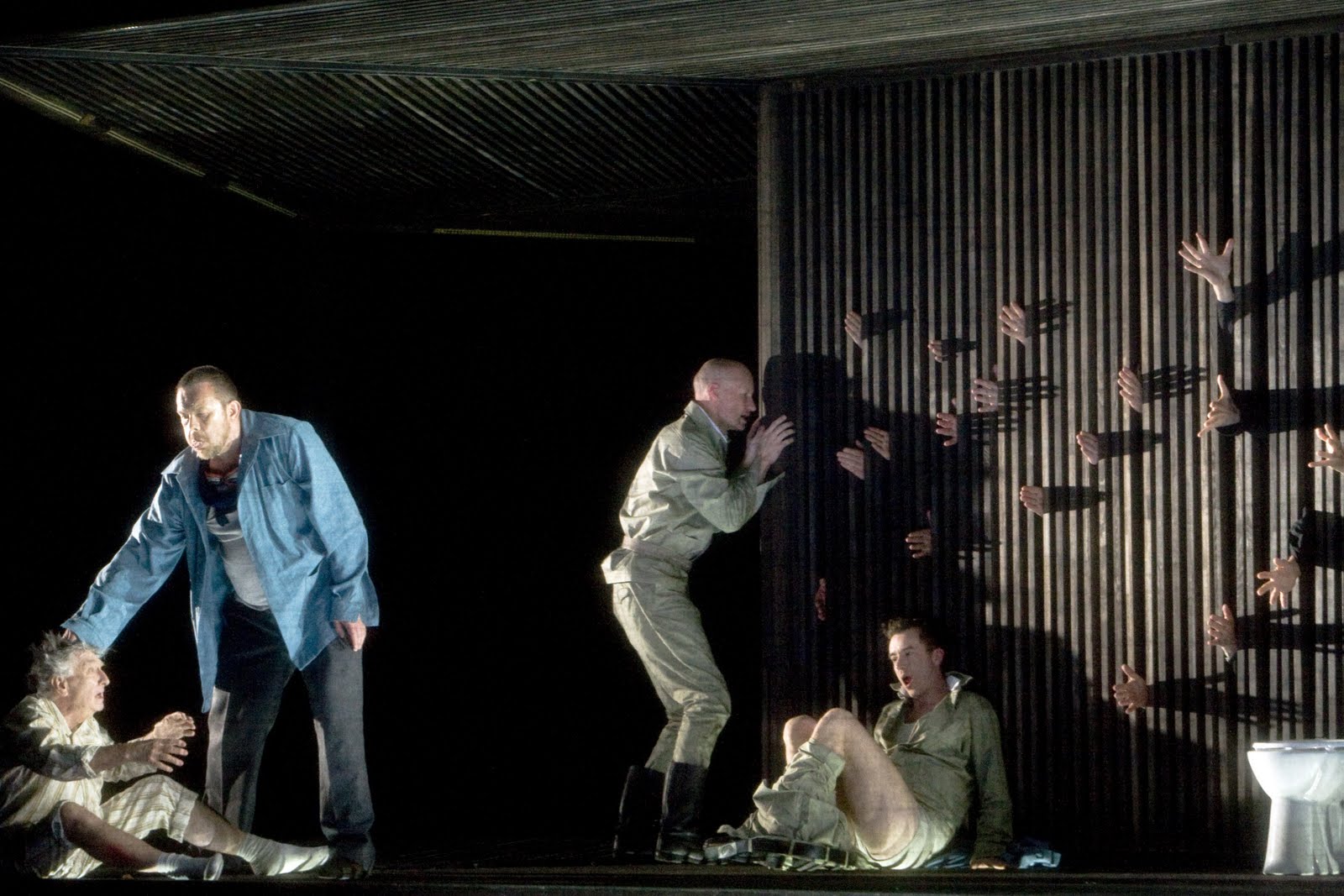
If anything, Breth pushes that further. We see Katya treated to the point of torture by domestic incarceration in a cupboard (or is it a refrigerator?). We witness perhaps a truly formidable Kabanicha, a fur-clad Karita Mattila, rule the roost and let her guard down in private: second-act drunkenness leading to an extraordinary scene with Dikoj, in which, rather than reject his advances, she joins him on the dinner table to masturbate him, only to react with anger when his stamina proves insufficient for her needs. And we see, likewise at beginning and close, a small girl led across the stage in quasi-religious procession. Who is she? Is she one of the female characters, whose life might have turned out differently, had it not been for this vicious society and ideology? Is it a baby girl Katya might have lost? There are various possibilities open to us; if only there had been to her.


A particular strength of Thomas Guggeis’s conducting of the Staatskapelle Berlin lay in kinship with Breth’s conception. No one in his right mind would eradicate Janáček’s lyricism from the orchestra, let alone from the vocal line. (How could one, anyway?) That said, these remained brief moments of thwarted possibility amongst a notably dark account of the score, its niggling motivic, even cellular, possibilities pointing already to the Dostoevskyan world of From the House of the Dead. If there were times, especially during the first act, when I missed a little in the way of more conventional musical narrative, it seemed to me that this was very much an aesthetic choice – and one that had me ask why, the answers seeming more than justifiable in context. When the storm came, the unleashing of orchestral power – almost a tone poem with voices – said what must be said. As, of course, in her conception, did Kabanicha at the close.


Mattila’s delivery of her final line, thanking the people for their efforts, offered an unanswerable summation not only of her richly expressive vocal portrayal; not only of her imperious stage presence, unquestionably possessed of a complicated back-story concerning whose nature we could only speculate; but also of work and tight-knit production as a whole. Equally impressive was Eva-Maria Westbroek in the title role, a character whose soul as well as her vocal line would constantly take flight, as much in societal repression as in those few, rare – in every sense – moments of free expression. Katya’s, Westbroek’s, and Janáček’s humanity shone through, extreme difficulties notwithstanding, indeed in many ways very much on their account. Simon O’Neill, if a little lacking in stage credibility, sang clearly and convincingly as Boris. Florian Hoffmann and Anna Lapkovskaja made for a lively, engaging pair of ‘secondary’ lovers; at least there was some hope remaining of matters turning out better in their case. Pavlo Hunka’s Dikoj and Stephan Rügamer’s Tichon proved keenly observed throughout. All, then, contributed intelligently and movingly to the greater dramatic conception. What a conception that continues to be.


Tuesday, 1 November 2016

Fidelio, Staatsoper Berlin, 28 October 2016


Images: Bernd Uhlig
Rocco (Matti Salminen) and Marzelline (Evelin Novak)

Schillertheater

Don Fernando – Roman Trekel
Don Pizarro – Falk Struckmann
Florestan – Andreas Schager
Leonore – Camilla Nylund
Rocco – Matti Salminen
Marzelline – Evelin Novak
Jaquino – Florian Hoffmann

 
Harry Kupfer (director)
Derek Gimpel (assistant director)
Hans Schavernoch (set designs)
Yan Tax (costumes)
Olaf Freese (lighting)
Berlin State Opera Chorus (chorus master: Martin Wright)
Staatskapelle Berlin
Daniel Barenboim (conductor)


What to do with Fidelio? It seems to be a question exercising everyone staging – and performing – it, which, in one, very obvious sense, is fair enough, even a necessity. On the other hand, the desire to ‘do’ something with it, whether musically, scenically, or both, will sometimes lead us down decidedly peculiar alleys. I have been sent down stranger, far less convincing ways than that of Harry Kupfer. Indeed a signal strength of his new production for the Berlin State Opera is that it seems to suggest – or at least can be understood to do so – that the desire to do things different musically, the jadedness that gave birth to the fashion-victim wing of ‘authenticity’ can be at least as injurious to Beethoven as Mahler’s ‘tradition’ as Schlamperei. Both the comfortable, too-smoothly-connected Beethoven of regular, all-too-regular performances at the Musikverein – seen at beginning and end, in a strangely convincing trompe l’œil backdrop – and a reductive, anti-metaphysical, post-Stravinskian inability to cope with him, his music, and his message, to connect anything, be it phrase or idea, with anything else, stand accused. Or at least they did for me. Kupfer is not always the most open of directors, but here, I think he offers the potential for different readings, according to one’s own needs as well as inclinations. Whether that has come at the expense of the directoral boldness we know from the Kupfer of old, whether there is a tiredness, as well as an accusation of tiredness, remains an awkward, nagging doubt.  


Kupfer, aided by Hans Schavernoch’s excellent designs, presents a Beethoven hemmed in by routine. His bust stands on the piano; that is what busts, especially of Beethoven, do. Performance directions, director’s notes, multilingual key words drive us up the walls. The day-to-day routine of an opera house or concert hall, even when well run, well thought through – having studied, for instance, at some of Kupfer’s notes for his Dresden Moses und Aron, I can attest that he thinks, certainly thought, things through – can militate against great artistry. No one, I am sure, would claim otherwise. Such, in a sense, is the world of the first scene of Fidelio, of Jacquino and Marzelline, or Rocco’s ‘gold’ aria. It would be an odd thing if the most memorable thing about a Fidelio were the ironing, but ironing is necessary, as are the non-heroic characters in general. Does it seep through too much, though? Are the prisoners as imprisoned by their Peters scores – which, mysteriously, they rarely if ever open, although I think Jacquino does his – as by something more objectively brutal? Is that an important question to ask, or is it gravely insulting to those who actually are physically imprisoned? Kupfer seems to invite us to ask such questions; I have thought a good deal about them since, and am still doing so.

Don Pizarro (Falk Struckmann), Leonore, and Florestan (Andreas Schager)
 

There are big moments, of course. They still shine through. Is the director perhaps telling us to simplify, to focus upon them? He might be, but I am not entirely sure. Perhaps that is as it should be. At any rate, the events in the dungeon retain a straightforward power of their own, as surely they must. Or must they? I know that many in the audience felt too much left to their own devices, and wonder whether some on stage did too. I am far from unsympathetic to them, yet at the same time, the contrast between the ambiguity of direction (and even, if non-direction it were, of non-direction) and the certainty of the musical performance was not, for me, entirely unproductive.

 
Florestan

For it was ultimately the contribution, unsurprisingly, of the Staatskapelle Berlin and Daniel Barenboim that made this Fidelio – well, Fidelio. That is not intended as any disrespect to the generally excellent singers, but Fidelio begins and ends with its symphonism – even when, perhaps even particularly when, it is aspirant symphonism. The oddity of opening with the second Leonore Overture aside – was even Barenboim joining in the game of ‘difference’? – not a foot was put wrong. That is not enough, of course: not nearly enough. More to the point, everything, even if there were multiple alternatives, felt right, felt necessary. Hearing the work from beginning to end, Barenboim built it intriguingly from Klemperian foundations to a blazing, almost incredibly Furtwänglerian final chorus. (The interplay between those two tendencies, living influences, has recently been a particular theme in his conducting of Beethoven symphonies.) The orchestra, as transparent as it was weighty, as dramatically incisive as it was metaphysically wise, stood quite beyond the realm of the quotidian. It played with greater ‘tradition’ than the unforgettable West-Eastern Divan under Barenboim, but this was a tradition, unlike that of some, that was constantly rethought, recreated. Much the same could, and should, be said of the magnificent choral singing. Barenboim’s Fidelio is not the same as it was, nor should it be. Is it better? Who cares? It is what it is now, and it is something special indeed.


Andreas Schager’s Florestan was also special. Too few singers who essay the role can actually sing it. Unsurprisingly, there was no such problem in Schager’s case: he is unquestionably the finest Heldentenor, as conventionally understood, of our time. (Jonas Kaufmann, a superlative exponent of the role, is something quite different again.) There was an appealing, rather straightforward sincerity to his portrayal, which is arguably just what it needs. And in a dialectical situation such as set up by Kupfer, straightforwardness will never ‘just’ be straightforwardness. Camilla Nylund’s Leonore was very similar. The near-impossible things Beethoven asks of her held no (vocal) fear. They were never despatched routinely, though; they mattered. The trajectory traced by Matti Salminen’s Rocco, from (relative) darkness to light, was very much that of the work; it moved immensely, the artistry undeniable, yet worn (in a different sense) lightly. Evelin Novak and Florian Hoffmann shone, in their own ways, as the ‘other’ couple, capable of excellent things indeed vocally, content in their non-heroic station dramatically. If Roman Trekel’s Don Fernando were a little dry, that should not be exaggerated. And if Falk Struckmann’s Don Pizarro could not quite create the malevolence the role seems to require, very few assumptions do. (In fact, do any?)


To return to where we began, then: what to do with Fidelio? The answer may seem obvious, but it is not trite, for Beethoven can never be trite. Whilst Guantánamo Bay remains open, whilst Palestine, Tibet, so many other parts of the world remain under brutal occupation, whilst, above all, Aleppo remains under siege, do we not know actually know very well what it is about? Are we not hiding, imprisoning ourselves and others, if we fail to acknowledge that, to let Beethoven’s music inspire us, and to let performances such as these do likewise? We need Beethoven most when he seems furthest from us. A Calixto Bieito will always be able to make us think differently, to reconsider a work such as this – or rather, this work, for there is not really any other work like it. Kupfer does, too, I think, if less clearly. However, a straightforward presentation, performed with burning conviction, may be all it needs. There is no harm, however, in pausing from time to time to question such apparent certainty. Does Fidelio mean Fidelio?


Thursday, 21 April 2011

Wozzeck, Staatsoper Berlin, 16 April 2011

Schillertheater

Captain (Graham Clark) and Wozzeck (Roman Trekel)
Images: Bernd Uhlig

Wozzeck – Roman Trekel
Drum Major – John Daszak
Andres – Florian Hoffmann
Captain – Graham Clark
Doctor – Pavlo Hunka
Marie – Nadja Michael
Margret – Katharina Kammerloher
First Apprentice – Jürgen Linn
Second Apprentice – James Homann
Idiot – Heinz Zednik
Marie’s Child – Fabian Sturm

Andrea Breth (director)
Martin Zehetgruber (stage designs)
Silke Willrett, Marc Weeger (costumes)
Olaf Freese (lighting)
Jens Schroth (dramaturgy)


Staatskapelle Berlin
Staatsopernchor Berlin (chorus master: Eberhard Friedrich)
Children’s Choir of the Staatsoper Unter den Linden
Daniel Barenboim (conductor)


Marie (Nadja Michael) with her child
(Fabian Sturm)
Though it was the first opera I saw in the theatre – bar a reduced Don Giovanni – it had been quite a while since I had seen a staged performance of Wozzeck, most likely the greatest of all twentieth-century operas. Certainly its stature seems somehow to grow with every hearing. Keith Warner’s Covent Garden production had its detractors, but I thought it in many respects impressive. Andrea Breth, in her first production for the Berlin State Opera, presented a more ‘faithful’ reading, but fidelity should not be confused in this instance with lack of commitment. It was indeed in the cases where she presented a different interpretation from that suggested in libretto and score that the production seemed weaker. In what came across – even if it were not intended this way – as a strangely misogynistic reading, Marie’s inner conflict was minimised: she did not appear to struggle at all with her conscience in the context of the Drum-Major’s advances, and indeed submitted a few inches away from her son, in full view of him. (I did wonder, without being prudish, whether this was really something appropriate for a child to witness, though I have no reason to think that Fabian Sturm’s fear was not acted.) Moreover, not having Marie read from the Bible, but simply recall it from memory, eliminated an important point that she has struggled to attain literacy. Margret, meanwhile, seemed merely a tart, and a paralytic one at that. The other odd decision was to have Wozzeck, presumably dead, tell his son that his mother was dead; no other children were on stage, their rhyme being delivered from the pit. Presumably a point about the cyclical nature of the tragedy was being made, but the chilling nature of children’s callous insouciance was lost.


Wozzeck and the Doctor (Pavlo Hunka)

Andres (Florian Hoffmann) and Wozzeck

Otherwise, the oppressive nature of an inhuman society was portrayed starkly. There could be no doubt that the singers had been properly directed, a welcome contrast with the previous night’s Salome at the Komische Oper. Actions and scene changes were well choreographed throughout in a thoroughly professional display. Martin Zehetgruber’s dark stage designs were simple, unfussy, and always apt. Militarism was present, as it should be, but never overplayed. The form it takes is, after all, a product of capitalist society, not its cause. The same could and should be said of the Doctor’s nasty experiments and his lust for bourgeois renown. As for the miserable depravity of proletarian life, whether in the barracks or for Marie, ‘wir arme Leut’ indeed… But never were such broader themes, undoubtedly present in the work itself, trumpeted over and above it: this was Berg’s Wozzeck, not, with the exceptions outlined above, Andrea Breth’s.

In the barracks

Daniel Barenboim was on excellent form in the pit, likewise the Staatskapelle Berlin. I might have expected a more overtly ‘Wagnerian’ reading, but then Barenboim’s Wagner has always been more variegated than many seem to think, and his Berg followed suit. There were power and punch when required, which of course includes the wrenching D minor climax of the final Interlude: tonality aufgehoben in a way Schoenberg may sometimes have attempted but never quite accomplished. (Webern never tried.) Not once was there any doubt as to Barenboim’s command of line, but equally impressive were an ear for colour surely born of his experience in French music, not least Debussy, and his characterisation of the closed forms and genres of which the greater structure is composed.


Tavern scene

Roman Trekel’s was one of the best performances I have heard him give, a great improvement upon his disappointing Eugene Onegin, on a par with his fine Doktor Faust. The dryness that has sometimes affected his voice was not at all in evidence on the present occasion. His was not an overtly emotional Wozzeck, not perhaps as searching nor as terrifying as Matthias Goerne’s, but Trekel’s Lieder-singer attention to detail paid dividends nevertheless. Nadja Michael gave her all as Marie. At her best, she is a fine singing actress; here, her vocal power proved generally as impressive as her stage presence. It would have been good to have had more of the right notes, but she is far from the only singer in this role to stand guilty in that respect. The Captain is a role made for a Mime such as Graham Clark; he did not disappoint, nor did Pavlo Hunka in the dangerous, deranged role of the Doctor. John Daszak, replete with plastic muscles, made a virile thug indeed of the Drum-Major, though never at the expense of musical values. Florian Hoffmann proved fair of voice indeed as Andres, as well as convincing on stage: this is clearly a young singer to watch. And finally, it was a genuinely moving pleasure to welcome back Heinz Zednik to the stage in a typically finely observed performance as the Idiot. But the whole was so much more than the sum of the parts: a description of performance as well as work.


Final scene

Lulu will follow during next year’s Festtage, again conducted by Barenboim and directed by Breth. Barenboim said at a press conference a couple of days later that he hopes to conduct both works over a number of weekends, to allow visitors to experience a Berlin ‘Berg Weekend’, a mouth-watering prospect indeed.

Friday, 9 April 2010

Berlin Festtage (5) - Tristan und Isolde, Staatsoper Unter den Linden, 5 April 2010


Staatsoper Unter den Linden

Tristan – Peter Seiffert
King Marke – René Pape
Isolde – Waltraud Meier
Kurwenal – Roman Trekel
Melot – Reiner Goldberg
Brangäne – Ekaterina Gubanova
Shepherd/Young Sailor – Florian Hoffmann
Steersman – Arttu Kataja

Harry Kupfer (director)
Hans Schavernoch (designs)
Buki Schiff (costumes)

Staatsopernchor Berlin (chorus master: Eberhard Friedrich)
Staatskapelle Berlin
Daniel Barenboim (conductor)

To direct Tristan und Isolde must be one of the most difficult tasks in the operatic world, though not of course so difficult as to perform it. Wagner, notoriously yet surely correctly, fretted about its power, writing to Mathilde Wesendonck, ‘I fear the opera will be banned – unless the whole thing is parodied in a bad performance –: only mediocre performances can save me! Perfectly good ones will be bound to drive people mad, – I cannot imagine it otherwise.’ If a ‘perfectly good’ performance in the strictest sense remained elusive – has anyone other than Furtwängler accomplished that? – this was, in terms of staging and performance, probably the best overall that I have seen and heard. No one in my theatrical experience has matched the conducting of Bernard Haitink at Covent Garden, and he too was blessed by a good, albeit generally uncomprehended production, that of the late Herbert Wernicke, but the startling, indeed staggering, vocal inadequacy of the Tristans conductor and audience had to suffer could not, alas, be entirely overlooked. Moreover, of the three Tristans in the theatre I have heard conducted by Daniel Barenboim, this was surely the best, above all in as searing a first act as I have ever heard, reminiscent of Karl Böhm at Bayreuth.

But let us return first to the matter of directing Tristan. The difficulty seems largely to centre upon the necessity to do very little, not something that comes easily to many directors. And by saying ‘do very little,’ I do not suggest reliance upon a superficial, empty minimalism, for, at the same time, something must be done. A concert performance could certainly work, up to a point, and would be vastly preferable to most of what is put before us, but staging nevertheless makes all the difference. Perhaps it is because, in Tristan, Wagner came closest to the Attic tragedy he so revered, that straightforwardness seems the only viable course here. (A production with masks might be an ‘idea’ with potential.) There is no point in suggesting that Tristan is ‘about’ anything other than what it is about, which might sound tautological and probably is, but it is certainly the case that some productions, profoundly unfaithful to a work, can succeed in turning it into something else. This does not seem to be the case with Tristan.

It needs, then, an intelligent director with the humility to recognise these difficult truths. In this resurrection of Harry Kupfer’s 2000 production, its thirty-second performance, the drama found just that. (About the intervening production, which I saw twice here at the Linden opera house, the less said the better, or at least the more deferred until another occasion the better. Covent Garden’s recent mishap with Christof Loy was considerably worse.) Kupfer is not a director averse to ‘intervention’, but here he shows an awareness of when not to intervene. To transform Wagner’s metaphysics into bourgeois drama might tempt some – though I cannot imagine why – but Kupfer and his team (Hans Schavernoch and Buki Schiff) avoid that trap. Non-specificity seems to suit this particular myth best, and that is what we saw here. The work is no more ‘about’ Cornwall than it is ‘about’ whatever directorial conceit one often must suffer. Nor is it in a straightforward sense ‘about’ the time at which Wagner wrote it, though considered references as opposed to wholesale relocation will probably do no harm. So we have a mix of the timeless and vaguely nineteenth-century costume, neither fetishised, both at the service of the drama. And likewise we have as the centrepiece of each act a fallen angel, with a Victorian touch of ‘bad nineteenth-century,’ such as Thomas Mann would surely have appreciated, but more importantly, a revolving space for the true, inner action, and an ever-present reminder of the fallen human condition. If Schopenhauer had understood, he would have approved.

Barenboim’s musical direction was equally fine. I have already mentioned the outstanding first act, heard as if in one breath, and with a dramatic surge such as one might fear one would never hear again. The following two acts were perhaps not quite pitched at the same level, but nor did they fall far short. And the playing of the Staatskapelle Berlin, whose praises I have often had cause to sing, was simply magnificent. The depth and tone of the strings were such that one could have mistaken them for Bayreuth of a certain vintage: no Philharmonic-style internationalisation here. The woodwind solos – not just that bass clarinet – were, aided by Barenboim’s balancing, dramatically telling and radically prophetic of Wagner’s successors, from Debussy to Schoenberg and beyond. One of Barenboim’s strengths in Wagner has been his awareness of a certain degree of ‘French’ style that can work here, whilst remaining fundamentally true to Furtwänglerian inspiration. This orchestra truly sounded as if it were representing the Schopenhauerian Will and the Greek chorus, twin poles of Wagner’s orchestral æsthetics.

It may come as no surprise to hear that Waltraud Meier turned in a superlative performance as Isolde, but it still must be said. She lives the role like no one else alive and perhaps offers a more rounded, nuanced portrayal than many of her revered predecessors. Commanding the attention through vocal and stage presence, she was so much more suited to this production than to that in Paris. And, crucially, the production permitted her dignity, assumed as to the manor, or rather to the crown, born. My accompanying friend, whom I had doubtless bored to tears by previous raving, now understood why I had tested her patience so. René Pape must likewise surely be today’s Marke of choice. It is a role in which many succeed, as grateful as that of Tristan is not. But to ally dignity and forbearance with quite such beauty of tone is a rare gift indeed. Roman Trekel had a surprisingly shaky start as Kurwenal, sounding tired, but this was soon overcome by a searching, moving account. Amongst the smaller roles, Florian Hoffmann proved as sweet a toned Shepherd as I can recall, marrying to that vocal allure a deeply considered account of the words. And then, there is the role that is anything but ‘small’. Peter Seiffert attempted the impossible and came off with credit. So many singers are so unequal to the task that one steels oneself the moment a Tristan comes on stage, but Seiffert had the stamina and, by and large, the technical resources. It was a somewhat generalised portrayal, but within its own parameters it worked. What was odd, though, was the number of verbal lapses, when Seiffert sang words that perhaps rhymed with what they should have been or bore some other similarity. Unfortunately – or perhaps fortunately – I cannot recall precise examples, but there was too much violence to verbal meaning for comfort, let alone for Wagner’s ‘perfectly good’ performance. Yet, in many other respects, the present performance came close. What a wonderful conclusion to the Staatsoper’s 2010 Festtage!