Showing posts with label Petra Lang. Show all posts

Saturday, 10 August 2019

Bayreuth Festival (1) - Tristan und Isolde, 9 August 2019


Festspielhaus


Tristan – Stephen Gould
Isolde – Petra Lang
Kurwenal – Greer Grimsley
Melot – Raimund Nolte
Brangäne – Christa Mayer
Shepherd, Sailor – Tansel Akzeybek
Steersman – Kay Stiefermann

Katharina Wagner (director)
Frank Philipp Schlößmann, Matthias Lippert (set designs)
Thomas Kaiser (costumes)
Daniel Weber (dramaturgy)
Reinhard Traub (lighting)

Bayreuth Festival Chorus (chorus master: Eberhard Friedrich)
Bayreuth Festival Orchestra
Christian Thielemann (conductor)


A frustrating evening, this, as Tristan performances tend to be. Wagner, notoriously, wrote to Mathilde Wesendonck: ‘I fear the opera will be banned – unless the whole thing is parodied in a bad performance –: only mediocre performances can save me! Perfectly good ones will be bound to drive people mad, – I cannot imagine it otherwise.’ I used to sympathise with that melodramatic claim, the work having affected me so deeply, so frighteningly, even in performances that fell somewhat short, especially vocally. Now, however, following a series of disappointments, to which only one recent staging has proved (mostly) an exception, I think I might prefer to be driven mad, in this particular sense, once again.


Oddly, given my early experiences of the work and of Tristan’s role in particular, this had most to be said in its favour in vocal terms. I shall pass over those first Tristans I heard, other than to say that they had me wonder whether I should ever hear someone capable of singing the notes, let alone singing them well, someone capable of making it through the first act, let alone all three. There has never been a golden age of the Heldentenor; the beast has always been rare, even at times apparently extinct. We do not fare badly at the moment, though. Stephen Gould can certainly sing the role – and sing it he did, without audibly tiring. Tristan’s third-act agonies were underplayed in what was overall a relative sensible portrayal, but better that than the agonies of quite a different, unintentional kind to which many of us have frequently been subjected. Petra Lang’s Isolde, if often overacted – this may have been Katharina Wagner’s doing – offered impressive response throughout to music, words, and what is here their ever-mysterious union. Her voice is deeper than one generally hears, with more of the tone, at times clarinet-like, and character of a mezzo-soprano (her original Fach). That, it seems to me, is all to the good. She certainly had one listen to the performance in the here and now, not to some all-too-readily (mis)remembered ‘great recording’ of the past, from which anything actually existing would doubtless fall short. Though a mezzo, Christa Meyer sometimes sounded more soprano-like than Lang. Again, no harm was done by this, slightly disconcerting though the initial impression may have been. Her performance and Greer Grimsley’s as Kurwenal were both marked by similar virtues, and less by strange melodramatic gesture. Georg Zeppenfeld’s Marke could hardly be bettered. It is a gift of a role – to those with the necessary instrument and intelligence. Those Zeppenfeld has in spades; here he left us in no doubt of that. Tansel Akzeyebek shone both as the Young Sailor and Shepherd: sweetly pleasing of tone, his singing recalled to us, at least to me, fine performances as Froh in Frank Castorf’s Ring.


What, then, of Katharina Wagner’s production, which I previously saw three years ago, in 2016? (I shall not re-read what I wrote until after posting.) It has some ideas to it: some of them odd, even perverse, ones, but good can come of it. How they cohere into anything not considerably less than the sum of its parts remains, I am sad to say, beyond me. Incessant insistence on activity, often for nothing more than its own sake, or so it seems, detracts from them – and is surely out of place in this of all operas, whose dramatic stuff is metaphysical or it is nothing. (A partial exception would be the previously trailed production by Dmitri Tcherniakov for the Staatsoper Unter den Linden: unique, in my experience, for attempting and, in large part, succeeding in its presentation of something different.) Whatever is going on here – truth be told, I am not entirely sure – it is certainly not metaphysical. Fair enough: let us try something materialist instead. Materialism, after all, is a strong current not only in nineteenth-century history but in our own time too. But whose materialism is it anyway? Feuerbach’s? The natural sciences’? That of Friedrich Albert Lange’s once-influential History of Materialism and Critique of its Present Importance? Unclear, I am afraid. It veers all over the place, less eclectic than in need of an editor.


Madness – recall Wagner’s caution to Mathilde Wesendonck – comes to the fore in the first act and never quite leaves us. It is a construction, of course; surely we are all to that extent Foucauldians now. Set designs often make that clear: a cruel, constantly changing labyrinth in the first act, brutal, Marke-directed surveillance in the second. Perhaps Isolde’s outsize, ‘operatic’ gestures are a reaction to that. Perhaps – but frankly, they seem more a decision to do something, pretty much anything. Dramatic confusion over what the couple may be doing rather than drinking the love potion can doubtless be justified: I have come up with a few tentative explanations myself. However, none of them feels justified, anything more than a post hoc justification of a directorial decision to have people faff around for a while, be it with knives, with portentously spilling the potion, or with shredding Isolde’s veil into tiny pieces, like children playing with napkins at the dinner table.


Likewise, the emphasis on darkness and light – night and day, in Wagner’s terms – augurs well for the second act. Tristan and Isolde attempt to hide from the searchlights, to little or no avail. But why, then, does Tristan start fixing fairy lights to the makeshift tent Brangäne has offered them as a shield? It may, I suppose, be to undercut the metaphysics, or even the physics, but again it comes across as activity for its own sake. There is masochism here too: intriguingly at first. Tristan clearly derives ecstatic pleasure from cutting himself on the sharp ends of a cage of incarceration. That, in some sense at least, is and must be different from death and a death-wish. An attempt to examine the relationship between the two, though, goes sadly missed, as does any attempt to explore the implications of Melot, at Marke’s instruction, stabbing Tristan, rather than having Tristan, here blindfolded, fall on Melot’s sword (here, I think, a flick knife such as Isolde has played around with for much of the preceding drama).


Then, suddenly, in the third act, we find ourselves back to ‘normal’: to a dark, gauze-obscured staging, replete with shapes, symbols, imaginary doubles, and so on a little too close to comfort to other productions for comfort. Quite why some of Tristan’s hallucinatory Isoldes appear, beckoning to him, to have morphed into Isolde/Iseult of the White Hands I do not know. Again, I could speculate: an alternative, marital path, for instance? Once more, perhaps; once more, however, it comes across less as mysterious than arbitrary. One of them falls from her triangle as the ship arrives: it is a reaction of sorts, I suppose. After the action, Marke, like a brutal Wotan, albeit one married to his Brünnhilde-Isolde, drags her off, unpityingly. Undercutting his noble compassion in the name of an attack on patriarchy could be a fascinating idea, if prepared, pursued, and examined. In this case, it is more the final thing that happens – in a drama that is really not about things happening at all.


There is something of the materialist, perhaps more thorough-going, but also infuriatingly arbitrary in application, to Christian Thielemann’s conducting too. There is no doubting Thielemann’s command of his craft. He can have the Bayreuth Festival Orchestra do anything he wants – well, almost anything, for there were a few rough edges when it seemed he stretched things a little too far even for them. It was a fascinating display, but ultimately a display is what it felt like: a conscious display of virtuosity, even narcissism. The opening Prelude’s phrases were made to swell as if a strange mixture of ‘period’ parody and a highly talented child having delightedly learned how to operate the organ swell pedal. There were times when everything came together: the aftermath of the potion-taking (or –spilling!) Here a veritable Adornian phantasmagoria worked wonders such as can rarely have been heard before, though even that had something, as phantasmagoria would suggest, of the astounding conjurer’s trick to it rather than the workings of Schopenhauer’s Will. At other times, Katharina Wagner’s insistence on activity for its own sake seemed strangely mirrored, if rarely at the same time, by Thielemann’s play with ‘his’ orchestra. The end of the second act came close to the interminable: because he could.


Oddly, the score as a whole came across as more number-oriented, more in the line of Hans von Bülow’s quip concerning Wagner’s bel canto opera, than I have heard: at least from someone who knows what he is doing, rather than from incapable of doing otherwise. There were highly sophisticated connecting passages in between, but connecting passages was ultimately what they were: testament, it seemed, to a conception of unendliche Melodie as solely horizontal, rather than vertical too. Surely the Tristan-chord itself should give the game away in that respect. The moment of the ship’s arrival – surely one of the most exhilarating in all Western art music, on a par with the advent of the finale in Beethoven’s Fifth Symphony – went likewise for almost nothing, though all was present and correct. Of Wagner’s all-determining bass line, we heard surprisingly little: either toned down, or simply an object of beauty. Thielemann’s way could not have stood further from Furtwångler or Barenboim (Tcherniakov’s conductor); but nor did his conception of the score have anything in common with a more Schoenbergian way, such as Esa-Pekka Salonen’s. For many years, Thielemann’s Strauss has seemed to me considerably more convincing than his Wagner. (His earlier Wagner was quite different – and, to my mind, preferable.) This, however, went far beyond what he might have done with Strauss, whose forms he tends to project with extraordinary, sometimes superlative, understanding. This was more akin to a parody of Strauss by his detractors. Or, perhaps, even to the Wagner of those Nietzsche damned as ‘Wagnerians’. It might conceivably have formed the basis of a critique, just as the production might. Neither, alas, seemed willing or able to do so.


Tuesday, 23 August 2016

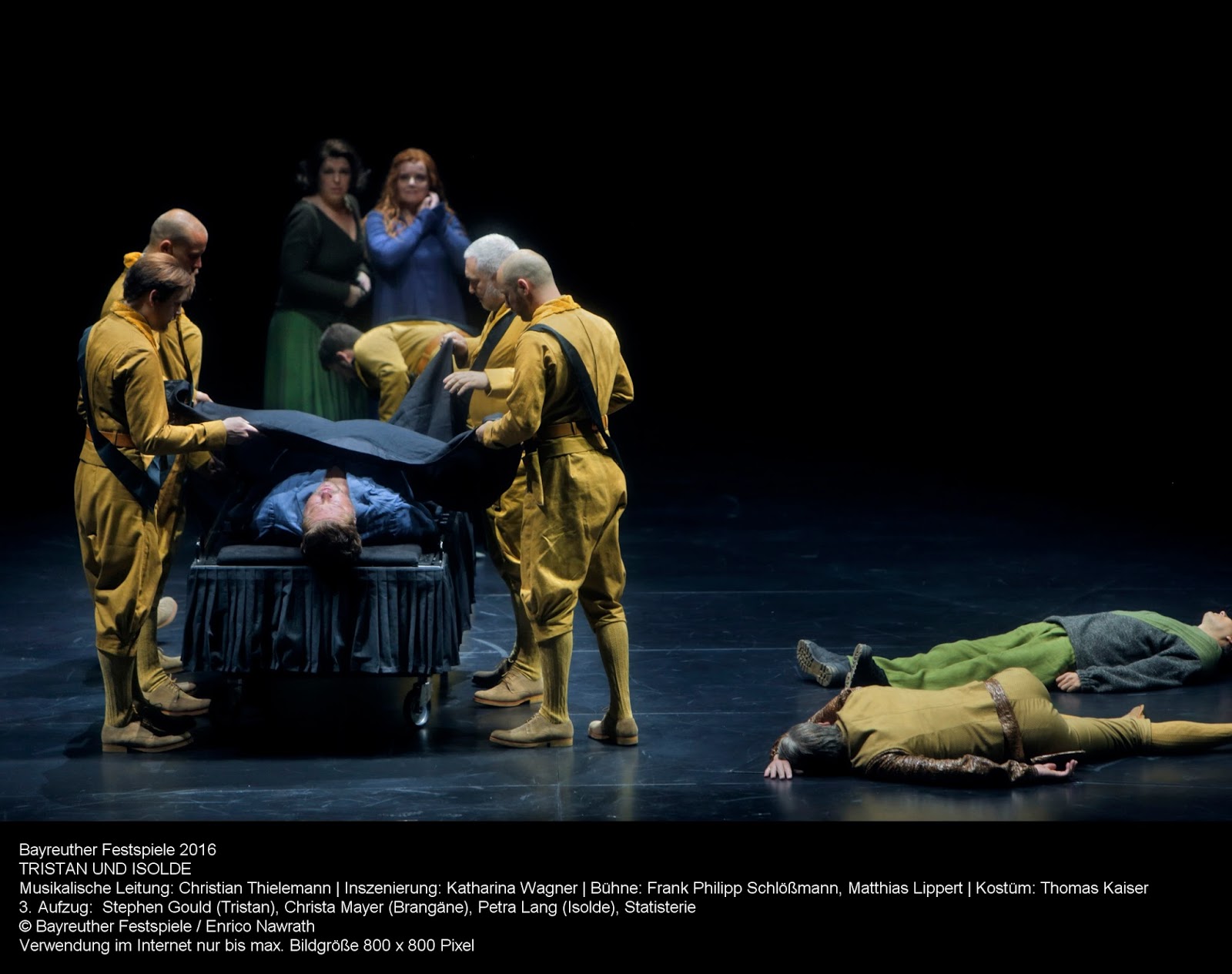
Bayreuth Festival (3) - Tristan und Isolde, 22 August 2016


Bayreuth Festspielhaus

Tristan – Stephen Gould
Isolde – Petra Lang
Kurwenal – Iain Paterson
King Marke - Georg Zeppenfeld
Melot – Raimund Nolte
Brangäne – Christa Mayer
Shepherd – Tansel Akzeybek
Steersman – Kay Stiefermann

Katharina Wagner (director)
Frank Philipp Schlößmann, Matthias Lippert (set designs)
Thomas Kaiser (costumes)
Daniel Weber (dramaturgy)
Reinhard Traub (lighting)

Bayreuth Festival Chorus (chorus master: Eberhard Friedrich)
Bayreuth Festival Orchestra
Christian Thielemann (conductor)


Let me summarise the case for Katharina Wagner’s defence; in this production, that is, rather than more generally. It is certainly better than her Meistersinger, although its problems are not dissimilar in quality. Nothing is downright embarrassing: remember those shoes being thrown all over the place for several minutes, because, well, because Hans Sachs is a cobbler (who nevertheless does not wear shoes himself), or a child-from-the-Stolzing-future requiring a lavatory break during the Quintet? This time, at least, it seems that the characters are doing what they are supposed (by the director) to be doing; there has clearly been progress made in terms of the director’s craft.


There are, moreover, several visually striking aspects to the mise-en-scène, for which designers Frank Philipp Schlößmann and Matthias Lippert certainly deserve credit. In some cases, although not all, they point to engagement with and a welcome critical standpoint with respect to the drama. The first act’s setting in a labyrinth, full of dead ends and other pitfalls, persistently – yet not entirely successfully – preventing the lovers from meeting presents a striking metaphor. That for the second act, in which Tristan and Isolde are constantly under King Marke’s surveillance, cruel, harsh spotlighting directed from above, initially makes its point well, taking on board Wagner’s Day/Night antithesis, and extending it, even questioning it. This is clearly a cruel world indeed; it may be understood politically, psychologically, or in both ways. The darkness of the third act is again visually attractive, and the images in which Isolde appears – I wondered to begin with whether something was being done with the white hands of legend, but then thought not – are again striking, even if their framing stands perhaps a little too close for comfort to Herbert Wernicke’s Covent Garden triangles. Tristan’s interaction with these empty ragdolls of his imagination is sensitively accomplished, although somewhat repetitive after a while. And the revisionist view of King Marke – yes, of course it is at odds with the surface of the text, but is it so very wrong to question, from time to time, its ideological basis and assumptions – is in itself welcome. His dragging Isolde off at the close, transfiguration clearly an idle, Romantic delusion, duly chills.


For the fundamental problem, however, is not so dissimilar to that of the hapless Meistersinger. Whilst there are striking images and ideas – in some instances at least, one presumes, dramaturge, Daniel Weber should at least share the credit for the latter – very little, at least until that striking conclusion, is really done with them; or, in some cases, too much of little import is done with them. I am all for an audience having to do some thinking for itself; a production that fails to accomplish that is unworthy of the name. Nevertheless, it seems to me, that there is a world of difference between, say, Frank Castorf’s Ring (at least so far, in revised fashion, as seen in 2016) and a staging (which may well, of course, undergo significant revision of its own in the future) in which the first act is made up more or less entirely of people running around, platforms being raised and lowered, and, on a couple of occasions, Tristan and Isolde are all over each other. Similarly for the stylised torture-medical (?) paraphernalia of the second act. Melot’s murder of Tristan, entirely without agency on the part of the latter, might have been suggestive; as it was, however, it came across as merely ‘different’ for the sake of it. If it were not for the striking designs – less happily striking in the hideous yellow costumes of Marke and his men – it would not be so very different from the most conventional, ‘traditional’ production. Although the screams of one audience member as I left the theatre – ‘They’ve changed the ending! You can’t change the ending! You can’t change the ending!’ – left me feeling more sympathetic with Katharina Wagner’s production than I might otherwise have done, having upset a person seemingly possessed of no critical abilities whatsoever is not in itself enough.


There is not really very much being said, then, whilst, at the same time, Wagner’s insistence – and I have yet to see it properly contradicted, on stage, in practice – that this is a metaphysical drama, majestically unconcerned with the ephemera of external representation, goes sadly unacknowledged. For, when condensing the action of Tristan und Isolde into a few words for Mathilde Wesendonck, the composer, in full Schopenhauerian flow, did not even mention Marke’s forgiveness (which is perhaps not so very important, then, to undercut). The action, he suggested, as much by omission as by commission, was not really of this phenomenal world at all; even Tristan’s agonies went unmentioned upon the way to ‘redemption: death, dying, destruction, never more to waken!’ (Erlösung: Tod, Sterben, Untergehen, Nichtmehrerwachen!) Now that need not be taken on trust, although this drama seems curiously, almost uniquely, resistant to attempts to question it on stage; the dots, however, need to be joined up a good deal more convincingly than they are here. Ultimately, what we see becomes tedious – and not in a self-critical, ‘let us consider tedium’ manner.


Fortunately, we were on much, much surer ground musically, permitting metaphysics a not insignificant re-entry to the proceedings. Hearing Christian Thielemann, in the finest Wagner I have heard from him for quite some time, made me realise that I had, in fact, been bending over backwards to excuse the shortcomings of Marek Janowski’s handling of the Ring scores (so far). De facto music director Thielemann has, of course, a huge advantage over Janowski: he has been dealing with the peculiarities of the Bayreuth acoustic – and pit! – for many years; indeed, he conducted Die Meistersinger here on my first visit, in 2000. And so, that fabled Bayreuth sound, more or less entirely absent, whether by design or otherwise, from Janowski’s performances, was once again a real presence amongst us. Perhaps I should say a variety of that fabled sound, for Thielemann tends perhaps to a slightly glossier, even more Straussian, sound than, say, that other fabled Bayreuth Straussian Tristan-master, Karl Böhm.


Beneath the surface, though – and what a glorious surface it was, all the more so for Thielemann’s not un-Barenboim-like willingness to let Debussy-tilting woodwind have their say too – there was undoubted rigour. Not only did the orchestra twist and turn, growl and gloat, speak and dissent as his fabled Oper und Drama successor to the chorus of Attic tragedy; it constituted, at least as much as merely representing, the Handlung of Wagner’s designation for the work. It was, I think, a reading of avowedly tonal understanding, such as would have pleased Wagnerian colleagues as distant ideologically from one another as JPE Harper-Scott and Roger Scruton. Schenker would have been proud. In the agonies of the third act, I might prefer something more Schoenbergian, more prepared at least to consider the air of another planet and the way it might criticise the (admittedly) iron-clad tonal structure of the work as a whole. (I think, for instance, of a performance Esa-Pekka Salonen gave with the Philharmonia in 2010.) Not every performance, not even one by Furtwängler, can present all of the potentialities of a Wagner score, though; no one would have been disappointed, or indeed anything other than thrilled, by the work of Thielemann and his orchestra, now back on superlative form.


It is unusual indeed not to find oneself making excuses for a Tristan cast, but there was no need to do so on this occasion. Bayreuth should be in the business of engaging casts to challenge, at the very least, those to be found anywhere else in the world; here it succeeded in doing so. ‘Untiring’ is often, in the Heldentenor world, a part-euphemism for ‘unpleasant, wildly out of tune, but he kept going’; not so in Stephen Gould’s case. Gould was able to put that ability to pace himself to thoroughly musical use, shaping his phrases with care, with dramatic meaning, in most cases equally careful with his words. The clarity of Petra Lang’s diction came and went, but hers was a powerfully dramatic reading, in which the somewhat unusual – for the role – colouring of her voice was relished. Her first-act sarcasm towards Brangäne, flouncingly acted as much as sung, was very different from that of, say, Birgit Nilsson, but made its point. I was less keen on the broken phrasing of the opening of her (non-)Verklärung, but it seemed to be part of a genuine effort to point to words as well as music.


Christa Mayer was as fine a Brangäne as I can recall hearing, wide of dynamic range and colour, unfailing sympathetic (perhaps especially when Isolde did not wish to hear). Iain Paterson seemed more at home with Kurwenal than the Rheingold Wotan, not that there was anything to complain about in his portrayal of the latter. This was a trustworthy, kind, unfailingly human servant and (failed) friend. Georg Zeppenfeld’s Marke proved as distinguished, at least, as his Hunding the previous night, exhibiting many similar musico-dramatic virtues. Zeppenfeld’s delivery of the second-act monologue was in no sense hampered by the director’s unsympathetic view of his character. Quite the contrary; potential difficulty was transformed into meaningful dramatic counterpoint. Tansel Akzeybek, whose Froh I had previously found uncommonly sweetly sung, offered similar pleasures in the twin roles of the Young Sailor and the Shepherd; I hope to hear more from him. Music, then, redeemed the work, or rather the production. Nietzsche’s opus metaphysicum was, more or less, reinstated as such.


Friday, 1 August 2014

Bayreuth Festival (4) - Lohengrin, 31 July 2014


Bayreuth Festspielhaus

King Henry the Fowler – Wilhelm Schwinghammer
Lohengrin – Klaus Florian Vogt
Elsa – Edith Haller
Friedrich von Telramund – Thomas Johannes Mayer
Ortrud – Petra Lang
King’s Herald – Samuel Youn
Brabantian Nobles – Stefan Heibach, Willem van der Heyden, Rainer Zaun, Christian Tschelebiew                                       

Hans Neuenfels (director)
Reinhard von der Thannen (designs)
Franck Evin (lighting)
Björn Verloh (video)
Henry Arnold (dramaturgy)

Bayreuth Festival Chorus (chorus master: Eberhard Friedrich)
Bayreuth Festival Orchestra
Andris Nelsons (conductor)


What a relief amidst the debris of the Castorf Ring! Hans Neuenfels’s Lohengrin is now widely acclaimed as a classic staging: not, of course, the only way to do it, for there is no single way, but a consistent, brilliantly-executed production, whose run has now been extended for another year. (Sebastian Baumgartner’s Tannhäuser is, by contrast, saying farewell a year earlier than originally envisaged; I cannot imagine why…) Having given accounts of the staging in 2011 and 2012, I do not have a great amount to add to description of what happens, but shall add a few remarks concerning particular aspects that struck me. There was perhaps a sense – born of a first-night performance? – of slight comparative slackness, especially in the first act, but that is really to quibble excessively; certainly the third act was at least as gripping as before, partly because Andris Nelsons’s focus had greatly improved by that stage too. (Again, that is comparative; it was in no way bad beforehand.)


The concept at the heart of the production is a mysterious experiment. (Are not all experiments in a sense mysterious, whatever the claims to the contrary?) During the first act Prelude – though not immediately: Neuenfels permits the music to speak first – Lohengrin seems to be trying to gain entrance to wherever it is that the action is taking place. That initial failure signals that whoever is running the show, it is not Lohengrin; indeed, judged by his record over the evening – and this is Wagner’s doing as much as it is Neuenfels’s – he is a singularly unsuccessful hero, very much in line with most of Wagner’s heroes, Parsifal and Walther excepted. Nor is anyone else we see in charge, least of all the flawed, Fisher-King-like Henry the Fowler, his stooping reminiscent of many an Amfortas. The rats are certainly not free agents, though there are instances of what might just be such free agency, just as there are with Ortud and Telramund, arguably at least as much so as with Lohengrin and Elsa. They are moments, though, and the inevitable victory comes, be it on the part of Fate or a higher earthly power.  It is, of course, to speculate concerning who – if anyone – is running the experiment, but we seem invited to do so, if only to realise the futility of the attempt. Much like late capitalism and its scientific handmaidens more generally, one might say. At any rate, the tragedy is clear, as is our voyeuristic status as observers. A leader at the end has been born or created, but his embryonic status tells the true story, or at least part of it. ‘Reality’ will prevail, which is to say a mystified claim upon scientism’s part will prevail. ‘Objectivity’ is deconstructed, as of course it has been many times before, but when will the powers that be listen?


Nelsons’s leadership grew in stature as the evening progressed. I suspect that it will do so still further as the festival continues. Flexibility and line were rarely in competition, but generally revealed to be two sides of the same coin, just as they should be. If there were a few moments when the score did seem to meander a little, even when the orchestra sounded slightly subdued, they were readily forgotten in a blaze of orchestral glory for the third act. Daniel Barenboim, amongst present conductors, may find greater metaphysical depth, broader terms of reference, in the score, but few others will. Eberhard Friedrich’s chorus gave a superlative performance: one could have taken verbal as well as musical dictation. And that, let us remember, was at the same time as having to perform highly intricate individual stage manoeuvres, often whilst dressed in rat costumes. There remains no greater opera chorus on earth.
 

Klaus Florian Vogt likewise retains his standing – at least for many of us – as the world’s premier ranking Lohengrin. The nay-sayers will not be convinced; they do not care for his tenor, light but extraordinarily powerful, and they are perfectly within their rights not to do so. The unearthly quality of his voice seems just right to me, its purity as chilling as it is alluring. Again, it is not, of course, the only way, but it is a uniquely compelling way. He looks and acts the part too. Edith Haller replaced Annette Dasch. She had a few uncertain moments, not least concerning intonation in the first act, but her performance grew in conviction, peaking like that of many others in the final act. Thomas Johannes Mayer offered an outstanding Telramund, his perfect marriage of poem and musical line having one wish he were singing Wotan. (But then he might be wasted in the Castorf Ring.) Petra Lang was likewise a truly world-class Ortrud; I can only think of Waltraud Meier in the same breath. Her stage malevolence and vocal magnificence were truly as one. Wilhelm Schwinghammer’s subtle portrayal of King Henry made him a far more interesting character than one often hears: partly Neuenfels’s doing, no doubt, but also the consequence of a thoughtful approach to musical dramatisation on stage, in which weakness and power (both relative) found themselves in fruitful contradiction. Samuel Youn had one notable slip with tuning, but otherwise made for a characterful Herald. Above all, the characters increasingly worked together – and with the chorus and orchestra. A wonderful, much-needed tonic, however disturbing!


Saturday, 8 December 2012

ORF SO/Metzmacher - Schreker, Mahler, Berg, and Pfitzner, 7 December 2012

Großer Musikvereinsaal, Vienna

Schreker – Vorspiel zu einem Drama
Mahler – Rückert-Lieder
Berg – Three Orchestral Pieces, op.6
Pfitzner – Palestrina: Three Preludes

Petra Lang (mezzo-soprano)
ORF Vienna Radio Symphony Orchestra
Ingo Metzmacher (conductor)

I struggle to recall the last time I heard a piece by Franz Schreker in a concert programme. It is a great pity, since, whilst he might not be a ‘great’ composer, he is often a very good one, and certainly superior to many composers who occupy concert, still more opera, programmes. This performance of his Vorspiel zu einem Drama, an expansion of the opening Prelude to Die Gezeichneten, opened with what one might consider a classic Schreker sound from the ORF SO under Ingo Metzmacher: lush yet variegated, with a finely-judged phantasmagorical quality. Not that it lacked direction; indeed, the onward tread, especially later on, of its progress was a particular quality of this reading. Unsurprisingly Metmzacher sometimes emphasised the more overtly modernistic qualities of Schreker’s writing, for instance for tuned percussion, but never didactically. Performance and work veered between post-Gurrelieder, post-Tristan, post-Salome writing, with a proper sense of nausea at the end. Having walked to the gilded Musikverein from the Belvedere, where I had seen a good number of works by Gustav Klimt, this seemed, as it was, properly golden late-late-Romanticism. If Metzmacher did not wallow unduly, the music remained something of a guilty pleasure.

 
Mahler’s Rückert-Lieder followed, albeit in unusual order. ‘Ich atmet’ einen linden Duft’ offered an immediately sparer sound: contrast with, perhaps even respite from, what had preceded. Petra Lang’s voice was not always ideally focused, although matters improved somewhat during the following ‘Liebst du um Schönheit’. Her delivery, however, continued to tend towards the operatic; one had to listen to the orchestra for a more detailed response. Turbulence aplenty came from that quarter in ‘Blicke mir nicht in die Lieder!’ Nastiness and fear – is this child’s play, or something more, and in any case is not child’s play something fearful? – pervaded Mahler’s orchestral writing, Lang’s performance more animated too. She certainly delivered gravity, a Nietzschean ‘deepness’, in the opening of ‘Um Mitternacht’, though later on became more operatic again. There was, however, a finely etched orchestral performance, the woodwind echoes of the Nietzsche movement of the Third Symphony especially apparent. ‘Ich bin der Welt abhanden gekommen’ brought Lang’s finest performance, unfortunately disrupted by a mobile telephone. Blowsiness was banished; lines were clearer. I still, however, could only make out about half of the words; that I knew them already should neither have been here nor there.

 
Berg’s Three Orchestral Pieces received a mixed performance. There was much to admire, for instance the truly inchoate opening, out of which germinated all manner of things Mahlerian and post-Mahlerian, though the harmonies could only ever have been Berg’s. Metzmacher’s was not a chilly performance, not even a Boulez-like performance; Romantic contrasts were more his thing than clarity. Sometimes that was problematical, when balances proved less than ideal. However, as time went one, communication of the hierarchy of voices – an extraordinarily difficult task to accomplish in performance – improved, the odd occluded and/or tentative entry notwithstanding. When waltz and march rhythms really got into their stride, the musical narrative was compelling indeed – and there was something undeniably moving to hearing this music in the Musikverein. A stray trumpet note after the final chord was a pity, but did not obliterate memories of the twentieth-century terror we had previously experienced.

 
Berg metamorphosed without a break into Pfitzner. The idea was to present two different past visions of musical futures. Of course, though, we knew whose vision won out, and in this case juxtaposition served principally to underline the justice of the musico-historical verdict. Pfitzner’s unpleasant nationalism aside, his æsthetics led nowhere, and even in the Preludes from what many consider his finest work, Palestrina, the invention sounded a little threadbare in response to the Bergian labyrinth. Metzmacher and the ORF SO certainly did what they could to level the score, their performances more consistent than they had been in Berg; whether this were the case or no, Pfitzner sounded more thoroughly rehearsed. The first prelude was dignified and direct, rhythms taut. Though great contrast was afforded by the performance of the second, I could not help but think that a less hard-driven account might have been to its benefit. Debts to Parsifal are so obvious in the third prelude, less productively (Debussy, Mahler) than just watered-down, that there is not much to be done other than to perform the music with as much conviction as one can muster. Metzmacher certainly did that. However, as I said, we knew only too well whose vision of the future won out, and were grateful for it.

Tuesday, 28 February 2012

Rusalka, Royal Opera, 27 February 2012

Royal Opera House, Covent Garden

Nymphs and Rusalka (Camilla Nylund)
Images: Royal Opera/Clive Barda

Rusalka – Camilla Nylund
Foreign Princess – Petra Lang
Prince – Bryan Hymel
Ježibaba – Agnes Zwierko
Vodník – Alan Held
Huntsman – Daniel Grice
Gamekeeper – Gyula Orendt
Kitchen Boy – Ilse Eerens
Wood Nymphs – Anna Devin, Justina Gringyte, Madeleine Pierard
Mourek – Claire Talbot

Jossi Wieler, Sergio Morabito (directors)
Samantha Seymour (revival director)
Barbara Ehnes (set designs)
Anja Rabes (costumes)
Olaf Freese (lighting)
Chris Kondek (video designs)
Altea Garrido (choreography)

Royal Opera Chorus (chorus master: Renato Balsadonna)
Orchestra of the Royal Opera House
Yannick Nézet-Seguin (conductor)


It is a truth universally acknowledged that an interesting opera production will be met with incomprehension and lazy, philistine hostility by vast swathes of the audience in many, perhaps most, of the world’s ‘major’ houses, a truth that renders one all the more grateful for the Royal Opera showing the courage to stage this new – to London – production of Rusalka. That is not to say that any production meeting with hostility qualifies as interesting; some, of course, are simply not very good, or worse. Yet, it seems that only the most vapid, unchallenging – and yes, I realise that the word ‘challenging’ is a red rag to self-appointed ‘traditionalist’ bulls – of productions will garner approval from the ranks of the petite bourgeoisie. The boorish behaviour of those who booed this Rusalka equates more or less precisely to the sort of antics they would condemn if they occurred on the street – the work of ‘hoodlums’, the ‘lower classes’, the ‘uneducated’, ‘rioters’, ‘immigrants’, et al. – yet somehow unwillingness or inability to think, the fascistic refusal to consider an alternative point of view, the threat of mob violence, becomes perfectly acceptable when one has paid the asking price for what they consider to be their rightful ‘entertainment’. They would no more bother to understand, to explore, to question, Rusalka were it depicted in the most ’traditional’ of fashions, of course, but they explode at the mere suggestion that a work and a performance might ask something of them. For, as John Stuart Mill famously noted, ‘Although it is not true that all conservatives are stupid people, it is true that most stupid people are conservative.’ Wagner’s ‘emotionalisation of the intellect’ – ‘emotionalisation’, not abdication! – remains as foreign a country to them as it did to the Jockey Club thugs who prevented Tannhäuser from being performed in Paris; at least one might claim that the latter were having to deal with challenging ‘new music’, Zukunftsmuik, even. Here they were faced with an opera by Dvořák, first performed in 1901, in a staging that would barely raise an eyebrow in most German house or festivals. (The production, by Jossi Wieler and Sergio Morabito, hails initially from the Salzburg Festival.) It would be interesting to know how many of those booing had selfishly, uncomprehendingly disrupted a recent Marriage of Figaro in the same house by erupting into laughter at the very moment Count Almaviva sought forgiveness from the Countess. (There was also, bizarrely, to be heard at the opening of the third act a shouted call from a member of the audience for a ‘free’ Quebec.)


Rusalka, Prince (Bryan Hymel), and Foreign Princess (Petra Lang)

What, then, was it that incurred the wrath of the Tunbridge Wells beau monde? I can only assume that it was for the most part Barbara Ehnes’s sets, since the stage direction (presumably a good part of it from revival director, Samantha Seymour) was more often that not quite in harmony with the urgings and suggestions of Dvořák’s score. (The hostile rarely if ever listen to the music; at best, they follow the surtitles and bridle at deviations from what they imagine the stage directions might have been.) Even modern dress is mixed with a sense of the magical, the environment of Ježibaba the witch a case in point. There is even a cat, played both in giant form by Claire Talbot, and in real form, by – a cat, ‘Girlie’. What is real, and what is not? Collision between spirit and human worlds is compellingly brought to life, the devils and demons of a heathen past, including Slavonic river spirits (rusalki) come to tempt, to question, to lay bare the delusions of moralistic, bigoted modernity. Just as modern ‘love’ and marriage’ quickly boil down to money and power, so Vodník the water goblin finds his tawdry place of temptation whilst issuing his moralistic warnings. (Did the audience see itself reflected in the mirror? Perhaps, though I doubt that it even bothered to think that far.) Our ideas of Nature having been hopelessly compromised by what we have become, we ‘naturally’ see the world of rusalki from within the comforts of our hypocritical bordello. Who is exploiting whom, and who is ‘impure’? The souls of women who have committed suicide and of stillborn children – there are various accounts of who the rusalki actually are – or those who shun them in life and in death? Wieler and Morabito do not offer agitprop; rather they allow us to ask these questions of the work, and of ourselves. But equally importantly, they permit a sense of wonder to suffuse what remains very much a fairy tale, realism coexisting with, being corrected by, something older, more mysterious, more dangerous, and perhaps ultimately liberating. Chris Kondek’s video designs, not unlike the hydroelectric dam of Patrice Chéreau’s ‘Centenary’ Ring, both suggest Nature and through their necessary technological apparatus remind us of our distance from any supposed ‘Golden Age’, just as the opening scene will inevitably suggest to us Alberich, the Rhinemaidens, and the power of the erotic. (Wagner used the term liebesgelüste.)

Musical performances were equally strong, in many respects signalling a triumph for Covent Garden. First and foremost should be mentioned Yannick Nézet-Séguin, making his Royal Opera debut. The orchestra played for him as if for an old friend, offering a luscious, long-breathed Romanticism that made it sound a match – as, on its best days, it is – for any orchestra in the world. Magic was certainly to be heard: the sound of Dvořák’s harps again took me back to Das Rheingold – and to Bernard Haitink’s tenure at the house. Ominous fate was brought into being with similar conviction and communicative skill. Above all, Nézet-Séguin conveyed both a necessary sense of direction and a love for the score’s particular glories. If there are times when Dvořák might benefit from a little more, at least, of Janáček’s extraordinary dramatic concision, it would take a harder heart than mine to eschew the luxuriance on offer both in score and performance. Crucially, staging and performance interacted so that the contrast between worlds on stage intensified that in the pit, and vice versa.

Ježibaba (Agnes Zwierko)
and her cat, Mourek (Claire Talbot)
Camilla Nylund shone in the title role. At times, especially during the first act, one might have wondered whether her voice would prove to have the necessary heft, but it did, and Nylund proved herself an accomplished actress into the bargain. Bryan Hymel may not be the most exciting of singers; the voice is not especially variegated. However, he proved dependable, and often a great deal more, the final duet as moving as one could reasonably expect. Alan Held was everything a Vodník should be: baleful, threatening, sincere, and yet perhaps not quite. The Spirit of the Lake may well have his own agenda – and certainly did here. Agnes Zwierko played the witch Ježibaba with wit, menace, and a fine sense of hypocrisy that brought the closed environments of Janáček’s dramas to mind. The four Jette Parker Young Artists participating, nymphs Anna Devin, Madeleine Perard, and Justina Gringyte, and Huntsman Daniel Grice all acquitted themselves with glowing colours. Indeed, Grice’s solo, enveloped by miraculous Freischütz-like horns from the orchestra, movingly evoked a world of lost or never-existent woodland innocence. Last but not least, Petra Lang’s Foreign Princess emerged, like Wagner’s Ortrud, as in some respects the most truthful, as well as the most devious, character of all. Splendidly sung and acted, Lang’s was a performance truly to savour. But then, this was a performance as a whole that was far more than the sum of its parts, a triumphant return to form for Covent Garden with its first ever staging of the work.

Thursday, 4 August 2011

Bayreuth Festival (3) - Lohengrin, 2 August 2011

Festspielhaus, Bayreuth

King Henry the Fowler – Georg Zeppenfeld
Lohengrin – Klaus Florian Vogt
Elsa – Astrid Weber
Friedrich von Telramund – Tómas Tómasson
Ortrud – Petra Lang
King’s Herald – Samuel Youn
Brabantian Nobles – Stefan Heibach, Willem van der Heyden, Rainer Zaun, Christian Tschelebiew

Hans Neuenfels (director)
Reinhard von der Thannen (designs)
Franck Evin (lighting)
Björn Verloh (video)
Henry Arnold (dramaturgy)
Susanne Øglænd (conceptual collaboration)

Bayreuth Festival Chorus (chorus master: Eberhard Friedrich)
Bayreuth Festival Orchestra
Andris Nelsons (conductor)


Lohengrin trying to break into the experiment
It was a relief, following Sebastian Baumgarten’s messy, incoherent Tannhäuser, to proceed to a production by Hans Neuenfels. I am not sure that I especially liked it, nor that it engaged as closely as it should have done with some aspects of Richard Wagner’s Lohengrin, but it is anything but a mess and, unlike far too many examples of so-called Regietheater, there did seem to be evidence that Neuenfels had engaged with the music too, sensitive shifts reflecting on occasion the contours of the score. (I for one have never understood why so many directors who do not read or at least have a good ear for music are so willing to work in the opera house. It can work, of course, but it seems as problematical as a non-Russian speaker directing Chekhov in Russian.)

Neuenfels’s production, now in its second year on the Green Hill, presents an experiment. So far, so like the Tannhäuser, one might say. But, for one thing, it is reasonably clear what is going on: this is a laboratory experiment, and those experimented upon are rats – or at least, they often are, for there are times when they shed much of their rat-like appearance and resemble humans. The feet always give them away though. Lohengrin is shown during the Prelude – which opens without stage action, but eventually acquires some – trying to break into the realm of experimentation. One notices straight away the stylish nature of Reinhard von der Thannen’s designs – and one continues to notice the aplomb with which scene changes and the like are accomplished, for which unstinting praise should be voiced for those oft-unsung heroes of the opera house, the stagehands, operators of machinery, and so on. The experiment, naturally, is political in nature – though this is never hammered home. However, the darker side of Lohengrin, the nature of its charismatic hero and the way a crowd will follow him, is surely the stuff of the conflict. (That may leave us asking: are Ortrud and Telramund right to resist?) It was a pity, therefore, that we did not hear the word Führer when Lohengrin introduced Gottfried (‘Seht da den Herzog von Brabant! Zum Führer sei er euch ernannt!’) I can testify to the chilling impression it made in Peter Konwitschny’s Leipzig production. But then, the presentation of Gottfried as an embryo, casting off his umbilical cord, rather gets in the way. (Is this an attempt to show that one is not born a leader? Perhaps, but I felt that it complicated in an unhelpful manner.)

It is a Lohengrin one does not easily forget, though: numbered laboratory rats provide an image that lodges itself in one’s mind, and makes one think, which is just what good musical drama should do. It is also clear that Elsa does not really desire Lohengrin: she is grateful, desperate even, but the lack of eroticism is probably correct and certainly thought-provoking. One thing, however, I did not understand was why Telramund, when stealing into the bridal chamber and consequently being felled by Lohengrin, had become a rat. He did not seem to have been so before. And the question remains: who is actually running the experiment? Who is on the outside? It is, in a sense, a variation upon a perennial problem of political philosophy, never more so than in Rousseau: who is the Legislator? It seems too easy to say that it is simply the audience and yet it was not clear to me from the production what the answer might be; perhaps there were clues that I missed. In that respect, I should probably mention the strange, sickly, Amfortas-like figure of King Henry. He is clearly not in charge, whoever is.

The orchestra was on fine form indeed, its strings silky and aspiring upwards in the First Act Prelude. (There was actually a minor slip here, but that merely served to highlight the excellence elsewhere.) Andris Nelsons fashioned an account of the score that was largely unobtrusive. There were occasions when his growing mannerism of slowing things down excessively and thereafter speeding up as if to compensate – almost like a giant-scale conception of rubato – manifested itself, but for the most part he proved himself a faithful guide. It may not have sounded like ‘great’ Wagner, but it was certainly good Wagner. The choral singing probably did qualify as ‘great’. I fear that I may become unduly repetitive extolling the excellence of Eberhard Friedrich’s chorus, but the extolling really needs to be done. And to think, all the time, the chorus members had to act their roles as individual rats too.

Astrid Weber was a late replacement for Annette Dasch’s Elsa. In the circumstances, one should not be unduly harsh, and it is true that she improved as she went on. However, much of her first-act singing was wobbly and unfocused. It was difficult, moreover, to distinguish more than a few of the words she sang (an especial problem, given Bayreuth’s lack of titles). Petra Lang, by contrast, was a magnificent Ortrud. Had I not heard – and equally importantly, seen – Waltraud Meier in the role, I should have been even more awestruck. As it was, she built up to a terrifying, blood-curdling climax at the tragic close, which even rivalled Meier. Tómas Tómasson and Samuel Youn were adequate as Telramund and the Herald, though far from memorable. Georg Zeppenfeld, however, showed us an intriguing Henry the Fowler, powerful in his suggestion of diseased decadence: quite different from the norm, but compellingly so. Two of the nobles, Rainer Zaun and Stefan Heibach, I had heard earlier in the day in the Ring für Kinder. I was delighted to see such talented artists performing in the ‘main house’ too.

That leaves the staggering Lohengrin of Klaus Florian Vogt, every bit as impressive as when I saw him in Berlin, in Stefan Herheim’s outstanding production. The beauty of his voice is one thing, the purity another, the strength and clarity still further signal qualities, but here, in this role in particular, one truly senses something unheimlich, other-worldly. It delights, coldly seduces in its (apparent) honesty, and yet it chills – which fits superlatively both with work and production. When shall we hear Vogt in a major Wagner role in London? Yesterday would be too late.

Wednesday, 16 December 2009

Staatskapelle Berlin/Gielen - Mahler and Bruckner, 14 December 2009

Konzerthaus, Berlin

Mahler – Des Knaben Wunderhorn
Bruckner – Symphony no.1 in C minor (Vienna version, 1890-91)

Petra Lang (mezzo-soprano)
Hanno Müller-Brachmann (baritone)
Staatskapelle Berlin
Michael Gielen (conductor)

A concert of two halves indeed – not so much in terms of the performances in themselves, but the works. I tried, I really tried, with Bruckner’s First Symphony. Unfortunately, the high standard of the performance only served to highlight what for me remained the grave shortcomings of the work itself. The first movement opened promisingly, Michael Gielen ensuring a gripping urgency to the response of the Staatskapelle Berlin. One of my very few reservations was a surprisingly lean sound to the strings, but after the exposition, this ceased to be a problem. I also wondered whether Gielen drove the music a bit hard, but then I should hardly have wished him to linger. The Tannhäuser-ish brass were truly resplendent, whilst the woodwind sounded delectable. And the structure was clear: perhaps too clear? The slow movement seemed to me the most successful. Once again, there was a Wagnerian grandeur to the Berlin brass. Moreover, a subtlety to the audible motivic working out in the strings put me in mind, much to my surprise, of Elgar. A magnificent bassoon solo should be credited. And there was no leanness of which to complain in the gleaming climactic gold, Viennese in quality, of the strings. Gielen ensured a furious scherzo, colourful too. If he could not quite paper over the cracks, then I am not sure anyone could. Once again, the brass, Freischütz-like horns, awesome trombones, and all, sounded magnificent, whilst the woodwind was full of woodland colour. The trio was nicely done, but I could make neither head nor tail of where it was going – largely, I fear, because Bruckner is unable to make it go anywhere at all. Then came the tumultuous finale – but to what end the tumult? Some marvellously sonorous playing from the lower strings could be savoured. I eventually gave up trying to discern a compositional thread so as simply to enjoy the Staatskapelle’s beautiful playing – and just about endured the movement’s apparently inordinate length.

The first half was devoted to Mahler’s Wunderhorn songs, split between Petra Lang and Hanno Müller-Brachmann. These were simply outstanding. If Müller-Brachmann seemed perhaps slightly to have the edge, that is probably partly at least a result of the nature of his songs. In any case, it is not a competition. Gielen and the Staatskapelle Berlin were equally crucial partners, for whose contribution I can find nothing but praise. Der Schildwache Nachtlied opened with a splendid military tread, setting the parameters not only for the song but for so much of the collection. And a new orchestral world, so crucial to much of the rest, was audibly glimpsed on and after ‘Muss traurige sein!’ Gielen showed, just in case anyone might have doubted, that impeccable modernist credentials entail no loss of Schwung when it came to Verlorne Müh’! Lang’s winsome cheek was spot on, likewise the loving (mock?) sternness of Müller-Brachmann’s response. One could almost have been at Der Rosenkavalier, albeit with something more cutting and harrowing in the orchestral ‘commentary’. Rhythms were, crucially, knowingly pointed in the following Wer hat dies Liedlein erdacht? Lang’s melismata were impeccably – and once again, knowingly – delivered, whilst the solo clarinettist simply had to be heard to be believed.

The after-life of Des Antonius von Padua Fischpredigt is worthy of an essay in itself, Second Symphony, Berio and all. Certainly the sinister tone of the orchestra ensured that the latter’s Sinfonia was all but straining to be heard. Once again, absolute rhythmic security was guaranteed by the conductor, whilst Müller-Brachmann was every inch the preacher in his delivery. Lang proved desperate but in no sense caricatured in Das irdische Leben, the orchestral contribution as urgent as I have ever heard. This was as terrifying – and as real – as a nightmare, or, perhaps better, a fairy tale. Gielen’s rubato in the following Rheinlegendchen was supremely idiomatic. Müller-Brachmann was as winning a guide as one could possibly conceive – and then some. The beauty and meaning of his phrasing were simply beyond reproach. That he followed up with superlative comic ability in Lob des hohen Verstands, ‘high intellect’ lovingly mocked both by him and by the orchestral soloists. Gielen took Der Tamboursg’sell at a daringly slow tempo, which truly paid off. It was as ominous in its opening sadness and dignity as anything in Wozzeck, and so it continued. The ebbing away on ‘Gute Nacht’ was heart-stopping.

Urlicht was taken attacca, the oboe solo contribution almost unbearably beautiful. Tightness of rhythm from the outset, not least from the drums, proved a spur to invention in Revelge. Müller-Brachmann drew upon seemingly inexhaustible vocal reserves, whilst orchestral precision proved chilling in the very best sense. ‘Chilling’ was also the quality one should ascribe to Wo die schönen Trompeten blasen; indeed, this song chilled to the bone. So then, a magnificent Mahler performance: if only it could have been followed by more Mahler...