Monday, 16 July 2012

Stephen Kovacevich - Beethoven and Schubert, 16 July 2012

Wigmore Hall

Beethoven – Piano Sonata no.5 in C minor, op.10 no.1
Beethoven – Piano Sonata no.31 in A-flat major, op.110
Schubert – Piano Sonata in B-flat major, D 960


Sad to say, this must rank as one of the most disappointing piano recitals I have heard in quite some time. Whether Stephen Kovacevich’s pianism has deteriorated, or whether the recording studio has worked wonders, it is difficult for me to say, this being the first time I have heard him give a full recital, but there were but a few glimmers of something less than dispiriting here.

The Beethoven C minor sonata, op.10 no.1, opened brusquely, more Presto than Molto allegro e con brio. There was no let up for the second subject either. More worryingly, a good amount of passagework was blurred. Though there was a sort of defiance to the performance that might just about be called Beethovenian, humour, let alone charm, were notable only by their absence. This was Beethoven alla Toscanini, albeit without the technical control. The opening of the slow movement was refreshing, indeed quite beautifully voiced. Phrasing soon stiffened, however, suffocating the music. A greater line was absent, not through the more frequently-encountered pianistic habit of pulling the music around to no greater end, but through a literalness so dogged that it apparently prevented Kovacevich from joining the dots. Harmonic jolts registered with force, it must be admitted, and some phrases were lifted up from utter mundanity: a frustrating, tantalising sign of what might have been. The finale benefited from a return of the first movement’s insistence, but that all too readily tipped over into brutalisation. Technical insecurities were, however, more disturbing, some passagework again fluffed or skated over.
There was promise to the opening bars of op.110, beguiling in their apparent simplicity. Yet Kovacevich again tended to skate over some of the faster passages. For the most part, the music meandered along nicely enough, sometimes vehemently, but to say that that is not enough for Beethoven would register as the understatement of the year. The scherzo veered, sadly, between the disjunct and the straightforwardly incoherent. Beethoven’s Klagender Gesang, if hardly intense or otherwise moving, at least did not fall too short technically. The first appearance of the fugue was better still, voiced and directed meaningfully and sounding for the most part as if it were actually piano music. The return of the slow material, however, was oddly halting, and the fugue in its second incarnation was reduced to muddy incoherence. Thank goodness I was not having to take dictation, for I should have failed miserably to discern vast swathes of the notes.

That said, there was hope, following the interval. The first movement of Schubert's final sonata opened with considerable sensitivity, not least to inner voices, though ‘sensitive’ is certainly not the word I should use to describe the weird combination of ultra-abrupt, even brutal, curtailment of the left-hand quaver in bar 9 whilst permitting the right hand’s chord to continue to resonate almost indefinitely. The same thing happened in the recapitulation – there was no exposition repeat – so it was definitely intended, but to my ears at least it sounded very odd indeed. There remained many instances of touch hardening and of undue brusqueness, but at least there was to be gleaned greater Beethovenian purpose to the development section than there had been to any of Beethoven’s own developments. If Schubert’s music did not move me once – a disturbing thing to say about this work – the performance nevertheless gave a sense of a greater whole. The slow movement was certainly not sentimentalised; it was faster than I can ever recall hearing, or at least so it sounded. Again, in context, that was something of a relief, though no depths were plumbed. As for the scherzo, it was so rushed as to be garbled, denying any real impression of what the music might be, let alone mean. It was faultlessly metronomic, if that is your thing, but the trio lurched around as if the metronome were malfunctioning. Kovacevich’s tempo for the finale was more reasonable, and potentially manageable, but his performance was so heavy-handed beyond belief. The rondo theme was bereft of light and shade, and so it went on and on, dogged by quite the wrong sort of grim insistence.

Oliemans/Martineau - Mahler, Strauss, Duparc, and Debussy, 11 July 2012

Wigmore Hall

Mahler – Frühlingsmorgen
Hans und Grethe
Erinnerung
Scheiden und Meiden
Strauss – Traum durch die Dämmerung
Nachtgang
Befreit
Duparc – Chanson triste
L’Invitation au voyage
Extase
Le Galop
Debussy – Trois ballades de Villon
Mahler – Rückert-Lieder


This was my first encounter with baritone Thomas Oliemans, though certainly not with the indefatigable Malcolm Martineau.  Oliemans already has an impressive C.V., including Salzburg Festival debut in 2005 (Gonsalvo Fieschi in Die Gezeichneten) and recent debuts at Covent Garden, Strasbourg, and for Scottish Opera. He is clearly also an impressive recitalist, as this performance made clear.

In a wonderfully constructed programme, Mahler appeared as alpha and omega, the first set comprising songs from his twenties. Frühlingsmorgen immediately displayed a ready communicative gift that went beyond the excellent German one tends to expect from Dutch singers. Working with the language, getting beneath the skin of the song, is more important still. Martineau’s handling of the intricacies of the piano part was equally impressive. Erinnerung showed an intensity and darkness of the soul not hitherto experienced: a matter of the songs’ nature than the performances, Oliemans shading his response intelligently and movingly. Intimations of Kindertotenlieder surfaced in Schieden und Meiden, a Wunderhorn song, the hushed stillness of a child’s passing a telling contrast – at least apparently, and that ambiguity registered powerfully.

Differences between Mahler and Strauss were subtly rendered apparent rather than emphasised, which is just as it should be. Strauss’s different manner of sophistication – no naïveté here, secondary or otherwise – was combined with a more evident, or perhaps ‘traditional’, lyricism, though both composers are surely two of the highest ranking princes of Lieder. Raptness in performance of Traum durch die Dämmerung was so finely achieved in part because the song was so clearly conceived as a whole, with a true sense of slowly pursuing the dusk (Dämmerung) of the title. Being drawn into ‘ein blaues, mildes Licht’ at the end was accomplished with a near-heavenly vocal pianissimo. Nachtgang likewise showed a proper sense of a formal and emotional whole, even to the extent that, as ever when faced with religion or even the metaphysical, Strauss tends towards a materialistic emptiness, as in the likeness here to saint, ‘mild, mild und grsoss, rein wie die liebe Sonne’. Befreit did not initially soar quite as would be ideal with Strauss – it is arguably easier for sopranos to do so in any case – but the second stanza rectified matters.

The Duparc set showed Oliemans to have an equally impressive sense of French pronunciation and style. (What a glaring contrast with some of the singers in Covent Garden’s Les Troyens!) Chanson triste quite rightly benefited from a Wagnerian tinge to its lyricism: there are many more routes from Wagner than those to Mahler and Strauss, Tristan here intriguingly, deliciously apparent. Likewise, of course, the Baudelaire setting, L’Invitation au voyage, its music most definitely ‘luxe, calme, et volupté,’ from both artists concerned. The setting of the sun was ecstatic, but musically so, rather than a forced imposition upon the text; Liszt too came to mind. Tristan again reared its head in Extase, not least through Martineau’s handling of Duparc’s harmonic progressions. A slight Gallic distancing was nevertheless maintained. The ghosts of Liszt and Schubert (Erlkönig in both cases) haunted yet never overwhelmed Le Galop and its transportation, not merely physical, into ‘l’inconnu profond’.

Debussy’s Trois ballades de François Villon opened the second half. Perhaps Oliemans’s rolled ‘r’ was more Dutch in quality than French; otherwise, the performance continued to be stylistically impeccable. (Again, I could not help but draw a contrast with some of the Italianate horrors experienced on the Royal Opera’s stage recently.) Martineau showed himself fully equal to the exigencies of Debussy’s piano writing. A Pelléas-like, ‘parlant’ style, with added mediævalism, was the hallmark of the ‘Ballade que Villon feit a la request de sa mere pour prier Nostre-Dame’. That quality, which so readily degenerated in the hands of lesser successors, was in Debussy’s hands properly magical, heightened by touching, yet sparing use of the head-voice. Quiet ecstasy – ‘La joye avoir fais-noy haulte Déesse’ – was to be heard in the conclusion. The ‘Ballade des femmes de Paris’ was nicely dry, in more than one sense. Oliemans even summoned up an authentically French shrug during the catalogue of place names: ‘Ay-je beaucoup de lieux compris?’

Mahler returned with his Rückert-Lieder. ‘Liebst du um Schönheit’ had touching inwardness, though its more outward protestations fared less well, proving less ecstatic than would be ideal. ‘Blicke mir nicht in die Lieder’ was another example of fine navigation to a tricky piano part. ‘Um Mitternacht’: it is almost impossible to say something about the song that does not sound irredeeembaly clichéd, but its desolate stillness was movingly conveyed. Again, its more external protestations were somewhat less happy, intonation an occasional problem, at least until a truly resplendent final stanza, but the Innigkeit was spot on throughout. ‘Ich atmet’ einen linden Duft’ requires absolute command of the piano line; that it received, spun as if ok silken thread, which in a way it is.  Inwardness was very much the hallmark also of ‘Ich bin der Welt abhanden gekommen’, though an occasional tendency towards crooning should be resisted.

Morgen, an encore I had hoped for, returned us to Strauss, after which came an initially vehement and then lightly stylish Wolf Abschied, by turns Wagnerian and (Johann) Straussian. We may just have a future Amfortas here.


Monday, 9 July 2012

Les Troyens, Royal Opera, 8 July 2012

Royal Opera House, Covent Garden

Cassandre – Anna Caterina Antonacci
Chorèbe – Fabio Capitanucci
Enée – Bryan Hymel
Didon – Eva-Maria Westbroek
Narbal – Brindley Sherratt
Anna – Hanna Hipp
Ascagne – Barbara Senator
Priam – Robert Lloyd
Hécube – Pamela Helen Stephen
Ghost of Hector – Jihoon Kim
Panthée – Ashley Holland
Hélénus – Ji Hyun Kim
Greek Captain – Lukas Jakobski
Trojan Soldier – Daniel Grice
Iopas – Ji-Min Park
First Soldier – Adrian Clarke
Second Soldier – Jeremy White
Hylas – Ed Lyon

Sir David McVicar (director)
Leah Hausman (associate director)
Es Devlin (set designs)
Moritz Junge (costumes)
Wolfgang Göbbel (lighting)
Andrew George (choreography and movement)

Royal Opera Chorus and Extra Chorus (chorus master: Renato Balsadonna)
Orchestra of the Royal Opera House
Sir Antonio Pappano (conductor)


It would be difficult not even to feel a little grateful for one’s first opportunity to see The Trojans in the theatre. By the same token, save for the very fact of that experience, it would be difficult to come up with a single instance in which Sir Colin Davis’s 2003 Proms performances were not superior. The Royal Opera’s new production is alleged to have some connection to the Olympic Games; the only connection I can think of is of large sums of money being ill-advisedly spent.

The chief villain here, for the performances are certainly not without merit, is the director, Sir David McVicar. Whether the knighthood has gone to his head, whether he is overworked, or whether he simply has no interest in Berlioz’s opera, something has gone terribly wrong here. Or perhaps better, nothing has gone right. Some of McVicar’s earlier work was very good indeed – I think especially of his Turn of the Screw for ENO – but more recently, it has been difficult to discern much beyond bread and circuses, an alleged theatrical imperative ‘to put on a show’, ‘to entertain’, taking precedence over any tedious requirements to have an idea or two. (In an opera of the scope and length of The Trojans, a dizzying three might be thought advisable.)

There is, I suppose, a ‘concept’ of sorts, namely setting the work – though would one know, if one were not told? – at the time of the Crimean War. Yet that is it, and I cannot for the life of me work out what the mere setting – an old, increasingly tired McVicar updating to the time of composition – tells us about the work, nor even what The Trojans tells us about the Crimean War. The set for the first part looks like something designed for a West End musical, doubtless testament to a great deal of skill on the part of Es Devlin, but to what end? There is, of course, a great deal of ‘theatrical’ busy-ness, unnecessary extras all over the place, children in particular making an unpardonable noise over the score, as if the cast were not large enough already. As for the horse and the bizarre iron man at the end, there is something quite repellent about the resort to pointless and doubtless extremely costly ‘special effects’; the ghost of Francesca Zambello’s hapless Don Giovanni, which we had all believed put out of our misery for good, is summoned in the silly use of fire at the end of the second and fifth acts with respect to the two ‘machines’. McVicar seems to have far more in common with Meyerbeer’s ‘effect without cause’ – at least if one believes Wagner – than with Berlioz’s world of fantasy, let alone the nobility inherited from Gluck. Indeed, I cannot imagine an approach less suited to an heir of Gluck. As for the mismatch between pseudo-realism and the requirements of myth, it was well-nigh impossible so much as to discern that the problem had even registered with those responsible. Carthage is vaguely ‘ethnic’. Perhaps the intention – I am being charitable – was to criticise orientalism; what we see instead is as clear an instantiation of orientalism as one could imagine, ‘exotic’ pageantry a poor substitute for sympathy, let alone engagement. Even theatrical expertise is thrown out of the window in the fifth act, when, following the departure of Enée, Didon’s outpourings take place in front of a dismal curtain, to enable extensive scene-changing to take place. And then, there are the horrors of Andrew George’s choreography. I am not sure I have ever seen anything quite so catastrophically inept, certainly nothing so insultingly unfitted to a musico-dramatic masterpiece, as the all-purpose writhing on the floor to which the ladies – and we – were subjected. I can readily imagine greater dramatic tension in a ladies’ sewing circle than George and McVicar were able to summon up for the followers of Cassandre. It seemed of rather more interest to them, if hardly of any greater dramatic import to us, to ensure that comely male dancers would display more flesh with their every appearance.

Singing, may the gods be thanked, fared better. Pick of the bunch was for me Anna Caterina Antonacci’s Cassandre. I can imagine others thinking differently and thinking her portrayal over-acted. However, the wild intensity of her account, seemingly quite dissociated from the trivia elsewhere on stage, pointed to the possibilities another production might have brought. Had a director been serious about engagement with an Oriental ‘Other’ and its strange – to us – world of prophecies and rituals, Antonacci’s Cassandre would have been the perfect place to start. Eva-Maria Westbroek’s Didon was heartfelt, sympathetic, accomplished, if not quite on the level of some past assumptions of the role. Hanna Hipp, after a slightly uncertain part, grew in stature as Anna, the heroine’s sister; there are a voice and a stage presence here with great potential to go far. Ed Lyon has little to do as Hylas, but what he does, in that gorgeous fifth-act song, is delectable to a degree; there was also a sense of French style here far from ever-present elsewhere. Brindley Sherratt’s Narbal and Ji-Min Park’s Iopas made impressive contributions, the former an excellent demonstration of strength in a character role. Likewise, the stars of Pamela Helen Stephen and Robert Lloyd shine brightly if briefly as the royal pair of Hécube and Priam. Lloyd’s French, both linguistically and stylistically, put to shame the dismal efforts of Fabio Capitanucci as Chorèbe. (French is a notoriously difficult language to sing, but I cannot recall hearing worse than that.) Bryan Hymel’s Enée fared little better in that respect, sorry though one felt for him in a situation when everyone was doubtless ruing the absence of Jonas Kaufmann. His tone was often dry, often strangulated, but there were moments when something freer emerged, even if the style sounded far more appropriate to nineteenth-century Italian repertoire than to Berlioz.

For much of the first part, the same could have been said of Sir Antonio Pappano’s conducting, despite the magnificent efforts of the orchestra. Indeed, the emphasis on display, seemingly ignorant of or uninterested in the legacy of Gluck, fitted all too well with McVicar’s production, and was often mercilessly hard-driven. There was undeniable skill, yet it was misplaced. However, from the third act onwards, and particularly during the fourth, Pappano showed himself far more sensitive to the delicacy that is at least as much a hallmark of Berlioz’s orchestral writing as his grander statements. The enchanted love-music at the close of the fourth act was, if not a match for Sir Colin’s performances, ravishing on its own terms.  The chorus, if on occasion a little rough-hewn, was for the most part a powerful music and dramatic presence.

Alas, the strengths of many of the musical performances could not distract one from the emptiness of the staging. Were it not for the half-hearted ‘updating’, the mindlessness of the production might have ‘Made for the Met’ stamped upon it. As it is, Vienna, Milan, and San Francisco will have to share the co-production woes of this crowd-pleasing extravaganza. (By the way, someone should inform McVicar that Mercury’s wings should be on his helmet or his shoes, not his back.) Is it not time perhaps for someone who has become almost a house director at Covent Garden to be used a little more sparingly? Imagine what a director – Stefan Herheim, for instance – more willing to engage with a work’s intellectual concerns and context might have done with The Trojans, and then ask whether this glorified pageant, with 'movement' that travelled so far beyond embarrassing that English vocabulary has yet to catch up, were more deserving of association with the vulgar, hubristic nonsense of the Olympics than with the fantastic subtlety of Berlioz.

Saturday, 7 July 2012

Looking forward to Parsifal at Bayreuth (III)

From Bayreuth, 1927, conducted by Karl Muck, with the celebrated Parsifal bells, melted down for the war effort in 1943 and never replaced:


Friday, 6 July 2012

Looking forward to Parsifal at Bayreuth (II)

An apt metaphor for and precursor to Monsalvat?

Our hearts are thrilled with compassion, for it is old Jehovah himself who is making ready to die. We have known him so well, from his cradle in Egypt … We saw him bid farewell to those companions of his childhood, the obelisks and sphinxes of the Nile, to become a little god-king in Palestine to a poor nation of shepherds … We saw him move to Rome … he obtained power and, from the heights of the Capitol, ruled the city and the world, urbem et orbem. … We have seen him purify himself, spiritualise himself still more, become paternal, compassionate, the benefactor of the human race, a philanthropist … But nothing can save him!
Do you not hear the bell? Down on your knees! The sacrament is being administered to a dying God!

(Heinrich Heine, ‘Of Germany since Luther,’ in Revue des Deux-Mondes, 1834, IV, 408)

What might be revealed in His place?

I do not believe in God, but in godliness, which is revealed in a Jesus without sin.
(Cosima Wagner's Diaries, 20 September 1879)

Much about church and state; he says, 'For me Christianity has not yet arrived, and I am like the early Christians, awaiting Christ’s return.' – But in the search for ideality, he adds, things look different!
 (Cosima Wagner's Diaries, 15 July 1879)

But how might they look different?
After breakfast he talks about philosophy and says that Kant found something eternal in his quiet avenue in Königsberg, an ideality of time and space, like Jesus in Galilee: 'My Kingdom is not of this world.'
(Cosima Wagner's Diaries, 31 January 1880)

Perhaps that points us to an answer, perhaps not; yet, in a sense, it merely rephrases the question, which may be another reason we need Parsifal, in which such issues are dramatised rather than 'resolved'...

Thursday, 5 July 2012

Looking forward to Parsifal at Bayreuth (I)


There are many reasons, of course, for me to look forward to Parsifal at Bayreuth this summer, not least amongst which would be the simple matter of it being Parsifal at Bayreuth. I recall reading William Mann saying somewhere that he had never heard a bad Parsifal there; nor had he ever heard a good one anywhere else. I have certainly heard considerably-better-than-good performances elsewhere, notably from Bernard Haitink at Covent Garden and from Daniel Barenboim in Berlin, though it has to be said, with the greatest regret, that both of those stagings conductors and audience suffered were truly execrable. Nevertheless, nothing will ever sound quite the same as the strains of the first-act Prelude emerging from the covered pit in the theatre whose specific acoustic Wagner had in mind when writing the work. It should never have been confined to Bayreuth, of course, but that is not to deny the very special status the Festspielhaus will always have with respect to this particular drama.

There is more to it than that, however. Sadly, Daniele Gatti will not be conducting this year, as he has on previous outings of this production, including 2008 and 2011, when I was fortunate enough to be present. Gatti's grasp of the score, his ability to present it in one breath, ranks with the great Wagner conductors I mentioned above. The principal reason this Parsifal has become so celebrated, venerated even, however is Stefan Herheim's production, which will receive its final staging this year. (And contrary to the Festival's initial, capricious decision, it will now be filmed for release on DVD.) I have written about it before, and the reader may follow the links above to my thoughts in 2008 and 2011, but suffice it to say here that there has never been a production to which I have so looked forward seeing for a second, let alone a third, time, and never can I recall an occasion on which that expectation has so richly been rewarded. The extraordinary tight-rope Herheim walks between telling the story of Parsifal, as in Wagner's work itself, and telling the story, or at least a story, of Parsifal, as in its after-life and that of the culture in which it was born and to which it contributed would be reason enough to honour the staging. Still more extraordinary, however, is the way that the two stories - I am simplifying, for there are many more stories at work here too - fuse, complement, contradict, emerge stronger and more meaningful; that is, they work in very much the same way Wagner's own compositional technique.

For, as I never tire of saying, most of the truly noteworthy opera productions come from musicians, those who not only can but those who actually do read the score. (It strikes me as almost incredible that one would have the nerve to stage an opera if one could not, but let us leave that issue for another day.) Ultimately, redemption in this production comes, as it must, through the music. That is Herheim's message, or one of them, and it is Wagner's message, or one of them. Moreover, it is possible some of what one gleans may not even have been intended, by Wagner, by Gatti, by Herheim, by anyone else involved; that openness is also the hallmark of an art that is developmental, not circumscribed. One may or may not like the results - I do, greatly - but sadly, a characteristic of negative reviews of this production, which have largely hailed from all too predictable quarters, whether personally or geographically, has been a signal lack of comprehension and, in many cases, an unwillingness even to try to comprehend, to make any effort to think. Nothing could be less worthy of Wagner and his 'emotionalisation of the intellect' than that. I have said it before, and doubtless, I regret, have to say it again: 'emotionalisation' (Gefühlswerdung, or 'becoming feeling') is not abdication. Indeed, it is anything but abdication, a standing rebuke to those content to let whatever it is they experience merely wash over them. (Nietzsche called them 'Wagnerians'.) Wagner's vision, rather, embodies active, transformational development of the intellect; it is dynamic, provocative, above all dialectical. Both feeling and intellect are, as it were, aufgehoben, proof if ever it were needed that Wagner never abandoned Hegel, even if he thought he had.

Tuesday, 3 July 2012

Bertrand Chamayou - Debussy and Liszt, 2 July 2012

Wigmore Hall

Debussy – Suite bergamasque
Ondine
Préludes, Book II : ‘Ondine’, ‘La Terrasse des audiences du clair de lune’, ‘Feux d’artifice’
L’Isle joyeuse
Liszt – Années de pèlerinage : Deuxième année – Italie: ‘Sposalizio’, ‘Il penseroso’ ‘Sonetto del Petrarca no.104’, ‘Sonetto del Petrarca no.123’, ‘Après une lecture de Dante, fantasia quasi sonata’


I had heard good things about Bertrand Chamayou, but this was the first time I had heard him, whether on disc or in the concert hall. Not everything came off equally well in this Wigmore Hall recital, but there was enough to impress in itself and enough to indicate further promise. Debussy and Liszt make natural bedfellows, but not every pianist skilled in the music of one has proved successful in the music of the other. Chamayou’s Debussy was perhaps the more consistently impressive, but his Liszt intrigued too.

The Suite bergamasque announced itself with a muscular opening to the ‘Prélude’, which proceeded with a clarity at odds with lazy ideas of ‘impressionism’. (The description, when it comes to music, surely ought to be shop-soiled enough to leave alone now, with a few exceptions, but alas not.) Liszt hovered in the background and rightly so. Both the ‘Menuet’ and the ‘Passepied’ displayed a keen sense of rhythm, the former more flexible than the latter, which might have benefited from greater warmth. Such was not a problem during the intervening ‘Clair de lune’, whose Romanticism positively invited comparisons with Liszt. Voice-leading suggested that Chamayou’s Chopin – which we heard as an encore, albeit transcribed by Liszt – and his Bach might be well worth hearing.

Clarity was again the hallmark of ‘Ondine’, the first of three Préludes from Debussy’s second book. This was not the razor-sharp, crystal-clear clarity of, say, Pollini, but it was nevertheless Debussy from a modernist perspective, perhaps closer to Ravel than we often hear. ‘La Terrasse des audiences du clair de lune’ came as quite a contrast, its sultry heat and languor suggesting that a night on the terrace would be anything but chaste, post-Wagnerian eroticism very much to the fore. It sounded not quite without bar lines, but was certainly not ruled by them. Frightening insistence of the initial penumbra in ‘Feux d’artifices’ metamorphosed into colourful Lisztian pyrotechnics. Finally, we heard L’Isle joyeuse, in rather similar mould, very much – perhaps a little too much – in primary colours. Whatever one’s judgement in that respect, it was clear that this was very much the pianist’s own reading, with emphasis lying upon Lisztian qualities of harmony as well as technique.

Liszt himself was to be heard following the interval, in the guise of five pieces from the Italian book of the Années de pèlerinage. The opening to ‘Sposalizio’ might have seemed prosaic to some, but Chamayou’s performance had the undoubted merit of laying out the thematic material, almost as if for a class in analysis. Rarely has Schoenberg’s inheritance from Liszt’s motivic transformation seemed so evident in what is still relatively ‘early’ Liszt. The performance did not ignite Romantically as early as many, but that had its own rewards in making clear that this was anything but a picture-postcard. ‘Il penseroso’ did not lack rhetorical grandeur, but harmonic progression – those extraordinary augmented chords and where they lead! – proved more fundamental. The two Petrarch sonnets were a touch studied perhaps, especially were one to compare them with great performances of the past, yet again, seriousness of purpose offered a good deal of compensation for the relative lack of abandon. No.123, however, would almost certainly have benefited from a freer approach to rubato. The ‘Dante Sonata’ certainly had no lack of big-boned Romantic rhetoric at its opening; it was properly arresting, musically and dramatically. Soon, however, it was difficult not to feel that a greater willingness to yield would have benefited what became a somewhat unremitting performance. That said, when Chamayou’s virtuosity was at white heat, it was impressive indeed, and there were passages to savour later on of almost angelic, yet strangely erotic, delicacy. One crucial thing: we were left in no doubt whatsoever of how Liszt had expanded to the nth degree the very possibilities of piano writing.

Sunday, 1 July 2012

Le nozze di Figaro, Royal College of Music, 30 June 2012

Susanna (Filipa van Eck) and Figaro
(Bradley Travis)
Britten Theatre, Royal College of Music

Count Almaviva – Morgan Pearse
Countess – Abigail Mitchell
Susanna – Filipa van Eck
Figaro – Bradley Travis
Cherubino – Emilie Renard
Marcellina – Hanna Sandison
Bartolo – Pnini Grubner
Basilio – Vasili Karpiak
Don Curzio – Simon Gilkes
Barbarina – Anna Anandarajah
Antonio – Bragi Jonssón
Bridesmaids – Harriet Jones, Stephanie Jennings-Adams

Jean-Claude Auvray (director)
Ruari Murchison (designs)
Mark Doubleday (lighting)
Terry John Bates (choreography)

Royal College of Music Opera Orchestra and Chorus
Michael Rosewell (conductor)


Jean-Claude Auvray’s production of The Marriage of Figaro for the Royal College of Music would doubtless generally be described as ‘traditional’, indeed traditional with a vengeance. Costumes are eighteenth-century, wigs, breeches and all; modest sets evoke the settings one would expect. There is nothing especially wrong with that; indeed, there is a great deal to be said for an eighteenth-century Figaro, unless one is to go in for the dangerous yet extraordinarily successful wholesale reimagining of Claus Guth’s Salzburg production. Half-hearted ‘updatings’ tend to miss out the intricate drama of social order and its upheaval without putting anything in its place. (David McVicar’s irritating Covent Garden production tries to mask the pointless vacuity of its updating to the Restoration period – why? it never even begins to explain – by inventing a huge amount of unnecessary stage ‘business’, most unforgivably, almost deafeningly, during the Overture.) The droit de seigneur is of course an exaggeration, to put it mildly, even when dealing with Spain, but it rarely makes any sense translated, unless real work is put in to render a new context meaningful.

Count Almaviva (Morgan Pearse)  et al.

Susanna and Don Basilio (Vasili Karpiak)
And yet, Auvray’s production seems uninterested in anything but costume and a little gentle ‘humour’,
unaccountably deemed sidesplitting by sections of the audience, but then the threshold for such things in opera houses seems to grow lower almost daily. Of social tension there is not a glimmer. It is all just an opportunity to look pretty, a grievous underselling of Mozart and Da Ponte, as if they were purveyors of crowd-pleasing ‘costume drama’. In such a context, the lengthy period of silence at the beginning of the fourth act, whilst Barbarina finds her bearings, seems quite out of place. Bizarrely – lest we forget? – a major component of the set is a screen that opened and closed displaying, in Mozart’s writing, the words Le nozze di Figaro. It is difficult to imagine anyone would have thought these were designs for Lulu or Donnerstag aus Licht. I can certainly appreciate the use in a music college opera school of an opportunity for young singers to deal with the paraphernalia of a ‘traditional’ production – actually, I think it is nothing of the sort: Jean-Pierre Ponnelle’s Figaro exhibited plenty of tension between social orders – but it is a pity that the ‘period’ setting could not on this occasion permit of something approaching an idea or two. Perhaps, nevertheless, the lessons learned will at some point be put to good use in Novosibirsk or Kettering, or wherever else it is that other people still direct Figaro in such a manner.

Act III Finale


Cherubino (Emilie Renard)
The principal object, however, of such performances is to permit young singers to perform – and in major as well as ‘minor’ roles. I think I am best passing over as quickly as possible the evening’s Countess, save to say that I can only assume her to have been ill. Other than her and a rather dull-voiced Bartolo, there was a great deal to enjoy vocally, especially when led to think how these voices might develop within but a few years. I was particularly taken, as was my companion, with Emilie Renard’s Cherubino, in many respects offering as complete an assumption of the role as one would expect on a ‘major’ stage. The tricky business of convincingly behaving – not just dressing – for a trouser role, still more so when it involves the character dressing as a girl, was navigated with aplomb, the requisite slight but winning awkwardness surely indicative of future success as an Octavian. Otherwise, Bradley Travis and Filipa van Eck were perhaps the pick of the bunch, with bright, fresh, and especially in Travis’s case, often moving portrayals of Figaro and Susanna. Both can act; both can sing; both can combine the two. Figaro’s often overlooked fourth-act aria was an especial joy. Morgan Pearse’s Count offered impressive competition to his valet, always well sung, with a depth and focus of tone unusual amongst singers of his age. Vasili Karpiak’s Basilio was an intelligent, often finely-drawn, portrayal, considerably more subtle than the caricatures one often encounters. Bragi Jonssón's Antonio made a fine impression in terms of voice and stagecraft. Hannah Sandison’s brightly-sung Marcellina also merits special mention. As ever, it was a pity that she lost her fourth-act aria. (Just what is it that conductors and/or directors have against it?) Even the two bridesmaids, Harriet Jones and Stephanie Jennings-Adams, brought a little vocal sparkle to their tiny roles. The Italian language was generally handled well, though not all of the cast have yet acquired the ability to make the language work dramatically in secco recitatives. (To be fair, one might say the same of a good few rather more celebrated singers too.)


Act II Finale

Marcellina (Hannah Sandison)
Bar the odd mishap – most unfortunately in ‘Non so più’ – the Royal College of Music Opera Orchestra played very well indeed, full of live, vigour, and magic. Hearing a reasonably-sized band – eight first violins downwards – for the size of the theatre was a rare treat; far too often one ends up with an orchestra of similar size in the likes of the Royal Opera House, where it simply sounds distant and underpowered. Here, in the RCM’s wonderful Britten Theatre, we benefited from true immediacy and, at times, weight of sound. Michael Rosewell for the most part kept the action moving well enough, not without doses of the the unduly hard-driven yet more often than not without excessive haste. However, his reading suffered notably from apparent inability, or at least unwillingness, to shape the acts as convincing wholes; numbers, including recitatives, tended simply to come to an end, their successors following on after unnecessary pauses. (That only encouraged an often poorly-behaved, chattering audience to applaud – not least during an unfortunate pause within the second-act finale.) There were, moreover, a few too many instances of disconnection between stage and pit, which might have been better covered from the latter.

Saturday, 30 June 2012

Encore...

Having recently heard Sir Colin Davis conducted the Berlioz Grande messe des morts made me recall his astounding Missa solemnis at the Proms last year, and think what I should give to experience something similar again. That set me thinking about works I should like to hear living (and still performing) musicians perform again, at least once more. Here are today's top dozen, in no particular order. (The list would doubtless change tomorrow.) I decided to exclude those who are no longer with us, let alone those I never heard. A choice between Furtwängler in the Ninth Synphony or Tristan, anyone? As it is, the task was well-nigh impossible: how to choose between Sir Colin in Beethoven's mass, Figaro, or Les Troyens...?

Sir Colin Davis - Missa solemnis
Bernard Haitink -  Der Ring des Nibelungen
Pierre Boulez - Mahler, Symphony no.6
Maurizio Pollini - Hammerklavier sonata
Christian Thielemann - Die Meistersinger von Nürnberg
Daniel Barenboim - Schoenberg, Variations for Orchestra
Claudio Abbado - Il canto sospeso
Raymond Leppard - L'incoronazione di Poppea
Michael Gielen - Moses und Aron
Jonas Kaufmann - Fidelio
Riccardo Muti - Iphigénie en Tauride
Matthias Goerne - Winterreise

Friday, 29 June 2012

Susan Graham/Malcolm Martineau, 29 June 2012

Wigmore Hall

Purcell – The Blessed Virgin’s Expostulation, Z 196
Berlioz – La mort d’Ophélie, op.18 no.11
Schubert – Heiß mich nicht reden, D 877/2
Schumann – So laßt mich scheinen, op.98a/9
Liszt – Mignons Lied, S 275
Tchaikovsky – None but the lonely heart, op.6 no.6
Duparc – Romance de Mignon
Wolf – Kennst du das Land
Joseph Horovitz – Lady Macbeth: A Scena
Poulenc – Fiançailles pour rire, op.101
Messager – L’Amour masqué: ‘J’ai deux amants’
Cole Porter – The Physician
Vernon Duke (arr. Roger Vignoles) – Ages Ago
Ben Moore – Sexy Lady


I recall vividly the first time I saw – and heard – Susan Graham. It was as Cherubino at the Salzburg Festival in 1996, my first visit to the festival and my first opera there. (I have from the time beaten myself up that I opted for Figaro rather than a once-in-a-lifetime opportunity to hear Boulez conduct Moses und Aron, but anyway…) Graham stole the show, and I cannot remember a single occasion on which I have heard her since when she has disappointed. This Wigmore Hall recital, surveying various types of women and their troubles, presented no exception, even though, were one to be truly Beckmesser-ish, there were a couple of songs at least that played less obviously to her strengths.

Purcell’s The Blessed Virgin’s Expostulation was a bold choice with which to open. Graham’s intensely dramatic, even operatic reading had no sense whatsoever of the warm-up, which was as well, given the difficulty of the coloratura the singer must despatch. But the words were relished equally, likewise their sound. Whether one thought the performance too ‘operatic’ would in good degree be a matter of personal taste, but Malcolm Martineau’s relative reticence made for a slightly unsatisfactory contrast; keyboard players such as Britten and Raymond Leppard have brought greater drama to Purcell. There was no such problem with Berlioz’s La mort d’Ophélie, and the slight beat in Graham’s voice – almost as if this were the warm-up – soon vanished. Both Graham and Martineau exhibited exemplary style; indeed, the piano part sounded especially limpid. Graham’s dramatic instincy was shown to good effect, without being overplayed, at the breaking of the bough and Ophelia’s consequent fall, ‘sa guirlande à la main’. And the delicate floating of the final ‘Ah’ was as noteworthy for its subtle inflections as, almost paradoxically, its unbroken line.

Goethe followed, with different ‘Mignon’ treatments. In Schubert’s Heiß mich nicht reden, Graham’s diction was most impressive, with clear communication of verbal meaning, though here and in Schumann’s So laßt mich scheinen, I felt – perhaps I am carping here – a certain lack of Innigkeit. I doubt that I should have wanted to hear an entire recital of German Romantic Lieder from her, but in the programming context, these two songs remained most welcome. Martineau’s unexaggerated impetuosity in the postlude to the Schumann song struck just the right note. Graham’s communicative skills were put to excellent use in Liszt’s setting of Kennst du das Land. Both musicians heightened the senses both of kinship to Wagner – though the Wagner we are talking about of course comes later – and of echt-Lisztian melodic bloom. Liszt’s truly ravishing harmonies were beautifully voiced by Martineau. Perhaps this came across more as a heartfelt aria than a Lied, but it was not necessarily the worse for that. Likewise the tendency towards opera heightened the drama of Tchaikovsky’s Nyet, tolko tot, kto znal. Duparc’s Romance de Mignon sounded not lit from behind, as in Debussy’s celebrate phrase concerning Parsifal, but illuminated from within: again, just the ticket. And Wolf’s Kennst du das Land opened with a greater sense of inwardness than had been apparent in the Schubert and Schumann songs. The Straussian glow Graham imparted to her line could not have been more welcome, though Martineau’s tone hardened at climaxes.

Having exchanged virginal white for vampish black during the interval, Graham gave us first Joseph Horovitz’s 1970 Lady Macbeth – A Scena. Skilfully written in its highly pictorial way, it remained derivative and obvious, even in such fine interpretative hands. It would have been as welcome to hear Graham simply recite Shakespeare’s text. Poulenc’s Fiançailles pour rire exhibited on both artists’ part an excellent refusal to sentimentalise. ‘Dans l’herbe’ provided a textbook case of using harmonies and their progression to dramatic ends, though shaping of melodic lines was just as impressive. The closing ‘Fleur’ was less light in tone, quite rightly, without a hint of the maudlin. Messager’s ‘J’ai deux amants’ from L’amour masqué  (1923) was a gift to Graham’s communicative skills in French and to her stage talent. Cole Porter’s The Physician and Vernon Duke’s Ages Ago were skilfully, winningly despatched, though I could not help but wish that we had been treated to something a little more substantial. Ben Moore’s Sexy Lady was written for Graham and wittily tells of the mezzo’s plight: all those trouser roles, latter-day competition from counter-tenors as well. It was an apt way to close the recital, though a couple of encores were to come, and took me back to that first encounter with Graham as Cherubino.

Looking ahead to the summer...


As I emerge from the morass of bureacracy surrounding university exams, the principal task of the summer is to work on the manuscript for my next book. That said, there will be a good deal of music in performance to which I can look forward, as well as the living hell of London during the vainglorious Olympic Games to dread. The programme will doubtless prove subject to change, but here is what lies in store until early September (i.e., the end of the Proms):

What remains of June

Wigmore Hall recital from Susan Graham and Malcolm Martineau (tonight)
Le nozze di Figaro at the Royal College of Music

July

Wigmore Hall piano recital, Debussy and Liszt, from Bertrand Chamayou
Royal Opera Les Troyens (British theatrical knights Antonio Pappano and David McVicar and a starry cast, albeit minus Jonas Kaufmann)
Wigmore Hall: Thomas Oliemans and Malcolm Martineau: Mahler, Strauss, Duparc, and Debussy
Wigmore Hall: Stephen Kovacevich plays Beethoven and Schubert
Prom 9: West-Eastern Divan Orchestra/Barenboim - Beethoven and Boulez
Prom 10: WEDO/Barenboim - Beethoven and Boulez
Prom 11: Les Troyens (again from the Royal Opera, but this time in concert, again alas without Jonas Kaufmann)
Prom 12: WEDO/Barenboim - Beethoven and Boulez
Prom 13: WEDO/Barenboim - Beethoven and Boulez
Prom 17 (late night) WEDO - Beethoven piano quintet and Le marteau sans maître with Hilary Summers, from the baton-less hands of the composer himself
Prom 18: WEDO/Barenboim - Beethoven's Ninth Symphony (apparently this and Les Troyens are somehow related to the Olympics, but few of us understand how or why)
Eugene Onegin from Opera Holland Park

August

Bayreuth Festival

Stefan Herheim's Parsifal, alas for the last time (previous reviews here and here). This time Philippe Jordan, rather than Daniele Gatti, will conduct.
The Flying Dutchman, in a new production by Jan Phillip Glogen, conducted by Christian Thielemann
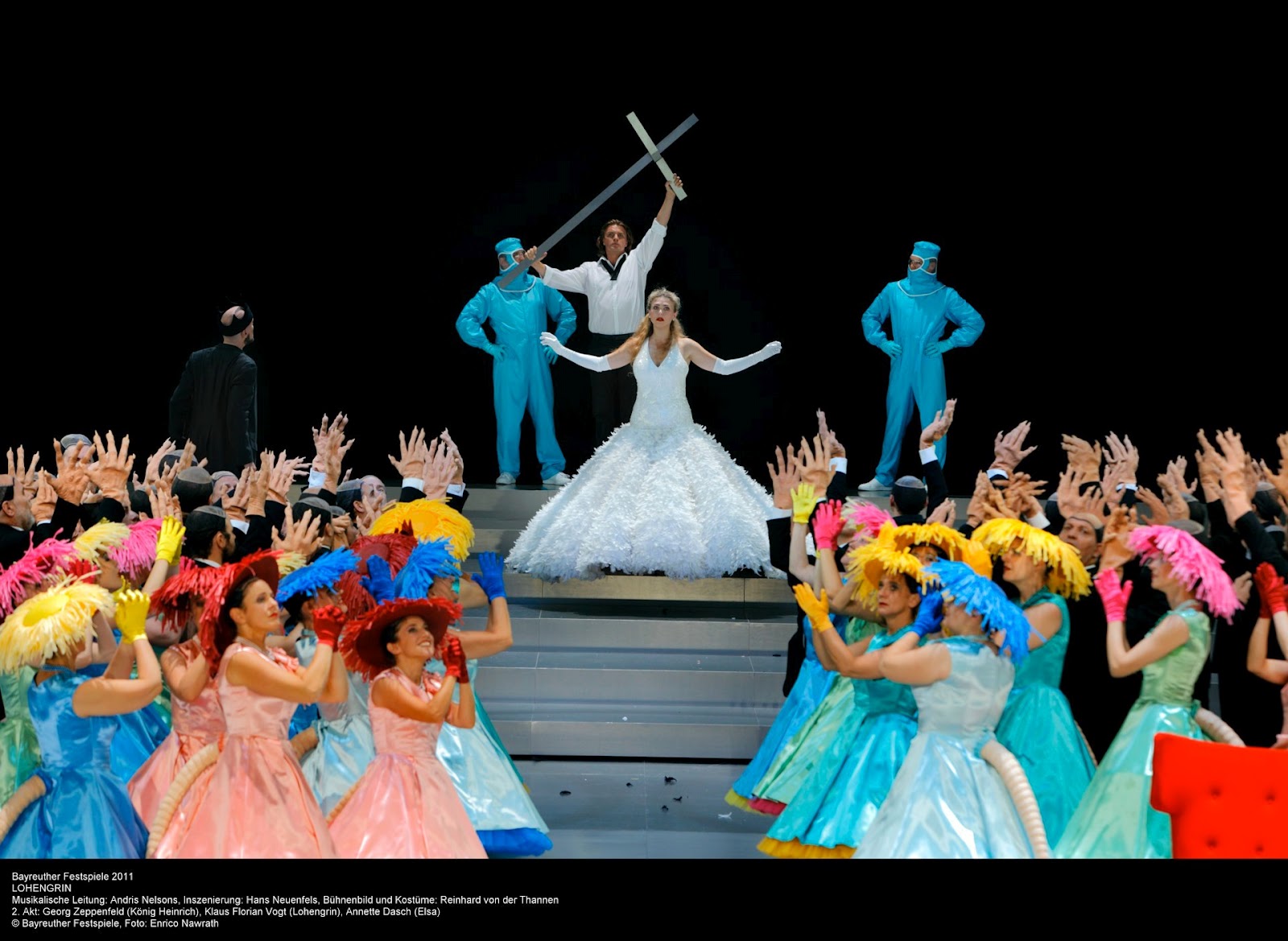
A second chance to see Lohengrin, from Andris Nelsons and Hans Neuenfels (previous review here)

Salzburg Festival

An extremely rare opportunity to hear the first version of Ariadne auf Naxos, replete with Le bourgeois gentilhomme, from the Vienna Philharmonic and Daniel Harding, directed by Sven-Erik Bechtolf (but again, alas, without Jonas Kaufmann)
Two Schubert sonatas from Daniel Barenboim
VPO/Muti - Liszt and Berlioz's Messe solennelle
Carmen, directed and choreographed by Aletta Collins, conducted by Sir Simon Rattle, and at last, with Jonas Kaufmann
Renaud Capuçon/Salzburg Mozarteum Orchestra/Ivor Bolton - Mozart and Haydn
La bohème, the VPO conducted by Daniele Gatti, and directed by Damiano Michieletto
Beethoven from Maurizio Pollini (the final three sonatas once again!)
Bernd Alois Zimmermann's masterpiece, Die Soldaten, the VPO conducted by Ingo Metzmacher, in a new staging by Alvis Hermanis

Elsewhere

Hänsel und Gretel from Co-opera Co.
Mittwoch aus Licht from Birmingham Opera (not quite the premiere, but one of the premiere performances)
Prom 57: Zimmermann/Gustav Mahler YO/Gatti - Wagner, Berg, Strauss, and Ravel
Christine Schäfer recites Pierrot Lunaire, along with Debussy's sonata for flute, viola, and harp

September

Prom 75: VPO/Haitink - Haydn and Strauss's Alpine Symphony

Wednesday, 27 June 2012

City of London Festival: LSO/Davis - Berlioz Requiem, 26 June 2012

St Paul’s Cathedral

Grande messe des morts (Requiem), op.5

Barry Banks (tenor)
London Philharmonic Choir
London Symphony Chorus
London Symphony Orchestra
Sir Colin Davis (conductor)


Both the LSO and Sir Colin Davis appeared in the first City of London Festival in 1962, though not together. Short of The Trojans – which, I hear is being performed in another place at the moment – it would be difficult to come up with a more appropriate work than the Berlioz Requiem for them to perform together during the festival’s Golden Jubilee season. Forces, spatial requirements, and, I suspect, a relative lack of popularity conspire to make performances rare things: not necessarily a bad situation when one thinks of all the terrible – or worse, merely unnecessary – performances to which poor, over-exposed Mahler has recently been subjected. No such problem here: if the LSO/Davis (not to forget the superb London Symphony Chorus) Missa Solemnis at the Proms last year may ultimately prove the still greater experience, that is only because the Missa Solemnis is the Missa Solemnis. This, the second of two performances in St Paul’s Cathedral, may even transpire to be the once-in-a-lifetime event, since, when it comes to Beethoven, one can always turn to Klemperer on CD. For the Grande messe des morts, superlative though Davis’s own past recordings have been – and this was being recorded for LSO Live – the fact remains, as I can now attest, that, like Stockhausen’s Gruppen, many of the works of Gabrieli, arguably Berlioz’s Te Deum too, one simply has not experienced the work until one has heard it spatially, in the flesh. (I wonder whether the best way to hear the forthcoming CD release would be to play it, like a piece of purely electronic music, in a suitable space. St Paul’s perhaps?)

Wren’s great cathedral is not of course a concert hall and I have heard performances here entirely ruined by the evaporation of sound upwards into the dome. (One simply has not known whether they were any good.) On this occasion, I was fortunate enough to be seated just under the dome; even there, it took ears and eyes a little time to become accustomed. Eyes were puzzled by the great lag between Sir Colin’s beat and what one heard, ears by what might otherwise have sounded a little like extravagantly excessive vibrato – though what is Berlioz if not extravagant? And yet, performance combined with building, permitting spatial considerations – not just the brass bands later on, but even the passing of the line between choral sections during the Introit – to come to the fore. It was actually, even for a member of the audience, not unlike being an organist, taking building and reverberation into account. As the Introit soon made clear, Davis managed to elicit, despite the ‘individual’ acoustic, a characteristically Berliozian orchestral sound, perhaps above all from the LSO woodwind, who, like the rest of the orchestra, played superlatively all evening. Fervour and doubt – for the fervour certainly does not seem to be invested in the Almighty – combined with grandeur and intimacy. Perhaps most crucially of all, structure, at least as important here as in Beethoven, if utterly different in nature, was unfailingly delineated and rendered ceremonially meaningful. For if Beethoven’s Mass tells of titanic struggle, here we have Requiem as ceremonial, a secular successor to the great festivals of the French Revolution, even Robespierre’s dreadful, almost comically uninvolving, Cult of the Supreme Being. Struggle with the Almighty is more interesting, more involving even, whether in Beethoven’s guise or that of a thoughtful atheist such as Marx or, much of the time, Wagner; secularism, whilst at times a necessary or advisable political stance, is not a system of belief, let alone a force for drama. The strange emptiness that lies at the heart of Berlioz’s work may be understood in that light, but it has its own interest, and could not have been better served than here, the dome of St Paul’s at times beginning to remind me, disconcertingly, of the Panthéon in Paris.

The plainchant with which the cellos open the ‘Dies irae’ sounded almost timeless, answered by sopranos and ultimately taken up by most of the forces present, doubtless a ritual more secular than mediæval, albeit with great musical rewards. (Words from the Psalmist inscribed upon the dome lingered in the mind: ‘Pse Him in the sound of the trumpet.’) The sheer weirdness of Berlioz’s orchestral interludes or interventions registered fully, even before that moment when the four brass bands made their extraordinary entry, anything but weird. This was Gabrieli to the nth degree, sending shivers down the spine, apocalypse now with brass, voices, organ, drums. I can honestly say that I had never heard anything like it before. At last, music truly for St Paul’s! And yet, historical resonances made themselves heard: the old trombone equali for All Souls or even newer equali – Beethoven, Bruckner, Stravinsky’s echo In memoriam Dylan Thomas – and, of course, Don Giovanni, which Berlioz adored. (Who does not?) A truly plaintive English horn (Christine Pendrill), with its strange amalgam of chant and the ‘Scène aux champs’ from the Symphonie fantastique, signalled the very different voice of the ‘Quid sum miser’. Choral tenors sounded universal rather than personal; this is not Bach. And yet, one was taken back to the twin intimacy and formality of Gluck – the obsequies of Orfeo – as well as to the Revolution.

‘De profundo lacu’ in the ‘Rex tremendae’ truly sounded as a bottomless pit, Dante almost having nothing upon it, and yet of course this was a relatively brief visit, especially when contrasted with the ‘Dies irae’. Equally telling were the imploring calls – though imploring whom? – of ‘Salva me’, followed by reiteration of the awe-inspiring ‘Rex’: ‘tremendae’ indeed. The ‘Quaerens me’ featured ravishingly beautiful choral singing from the London Symphony Chorus and London Philharmonic Choir, neither of which ever seemed to put a foot, or even a toe, wrong. As for the ‘Lacrimosa,’ well, however does one set this after Mozart and the inescapable mythologising that surrounds his final masterpiece? Berlioz’s deeply unsettling and yet magnificent solution resounded fully before consolation of sorts. The absence of God made for its own drama, as Sir Colin clearly appreciated.

I was especially struck by the fine violin playing during the Offertorium, just as much as by the ever excellent woodwind and voices. Davis’s handling of structure and meaning once again rendered all as clear as one could ever imagine, indeed more so. This was the hushed awe of an unbeliever. A sense of human hopelessness sounded in the ‘Hostias’: to whom were the prayers being made? If praying for the souls of the dead, or rather not praying for them, has always seemed to me an issue on which the Reformers had things utterly, unambiguously wrong – why ever would one not pray for the souls of fellow participants in the Communion of Saints? – then the implied competition here between divine mercy and nihilism struck a powerful dramatic chord. An orchestral sweetness that one could hardly fail to dub celestial was to be heard in the ‘Sanctus’. I did not care for Barry Banks’s Verdian rendition of his part, but that was a mere blemish, tempered by the dome. The strange impersonality of the cries of ‘Hosanna’ recalled once again Berlioz’s French forebears, ironically perhaps bringing Cherubini to mind. What the latter would have made of the cymbals at the return of the ‘Sanctus’, doing what one would least expect of them, is anyone’s guess. What mastery of orchestration there is here! And what splendid choral singing was to be heard too.

The ‘Agnus Dei’ displayed Davis’s renowned gift for taking his time, both for the sake of the music and the acoustic, those two aspects combining so as seemingly to present what Berlioz had all along had in mind. (‘Did he not write the work for St Paul’s?’ one was almost tempted to ask.) Cyclic completion, which if not exactly symphonic is not entirely un-symphonic, brought a satisfaction which, if not of the nature of a peace that passes all understanding, nevertheless passed beyond mere understanding. We heard the wisdom and cogency of a performance that seemed to sum up the devotion of a career – except that, nowadays, whenever one thinks that Sir Colin has crowned that extraordinary career, one is likely to experience a subsequent coronation a month or so later.


Monday, 25 June 2012

Gluck's Orfeo from Glyndebourne: Dame Janet bids 'Addio, addio'

After Nigel Lowery's dreadful assault upon Gluck, I felt the need of something more wholesome. Of course the staging would be unlikely to be carried out in quite the same way now; I am sure that Peter Hall would do it differently, were he to return to the work. Not that there is anything wrong with it, but fashions change more quickly in this respect than perhaps any other. It is certainly a hundred times preferable to Lowery's puerile effort. The glories of the audio recording (heartily recommended, with links below) originating from this production were always Dame Janet Baker's astonishingly intense, truly heartfelt farewell to the stage and the London Philharmonic's playing under Raymond Leppard; so they are here, though there is little cause for complaint here, and the chorus, trained by Jane Glover, acquits itself beautifully. 'Purists' will doubtless moan about the composite version of the work, let alone the aria ending the first act, a guilty pleasure if ever there were one; even my own favourite Gluck conductor, Riccardo Muti, disdains anything but 'pure' Vienna. The rest of us can sit back and enjoy...


Gluck, Il trionfo di Clelia, Tutti all'Opera!, 24 June 2012

Linbury Studio Theatre, Royal Opera House

Clelia – Hélène Le Corre
Orazio – Mary-Ellen Nesi
Tarquinio – Irini Karaianni
Porsenna – Vassilis Kavayas
Larissa – Lita Messini
Mannio – Artemis Bogri

Nigel Lowery (director, set designs)
Paris Mexis (costumes)
George Tellos (lighting)

City of London Sinfonia
Giuseppe Sigismondi di Risio (conductor)


Metastasio and Gluck are both crucial musico-historical figures whom we tend to hear about more than we hear. And when opera houses, usually through gritted teeth, deign to present us with Gluck’s operas – works that matter to all those who take opera seriously as musical drama – they will almost exclusively be his ‘reform operas’. Fair enough, up to a point, for it was in that extraordinary series of works that Gluck and his librettists – it was Ranieri de’ Calzabigi who penned the celebrated preface to Alceste – truly reinstated dignity and purpose lost somewhere along the road from Monteverdi to the eighteenth century. One of the principal villains in the piece is, of course, Pietro Metastasio, Caesarian court poet in Vienna, whose codification of the principles of opera seria is held by many to represent everything that is worst about pre-reform opera. Except, of course, that Gluck set Metastasio; so indeed would Mozart. (They both set not only Il re pastore but La clemenza di Tito, even if Mozart’s setting of the latter would be in a heavily revised version.) That is where Il trionfo di Clelia comes in: one of those earlier Gluck works we never find ourselves afforded the opportunity to hear.

And yet, the need for refinement of preconceptions does not stop there, for whilst early Gluck goes unheard, Metastasio stands occasionally heard and frequently misunderstood. He certainly did not see himself, nor should we, as a server of non-dramatic entertainments; rather, very much in the line of Plato and Horace, he wished to present ‘pleasurable instruction,’ and it was the moral purpose of his art that remained most important to him. It is not at all clear that the excesses of opera seria against which Gluck and Calzabigi would protest should be lain at his door, as opposed to that of certain composers. Indeed, ironically, it would appear that the staging of this work was far more ‘Baroque’ than the libretto, so much so that, following its first performances in Bologna in 1763, other European theatres found themselves unable to put it on, owing to the complexity of stagecraft required. This was not, then, quite the ‘noble simplicity and quite grandeur’ (edle Einfalt und stille Grösse) of which Johann Joachim Winckelmann would soon write, and which would become a hallmark, however misleading, of our understanding of Gluckian opera as well as Hellenic sculpture. (The Preface to Alceste concludes with a paean to ‘belle simplicité’.)

The first composer to set Metastasio’s text, Il trionfo di Clelia, had been Johann Adolph Hasse in 1762, celebrating the confinement – those, for better or worse, were the days – of Isabella, consort to the Archduke Joseph, soon to be Holy Roman Emperor and co-regent of the Habsburg Monarchy with his mother, Maria Theresa. Gluck’s setting would be the next, to mark the opening of Bologna’s Teatro Comunale. Other renowned composers such as Josef Mysliceček and Niccolò Jommelli would follow suit (the latter in a somewhat revised version), though this late Metastasian text would never acquire the popularity of many of the poet’s libretti. (Artaserse received not far short of ninety settings.) Fashions were changing; indeed, it was not even that Gluck’s Orfeo ed Euridice lay around the corner; that celebrated azione teatrale (1762) actually preceded Il trionfo. Yet, for all the necessary deconstruction we might conduct of the qualitative leap between ‘reform’ and ‘pre-reform’ operas, we cannot and should not jettison the musico-historical baby with the coloratura bathwater. Reactions, moreover, were mixed, and counsel against easy reductionism. Perhaps put out by a commission that warned him against undue innovation – this was, after all already the composer of Orfeo – Gluck voiced dissatisfied with the performance of the orchestra, comparing it unfavourably, despite seventeen rehearsals, to the precision and ensemble to which he had been accustomed in Vienna. Yet, despite the failure to be staged elsewhere, twenty-eight performances, many of which sold out, were mounted in Bologna. The Linbury’s performances of this first production by a new consortium, ‘Tutti all’Opera!’, have sold out too, though they amount, less ambitiously, to a mere brace.

Before passing to the music and to the performance, it might be worth saying something about the plot, given that it will most likely be unfamiliar to many readers. The action opens during the truce following the siege of Rome conducted by the Etruscan king, Porsenna (the Italian form for ‘Porsena’), who is in league with the villainous Tarquinio (Tarquinius), who in turn would be restored to the Roman throne. One of the hostages granted by the Romans to Porsenna as a sign of good faith is Clelia (Cloelia), who is betrothed to Orazio (Horatius), the Roman Ambassador. Clelia refuses Tarquinio’s advances, disdaining a throne that is not his to give and pointing out that he is in any case betrothed to Larissa, daughter of Porsenna. Following various confusions and Cloelia’s escape, Tarquinio’s treachery is shown not only to have extended to would-be kidnap of the object of his obsessive love, but to have been political too, if ultimately to no avail; for, impressed by the virtue of Clelia and Orazio and shocked by the duplicity of his erstwhile ally, Porsenna ultimately acts as Roman liberator. Those are the bare bones, though it is not an especially complicated affair: again, much of what is alleged concerning Metastasio seems to emanate from those ignorant of him. (On this occasion, comprehension was not aided by sometimes bizarre surtitles, whose mangled and/or inappropriate language suggested that cardinal sin of translation, use of a non-native-speaker. References to characters ‘exposing’ themselves caused apparently unintentional hilarity.)

I have dwelled on the history, first because it is, I think, important, but second because Nigel Lowery’s production proves such an outright travesty. It would be tedious beyond words, almost as tedious as Lowery’s production, to list everything that was wrong with it, but some explanation needs to be given. Were you to wish to present a compendium of directorial clichés, there would be no better place to come. Following the Overture, there is a considerable musical pause, in which Clelia walks around, the director seemingly more attuned to the sound of her heels than to Gluck’s score. She wears a raincoat and carries – yes, you have guessed it – a suitcase. Before long, we see Tarquinius place a pair of dark glasses – an emblem of deceit, I suppose – upon Porsenna. The setting is vaguely and terribly unsurprisingly something akin to Fascist Italy. Armbands and uniforms remind us of that. What might have been a genuinely interesting prospect, deconstructing the claims to virtue of Clelia and Orazio, is only hinted at. Perhaps I was reading too much into a feeble attempt at a book-burning; maybe it was just there because Lowery has seen such things in other productions, genuinely radical or otherwise. Orazio must choose between love for Clelia and devotion to Rome – AMOR/ROMA, the fulcrum of Metastasian drama – and therefore has to wheel a Cross around the stage for a while. Never mind the chronology, feel the subtle, highly appropriate symbolism. Larissa is presented as an overgrown schoolgirl, who carries a doll around her. At some point, Tarquinio starts to take off Porsenna’s clothes, but does not get very far, and everyone forgets all about it. Someone else – I cannot remember who – takes off a few clothes from someone else – I cannot remember whom – and so forth, though there is not the slightest hint of eroticism. Towards the end, when war is once again the order of the day, Porsenna turns far too nasty and injects someone with a syringe, before ripping the poor person’s heart out. I think, by the look of the uniform, that that unfortunate was a generic Roman; who knows? As for the video projections depicting war itself, they veer between the offensively cartoon-like and the most tired of rehashing. I could go on and on about what we see in the production, but what do we not see? The slightest glimmer of sympathy with or even interest in the work, the slightest hint that the score might be of any importance whatsoever; above all, we witness not the slightest glimmer of any real idea. This, for all its pretension, is as anti- or at least as non-intellectual as crowd-pleasing Zeffirelli. Indeed, not unlike the monster of the Met, all we have is a few designs, which, even when accomplished – credit must certainly be granted to Paul Mexis’s costumes in themselves – tend very strongly to resemble anything else we have ever seen from Lowery, strongly suggesting that he would have been better remaining a designer himself. Gluck and Metastasio deserved far better than a bad parody of an off-night at the Komische Oper, Berlin. (And I speak as an admirer of a good number of productions from that house.) The production was first seen in Athens earlier this year. A recording (link below) was made for MDG – I have not heard it – but the lack of a DVD must surely be accounted a blessing.

The City of London Sinfonia, does not, blessedly, play on ‘period’ instruments, so we were spared the whining strings and so forth one must endure on Youtube extracts from those Athens performances – and presumably on the CD recording too. That said, whilst there was, occasional roughness aside, nothing especially wrong with the CLS performance, it often tended towards the anonymous. The orchestra was really too small; a greater body of strings than 4.4.3.2.1 would certainly have been advisable, especially in the unfriendly acoustic of the Linbury. Something is certainly awry when the harpsichord, an unpleasant sounding version even of its kind, drowns out the orchestra. There was, however, some fine wind playing to enjoy.

Giuseppe Sigismondi de Risio’s conducting tended a little too much at times towards alleged ‘period style’ – in reality, of course, nothing of the sort – but not everything was too rushed or too mannered, and the conductor had limited success in persuading the strings to adopt the pinched style of which he seemed to be fond. Unconvincing ritardandi, however, suggested that he was better playing it straight; the performance benefited when he did. Not that there is anything wrong with fluctuations of tempi in Gluck: Furtwängler’s masterly Orfeo from La Scala would readily confute such a claim. But Furtwängler, it need hardly be added, is never arbitrary. Still, having to cooperate with such a staging may well have taken its toll, and Gluck is not an easy composer to conduct. Indeed, of present-day interpreters – alas, there are not so many – I can only think of Riccardo Muti as a shining example.

As if to revert to stereotypes of opera seria, there was more to enjoy in the singing. Pick of the bunch was Mary-Ellen Nesi's Orazio, her third-act aria a show-stopper convincing one that ‘pre-reform’ – well, just about – vocal display could actually, and despite the staging, have dramatic import. Her mezzo exhibits enviable colour and precision, as does Irini Karaianni’s (Tarquinio), the latter’s lower register especially expressive. Hélène Le Corre proved at times a little colourless as Clelia, though she handled her coloratura well and her smallish voice is not unattractive. Lita Messini was a late substitute as Larissa, so her intonational problems may well be ascribed to that. Whether her strangely gawky schoolgirl act betokened good acting ability, following the director’s instructions, or a lack thereof, must for the moment remain a matter of speculation. Artemis Bogri had a decent showing as Mannio, Prince of Vejenti, Larissa’s lover. However, the tenor, Vassilis Kavayas (Porsenna) seemed strained by a good number of the score’s demands.

The director did not appear for a curtain-call, whether at 9.20, the time at which the website had billed the performance as ending, or at 10.15, when it did.