Friday, 10 June 2016

Cooper - Schumann, Liszt, and Wagner, 8 June 2016


St John’s, Smith Square

Schumann – Geistervariationen in E-flat major, WoO 24
Schumann – Davidsbündlertänze, op.6
Liszt – Années de pèlerinage: Deuxième année (Italie), S.161: ‘Sposalizio’, ‘Il penseroso’, ‘Canzonetta del Salvator Rosa’, and ‘Sonetto 104 del Partrarca’
Wagner – Elegie, WWV 93
Wagner, arr. Kocsis – Tristan und Isolde: Prelude to Act I
Liszt – La lugubre gondola, S200/1
Wagner, arr. Liszt – Isoldens Liebestod – Schlußszene aus Richard Wagners Tristan und Isolde, S447

Imogen Cooper (piano) 
 

The Southbank Centre’s International Piano Series came to a season close with Imogen Cooper, on Schumann’s birthday. The first half, not unreasonably, was devoted to Schumann’s music: never something about which I am likely to complain, and certainly not here. That said, I find the Geistervariationen disturbing music indeed, even when performed with such warmth of tone as on this occasion. Cooper gave the theme the nobility of late Beethoven; its simplicity is not entirely dissimilar either. The strangeness of the first variation disconcerted all the more. And so Schumann’s final work went its own strange way, but with a quiet, assured sense of purpose. Its flights of fancy continued to disturb, but the turn to the minor mode brought with it both an almost Classical self-justification and post-Schubertian poignancy. The return of the theme had it sound both the same as before and yet utterly transformed by experience, almost as if we had just heard the Goldbergs.
 

The Davidsbündlertänze followed, seemingly flowering in the wake of death yet to come. A veritable kaleidoscope of colours was to be heard even in the first piece, announcing a grand manner that not only suited the work surprisingly well but also laid some of the groundwork for Liszt in the second half. Cooper’s leaning into phrases and her weighting of them always intrigued and, far more often than not, satisfied. The second, marked ‘Innig’, sounded just so, with finely judged balance between the melodic and harmonic demands of inner voices. The third, however, sounded unduly deliberate to my ears, ultimately remaining earthbound, although its successor made amends, with a highly Romantic, even mercurial reading. I greatly enjoyed the semi-introverted charm of the fifth and the stark power of the sixth, after which the sadness, as well as the strength in sadness of the seventh suggested that this was truly the emotional heart of the work. Agility and impetuosity were the hallmark of its successor, although I sometimes wondered whether it might have yielded a little more. The tenth certainly did, and was all the better for it. As we neared the close, the splendidly judged heavy lilt of the thirteenth piece made its mark, and somehow we always knew – even if, rightly we were made to doubt this – that Eusebius would win out. So he did, of course; and so he should have done.
 

Liszt was the most generous of composers – in almost every sense. However, even he was known to use ‘leipzigerisch’ as a not entirely complimentary term with respect to Schumann and Mendelssohn. Nowadays, we are perhaps more inclined to hear what Liszt and Schumann, Wagner and Brahms, Berlioz and Mendelssohn had in common. At any rate, the second half, of Liszt and Wagner, offered both things in common and a good deal of contrast. I had not thought of Cooper in connection with Liszt before: my oversight, for she revealed herself to be very much my sort of Lisztian, one who takes Liszt’s music seriously, quite the antithesis of a shallow virtuoso.
 

‘Sposalizio’ brought strength and mystery in its opening bars, both with respect to mood and to thematic working out. Cooper brought an undeniable sense of narrative, with or without words (or images) to what we heard, in a distinguished performance. ‘Il penseroso’ was grief-laden, but Cooper never confused sentiment with sentimentality. Liszt’s extraordinary dissonances were not exaggerated; they seemed ‘simply’ to speak. It sounded, like its predecessor, as the visionary piece it is. I still do not quite understand what the ‘Canzonetta del Salvator Rosa’ is doing in such company – doubtless my problem – but it received a nicely jaunty performance, its sterner moments registering too. It actually made for an excellent context from which the 104th Petrarch Sonnet could emerge. Cooper had it do so without a break, in commanding fashion. This full-blooded performance balanced well the demands of the ‘public’ Liszt and interior eroticism.
 

Wagner’s Elegie is a fascinating miniature, serious indeed, clearly born not only from the world of the scandalously underrated Sonata for Mathilde Wesendonck, but also from the world of Tristan und Isolde itself. Its curious insistency here sounded not un-Lisztian. Likewise the Prelude to Act I of Tristan, in Zoltán Kocsis’s transcription. Its opening bars both melted and insisted, invited and warned. I remain ambivalent about the transcription itself; here I could not help but wonder what Liszt himself might have achieved. It was undeniably interesting, even provocative, to hear it, though. Cooper offered a performance of considerable cumulative power, a certain squareness to the arrangement notwithstanding. Instead of the Sailor’s Song for which it cried out, we heard, still darker music, the first version of La lugubre gondola, issued forth. Venetian waters seemed to threaten to suspend rhythm as much as tonality; and yet, quite rightly, they did not succeed in either case. Here, again, was Liszt the visionary, but now the darkly embittered visionary of old age. If Wagner’s death beckoned there, we heard transfiguration in the so-called ‘Liebestod’ (Liszt’s fault, not Wagner’s). It sounded, resounded as a true conclusion to the arduous journey taken. Cooper offered great tonal beauty, but that was never the point. Her serious Lisztian credentials were furthered in her encore: the Fourth Mephisto Waltz. Its Mephistophelian character told – how could it not? – yet so did kinship with what had gone before: with Liszt and with Wagner. So too did anticipations of Bartók.

Sunday, 5 June 2016

Arensky CO/Kunhardt - Wagner, 2 June 2016


Oak Room, The Hospital Club, London

Siegfried-Idyll
Selection from Götterdämmerung (arr. Iain Farrington)

Arensky Chamber Orchestra
William Kunhardt (conductor)
 

Since its founding concert, held in another, rather different London club, the Arensky Chamber Orchestra has done things differently. That has not, I think, been for the sake of it, although novelty certainly does no harm in having one noticed, but because difference, by its essence, has perhaps helped it do things more ‘conventional’ ensembles might not, has perhaps helped it reach slightly different audiences, and perhaps also because different locations, not always concert halls, perhaps make one think about music differently.


Here, at the Hospital Club in Covent Garden, we heard Wagner’s Siegfried-Idyll, and towards its end were served with mushroom canapés. The ACO’s music director then introduced us to the music from Götterdämmerung by reading us to a story-book-like account of the action interspersed with musical examples from the orchestra. We were then treated with a cocktail, ‘Siegfried’s Fate’ – what a pity Hans von Wolzogen did not open a bar! – before hearing a skilfully made continuous selection from the grandest of all musical denouements.  
 

The Siegfried-Idyll was lovingly played. Kunhardt spoke of his own love for the music and added that it was a favourite of the players too; there was no difficulty in imagining that from the performance we heard. There was a considerable degree of rubato, especially to begin with, but it convinced. A chamber sound – one really heard the music as a string quartet at the opening – was very much what we heard; although it most certainly was, it rarely sounded ‘conducted’. It seems invidious to single anyone out, but I was especially taken by the contributions from the flautist and the first violist. String playing in particular, perhaps partly on account of the intimacy of the venue, came across in powerfully physical fashion; one could almost feel the contact of bow with string. This was a well-shaped performance throughout, not afraid to linger, yet without exaggeration.


It has perhaps not irrelevant to mention that Iain Farrington is Arranger-in-Residence (wonderful title!) to the Aurora Orchestra, for the ACO shows much of that ensemble’s enterprise. They certainly took to an arrangement from Götterdämmerung, which incorporated more of the action within its relatively brief span – I am afraid I cannot tell you how long – than I should have thought possible. It is in the nature of listeners to moan about what is or is not included in such selections; I shall try to resist that temptation, for Farrington even managed to give us a little of Hagen’s call to the Vassals, despite the greater part of his attentions having been devoted, perhaps not surprisingly, to the first act (and Prologue) and to the third. Taking us from the Prelude to the first act, through Dawn, with wonderful, grainy woodwind, we took in a little of Siegfried and Brünnhilde’s love duet before sailing down the Rhine. In this context, the affinity of this music with some of the material from the Siegfried-Idyll was striking. That little detour into the second act having been savoured, we heard Siegfried meeting the Rhinemaidens in the third, before spending more time on the final scenes. Siegfried’s death registered with properly tragic import, time almost yet not quite standing still: skilful conducting indeed here, as well as excellent solo playing! The Funeral March registered with due tragedy too, especial mention here being warranted by the ACO’s solo trumpeter and its percussionists. Gutrune’s scene – notoriously omitted by Wieland Wagner – was present, before a truncated Immolation Scene, which had the only really awkward arrangement-corner of the evening: no mean achievement at all. This was a most enjoyable and, yes, productively different evening. Now we can look forward to a new series of concerts starting in the autumn.

Thursday, 2 June 2016

Ariane and Alexandre bis, Guildhall, 31 May 2016


Silk Street Theatre, Guildhall School of Music and Drama

Ariane

Le Veilleur (M. Yvon Villeneuve) – John Findon
L’Homme aux cheveux blancs (M. Giuseppe di Bergamo) – Milan Siljanov
1er garçon (M. Gerard Fennial) – Robin Horgan
2ème garçon (M. Gauthier Cardin) – Bertie Watson
3ème garçon (M. Gregoire Lissard) – James Liu
4ème garçon (M. Olivier Moreau) – Laurence Williams
5ème garçon (M. Jean-Baptiste Daude) – Jack Lawrence-Jones
Thésée (M. Dmitri Romanov) – Josep-Ramon Olivé
Ariane (Mme Maria Callas) – Nicola Said
Bouroun (M. Pierre LeClerc) – Dominick Felix
Le Minotaure (M. Giuseppe di Bergamo) – Milan Siljanov 

Alexandre bis

Philomène – Bianca Andrew
Le portrait – Milan Siljanov
Alexandre – Josep-Ramon Olivé
Armande – Elizabeth Karani
Oscar – John Findon
Dancing Devils – Robin Horgan, Jack Lawrence-Jones, Bernie Watson, Laurence Williams

Rodula Gaitanou (director)
Simon Carder (set designs, lighting)
Cordelia Chisholm (costumes)
Victoria Newlyn (choreography)

Orchestra of the Guildhall School of Music and Drama
Timothy Redmond (conductor)
 

I keep trying with Martinů, but I am yet to ‘get’ his music. Perhaps there is too much of it; that seems to be a common claim amongst his apologists. I have maybe not heard the right pieces. As it stands, though, I have yet to detect an original voice; more concerningly, I have yet to hear anything that has had me want to listen to it again. This enterprising operatic double-bill at the Guildhall did not, alas, buck that trend, splendid stagings and performances notwithstanding.
 

First came the composer’s penultimate opera, Ariane, a vaguely neo-Baroque re-telling of the legend of Theseus, Ariadne, and the Minotaur. Not everything can be Birtwistle, I suppose, but this seems a more or less arbitrary collection of passages in differing styles, culminating in an all-too-extended lament that had one longing for the real thing, be it Monteverdi, Cavalli, Purcell, anyone. Given the anonymity of the work, director Rodula Gaitanou’s solution seemed to me inventive, indeed more interesting than the original material. Drawing upon the composer’s attested love for the artistry of Maria Callas during his work on the score, she offers a metatheatrical treatment, the excellent designs (Simon Carder and Cordelia Chisholm) drawing upon photographs, particularly by Robert Doisneau and Sabine Weiss, of Callas recording Carmen at the Salle Wagrame in 1964, six years after Martinů completed composition. It looks wonderful and the young, spirited cast responded eagerly to Ariane as Callas, the additional action – amatory and other rivalry, the business of recording and rehearsal, etc. – doubtless drawing upon their own experience as well as setting them up well for future careers, in which metatheatrical concerns are likely to loom large. Nicola Said’s performance in the title role took a little while to warm up, but she soon made it her own; if only, alas, I could have responded better to Martinů’s writing, which, whilst not so bad as Donizetti, did not seem especially concerned to free itself from such association. Josep-Ramon Olivé was a dashing Thésée, both on stage and vocally. The five boys (named above) enjoyed their intrigues. Milan Siljanov brought a touch of welcome gravity to the role of the Minotaur, whilst Jon Findon busied himself nicely as the Watchman.


Alexandre bis, I am afraid to say, proved tedious. Again, that was no fault of the performers. Here, as in Ariane, the orchestra proved remarkably adept, under Timothy Redmond’s baton, at tracing and communicating the changing moods of the score, such as they were. Attempts at musical surrealism were rarely successful; this proves no exception. Essentially, it is a tale of would-be infidelity, which never happens, although we learn from a dream what might have happened. Von heute auf morgen it certainly is not, let alone Così fan tutte (for those very few, that is, who understand what that work is actually about). If you like the world of Feydeau farce, you might find something in this, I suppose, but it is slight even by those undemanding standards, and fails to attain the lightness of, say, Offenbach. The Magritte-like designs are once again splendid, and there could be no faulting the enthusiastic response of the cast (even if French dialogue was despatched rather too slowly). Siljanov offered a nice turn as a talking portrait. Olivé proved lively and as winning as the work would allow in his new role. If there were any true echo at all of Così, and this is stretching it, it would be in the servant’s role of Philomène; Bianca Andrew had one wonder what she might have made of Despina, in another excellent performance. Elizabeth Karani’s bored lady of leisure proved equally convincing, insofar as it could. Martinů eluded me once again.


Wednesday, 1 June 2016

Lear, Opéra national de Paris, 29 May 2016


Palais Garnier

King Lear – Bo Skovhus
King of France – Gidon Saks
Duke of Albany – Andreas Scheibner
Duke of Cornwall – Michael Colvin
Earl of Kent – Kor-Jan Dusseljee
Earl of Gloucester – Lauri Vasar
Edgar – Andrew Watts
Edmund – Andreas Conrad
Goneril – Ricarda Merbeth
Regan – Erika Sunnegårdh
Cordelia – Annette Dasch
Fool – Ernst Alish
Servant – Nicolas Marie
Knight – Lucas Prisor

Calixto Bieito (director)
Rebecca Ringst (set designs)
Ingto Krügler (costumes)
Bettina Auer (dramaturgy)
Sarah Derendinger (video)
Franck Evin (lighting)

Chorus of the Opéra national de Paris (chorus master: Alessandro di Stefano)
Orchestra of the Opéra national de Paris
Fabio Luisi (conductor) 
 
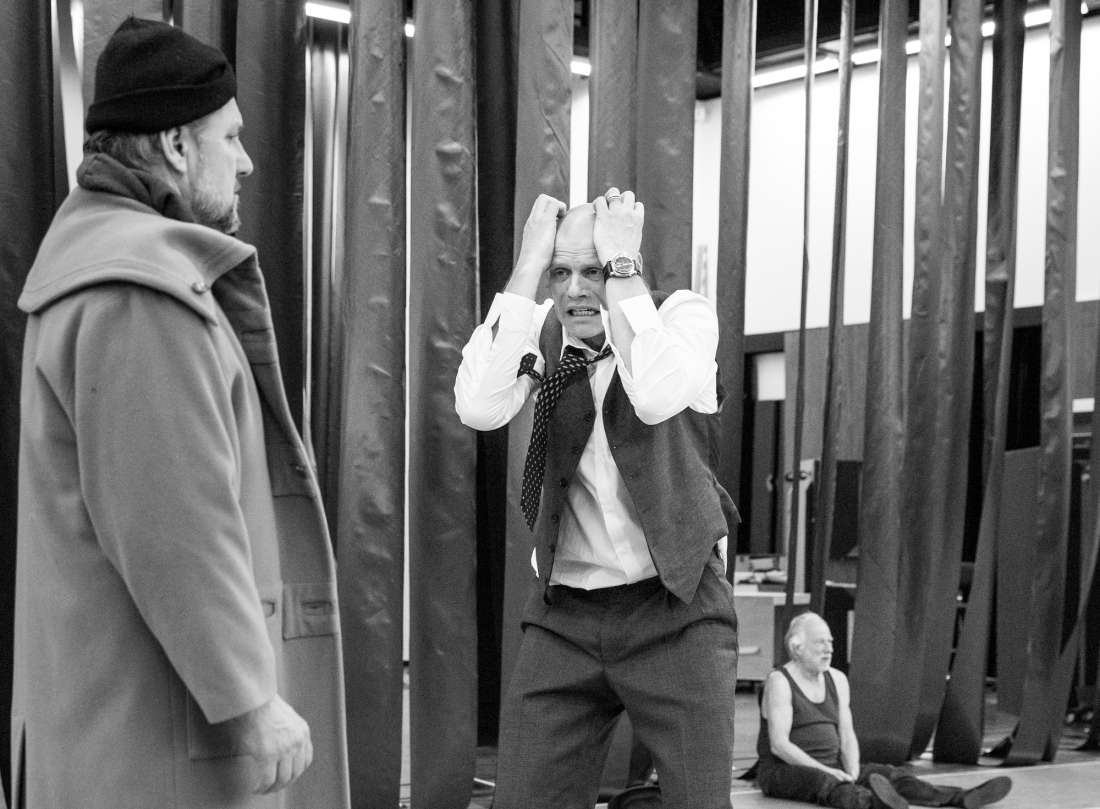
Rehearsal photograph: © Élena Bauer / OnP


This year has seen musical Shakespeare commemorations aplenty, although I cannot help but wonder whether some miss the point. Although there are many wonderful musical settings of Shakespeare, his verse is often so musical in quality that it requires nothing additional. Successful Shakespeare operas are thus less surprisingly few than one might initially suspect. Britten’s A Midsummer Night’s Dream has its devotees, many of them fervent; I should rather stick with the play and Mendelssohn’s incidental music. Falstaff: well, it is difficult to care much one way or the other about The Merry Wives of Windsor, even if Nicolai’s version is (slightly) preferable. Lear, however, has at least one other excellent operatic version, very different in conception: Alexander Goehr’s Promised End. Aribert Reimann’s opera is more conventionally operatic, perhaps, than Goehr’s post-Brechtian response, although such a claim is highly relative and this is no work, thank God, for canary-fanciers. We are lucky to have both – and equally lucky never to have that threatened late Verdi opera. (I have never heard Aulis Sallinen’s 2000 opera.) At any rate, the Paris Opéra’s contribution, whether intended as such or no, is most welcome in principle, still more welcome in practice.


Claus H. Henneberg wrote a number of libretti, from Reimann’s 1971 Melusine to works by Peter Eötvös and Matthias Pintscher. (How I should love an opportunity to see the latter’s Thomas Chatterton!) This, first performed at the Munich Opera Festival in 1978, was written with Dietrich Fischer-Dieskau very much in mind for the title role, and that seems to have helped the initial dissemination of the work, both in the theatre and on its first recording. For a number of stagings followed, including San Francisco, Paris (making Calixto Bieito’s staging the Opéra national de Paris’s second), East Berlin (the Komische Oper), Vienna, Amsterdam, and eventually in 1989, London (ENO). Opera of this period has not generally been well served well by our opera houses, although many continental houses – and not just German ones, as this Paris production and its predecessor attest – tend to do better than their English counterparts; nor has it been in much Anglophone writing. In the meantime, however, you are recommended to seek out a performance and/or a recording where you can.
 

This Paris production and performance will do nicely in that respect. Reimann’s post-expressionist score – not unlike what you might expect from so fine a pianist in Lieder of the Second Viennese School – and Henneberg’s libretto do nothing especially ‘to’ the play, although it is of course not remotely set in its entirety. Given the musical language, violence comes much to the fore, without forsaking claims upon our human sympathies. Indeed, as one would expect, the latter become progressively engaged as the second of the two acts progresses. Dramatic parallelisms and distinctions, for instance between Lear (baritone) and Gloucester (bass-baritone), Cordelia and Edgar, are surely, if sometimes rather obviously, handled in words and music. The series with which the latter pair are associated come strongly into the foreground, much as they might have done with Berg, although there is far less of the ‘Romantic’ to this score. As with a good deal of serialist opera, one has a sense of the workings of the serial machinery and its implications, even if one could not quite put it into words, and would have to consult the score properly to analyse it. (When, after all, would one not? Surely the same is true of Mozart or Wagner.)


Although I felt that Fabio Luisi sometimes led the excellent Orchestra de l’Opéra national de Paris with a little too much restraint, and that something more full-blooded would have turned the dramatic screws with a more evident sense of theatre and ultimately of musico-dramatic generation, audibility of such procedures and our consequent ability to relate them, indeed to fuse them, with stage action were nevertheless most welcome. Not that screams from the orchestra – seemingly, insofar as I could tell, never having seen the score, executed with pinpoint precision – or stereo dialogue between percussionists in boxes either side of the pit had nothing of the visceral to them, far from it. The score can rarely, if ever, have been played with such clarity and, at times, both depth and brightness of string tone as by this fine orchestra, still woefully underrated by many who should know better. My mind was cast back to their magnificent Moses und Aron at the opening of this season.
 

The cast was excellent too. Bo Skovhus gave a highly distinguished, dramatically detailed performance of the title role. His initial pride and its disintegration into a complex web of emotions, inadequacies, and ultimately greater humanity were accomplished in what I presume would have been a more physical performance than that adopted by Fischer-Dieskau (or indeed, really possible to the role’s creator at the time). Skovhus was, I am sure, just as committed as his great predecessor would have been. The dryness I have sometimes observed more recently in his voice seemed as resolutely banished as Cordelia, without danger of its parallel return.
 

Lauri Vasar’s Gloucester was handsomely sung, in a portrayal of considerable emotional depth. Facial, vocal, and verbal expression seemed very much of a piece, as indeed they did in general on stage, testament surely to Bieito’s work as director as well as to individual artistry. Indeed, it is surely testament to both that it is difficult to disentangle the two, and I shall not really attempt to try. Bieito certainly does not seem out to shock, but rather to draw from characters, production, and performances the elements of musical drama. Modern dress is employed, if one cares about that sort of thing in itself, but the designs more broadly are stark, permitting one to allow oneself to imagine any manner of ‘setting’ or none: so more or less what all but the most hidebound reactionary would expect in Shakespearean tragedy. I am not sure that anyone would claim this as a ‘history play’, but perhaps someone silly will claim it as a ‘history opera’; frankly, who cares?
 

What Goneril and Regan have in common and what, increasingly, sets them apart is fascinatingly explored, Ricarda Merbeth’s Goneril the power-dressing big sister, initially less interested in the sexual, it would seem, but ultimately more successful – perhaps because her actions have not previously been so overtly erotic? – in its exploitation. The depravity of Regan’s actions, by contrast, from the initial sexual approach to her father (one almost wants to have her convicted of elder abuse) to her sleazy demise (a touch of necrophilia before expiring, perhaps, however understated?) tell their own story. Erika Sunnegårdh’s performance again melded the ‘musical’ and the ‘dramatic’ into a single, dynamic whole. If Annette Dasch’s Cordelia made less of a strong impression, that was more a function of the work; when she returned, hers was an undoubtedly sympathetic contrast, if ultimately never one that could emerge victorious. Andreas Schiebner’s Albany was intriguingly ambiguous: here, one felt, was a truly conflicted character, no doubt weak yet still a victim of circumstances. Andreas Conrad’s Edmund followed the seeming fate, even nature, of his own personal circumstances, with similarly powerful command of musico-dramatic theatre. His legitimate half-brother, Edgar, received a memorable performance, especially but not only in vocal terms, from Andrew Watts, switching as he must between tenor and countertenor. Here, again, was a desperately needed hint of sympathy, if also a reminder of hopelessness. There was no sense, however, of whether he might become king; our eyes and ears were focused upon tragedy.


Now I should like to see Bieito direct King Lear ‘itself’ or not quite ‘itself’. Shakespeare stands no more in need of Werktreue than any composer of opera, indeed if anything, less so. The Barbican has staged some of his Shakespeare; alas, I was unable to go, but hope that it will not prove the last opportunity in London. Otherwise, to Paris, to Barcelona, or to wherever else might oblige…


Andsnes and friends - Brahms Piano Quartets, 28 May 2016


Milton Court Concert Hall
 
Piano Quartets nos 1-3

Leif Ove Andsnes (piano)
Christian Teztlaff (violin)
Tabea Zimmermann (viola)
Clemens Hagen (cello)
 

I remain sceptical about this sort of programming. Performing, say, Beethoven’s three final piano sonatas in a single recital makes a great deal of sense, although so likewise does performing them separately with other works, attempting to suggest, even to draw, connections. Performing all five of Prokofiev’s piano concertos does not, however much that combination of works might be helpful to collect as a 2-CD set. This concert, part of Leif Ove Andsnes’s LSO Artist Portrait series (albeit without any members of the LSO!), fell somewhere in between. It made for a long evening, especially when programmed in chronological order, with a single interval separating the first and second quartets. On the other hand, we do not hear these works nearly so often as we should – much the same might be said for any piano quartet – and hearing Brahms’s development is always interesting. If I should have preferred two or three concerts, including works by other composers, that was no reason to look a gift-horse in the mouth, for these were excellent performances from beginning to end, much as one might have expected from Andsnes, Christian Tetzlaff, Tabea Zimmermann, and Clemens Hagen.
 

First was the First, in G minor, op.25, as orchestrated, unforgettably, whether you like it or not, by Schoenberg. It was a strength of this performance, the first movement opening straight away with an echt-Brahms sound, that one did forget, and indeed I am now still hearing the original, not Schoenberg’s version, in my head. Strings, and then piano, sounded ‘right’ – which is not to say that there is only one ‘right’, of course, although there are surely many ‘wrongs’. It was not just the sound, though; phrasing and, cumulatively, paragraphs evinced a similar sense of ‘rightness’, all richly Romantic. (The disjuncture between literary and philosophical Romanticism and its musical counterpart, if counterpart it be, means that we cannot really call this ‘late Romanticism’. We probably should, but it would only serve to confuse.) A viola solo from Zimmermann, rich-toned and beautiful in itself, also brought so much more, heralding not only Andsnes’s elaboration, but, so it seemed, the whole of the second group, even the development. The development section itself brought half-lights (yes, this ‘early’ in Brahms’s career) and, of course, vehemence; both propelled the music. So, fundamentally, did the composer’s motivic working, which surely must have been the greatest attraction of all for Schoenberg, here heard meaningfully throughout, quite without pedantry. This was indeed ‘Brahms the Progressive’.
 

Romantic unease (earlier?) from Hagen’s underpinning cello characterised the second movement, permitting of great ambivalence, great ambiguity. Andsnes’s way with rhythm and its relationship, inextricable, to harmony assured motivic integrity, not that that was ever in doubt! Much the same might be said of the Andante, despite its different character. Menacing currents made their point without cheap exaggeration, for they had been prepared and understood harmonically by all concerned; this was true chamber music-making. There was vehemence in those martial rhythms later on, but harmony remained the ultimate mover. They cast their shadow over the return of the opening material, just as they should. There was likewise no doubting the urgency of the finale, taken at quite a lick, nor the astounding virtuosity of the players, but that was not at the expense of chiaroscuro. Contrasting episodes certainly contrasted, but within a greater unity to which they contributed.


The A major Quartet, op.26 followed. If I found this slightly less compelling, that is more a reflection of my response to the work than to the performance, which again was of the highest quality. Andsnes opened the first movement in intriguingly neutral fashion, having us wonder where it might lead. There was certainly a lightness to what immediately followed, underlining the vehemence that followed that, and so on. But ‘difference’ never seemed in retrospect to have been for the sake of it. From Teztlaff’s golden- or silver- or various other- hued violin line – no all-purpose ‘beauty’ here – to the twists, turns, and pedal points of the bass, in whichever part, this performance knew where it was heading. The spirit, and not just the scale, seemed to owe as much to Schubert as to Beethoven, which is surely right in this particular work. The second movement progressed similarly – yet in difference, with more than the occasional hint of Brahms’s Mozartian inheritance (highly welcome!) Nostalgia and distance seemed thereby evoked and dramatized, grief in response all the more heightened. In the third movement, tendencies from both predecessors seemed united, played off against one another: form here was dynamic, never a mere framework. The finale, taken attacca, sounded very much a finale (not always as evident a quality as one might expect). If the ghost of Beethoven had sometimes been placated, here he returned with a vengeance; he had never gone away.
 

The first movement of the Third, op.60 in C minor, registered a very different character from the outset. Internalised anger of an almost Webern-like concision, tension screwed up, at times almost unbearably: this was a performance (as it is a work) still more dialectical in quality. There was nothing appliqué to this terror: it emerged from musical necessity. Rhythm was the progenitor, at least at first, of the different character to the scherzo, as one might expect. Relative rhythmical relaxation was predicated upon what it was relaxing from. The changing relationship between piano and strings, the latter sometimes ‘led’ by Teztlaff, at other times in quite a different formation, proved a crucial element to the drama unfolding. The movement came to a close with such fury that it might almost have been the close of the work; except… The cello sonata-like opening to the Andante thus came as relief (not unlike the Andante to the Second Piano Concerto). Then a piano trio, in perfect balance; then the full quartet, transformed by experience, melancholy heightened. Again, the changing relationship between parts, between ensembles, was very much of the essence. In context, we heard the opening to the finale almost as part of an ‘additional’ violin sonata; in the hands of Andsnes and Teztlaff, how could it not, if only momentarily? So subtle were the entrances of viola and cello, one hardly noticed them. The intensity, emotional and intellectual, of what followed, could not, however, have been missed by anybody.

Die Meistersinger von Nürnberg, Glyndebourne, 25 May 2016


Glyndebourne Opera House

Hans Sachs (Gerald Finley)
Images: Tristram Kenton/Glyndebourne

Walther – Michael Schade
Eva – Amanda Majeski
Magdalene – Hanna Hipp
David – David Portillo
Veit Pogner – Alastair Miles
Sixtus Beckmesser – Jochen Kupfer
Hans Sachs – Gerald Finley
Kunz Vogelgesang – Colin Judson
Konrad Nachtigall – Andrew Slater
Fritz Kothner – Darren Jeffery
Hermann Ortel – Nicholas Folwell
Balthasar Zorn – Alasdair Elliott
Augustin Moser – Daniel Norman
Ulrich Eisslinger – Adrian Thompson
Hans Foltz – Henry Waddington
Hans Schwarz – Sion Goronwy
Night Watchman – Patrick Guetti

David McVicar (director)
Vicki Mortimer (designs)
Andrew George (choreography)
Paule Constable (lighting)

The Glyndebourne Chorus (chorus master: Jeremy Bines)
London Philharmonic Orchestra
Michael Güttler (conductor)


Having been privileged already to see in little over two months two great productions of Die Meistersinger, one in Paris (Stefan Herheim) and one in Munich (David Bösch), I was unable to resist the prospect of a third staging, at Glyndebourne. Alas, David McVicar’s production – for the moment, I am considering solely the staging, for there was much to admire in the musical performance – proved by far the weakest. Alas, we see here the continuation of the sad decline of a once accomplished director – his ENO Turn of the Screw remains the finest I have seen – into the Franco Zeffirelli de nos jours. McVicar’s Glyndebourne Entführung seemed like a caricature of something from an alleged ‘golden age’, which of course never was and never could have been, before the alleged invention of big, bad ‘Regietheater’. As I discuss in my recent book, After Wagner, that would take us back at least before Wagner’s own opera stagings. Indeed, it would take us back, paradoxically, to a time of opera staging prior to the origins of opera.
 

Such an approach, if one may call it that, disdaining, with more than a hint of Teutonophobia, any hint of the directorial Konzept, could hardly find a composer less suited to it than Wagner. And yet, there seems, to start with, as though there might actually be a Konzept: well, an updating, at least. For the action does not take place in sixteenth-century Nuremberg, but rather in the earlier nineteenth century, presumably at around the time Wagner was growing up. There is much to be said for such an idea, looking at the societal influences upon the young Wagner, which certainly helped shape his world-view (from a more hostile standpoint, his ideology). Moreover, the guilds and corporations came under sustained post-Enlightenment attack at this time, the Stein-Hardenberg reforms in Prussia, for instance, offering more or less the only instance in that reforming programme of a policy vehemently opposed by Hegel (as an attack on partial association, on civil society). The guild in Nuremberg, then, might be portrayed as under attack; that, after all, is partly the meaning of Walther’s intrusion, a typical Wagnerian move of introducing a charismatic leader from outside. And so we might go on. There is, unfortunately, no attempt to do anything with the updating. Indeed, as with the aforementioned Entführung, or as with McVicar’s Marriage of Figaro for the Royal Opera, one is left with the nasty suspicion that the principal point, or at least principal result, of the updating is simply to present us with a host of ‘pretty’ designs. Vicki Mortimer’s handsome designs might have done so much more – or even just a little more.
 
Beckmesser (Jochen Kupfer) attempts the Prize Song


Moreover, the typical McVicar trait of reducing drama to mere ‘entertainment’ is much in evidence here. There is nothing wrong with art being entertaining, of course; much of it would be failing if, in at least some sense, it were not. However, here the playing to the gallery – and not in some metatheatrical sense, imitating or leading the relationship between the Masters and the populace – becomes especially wearying. ‘Amusing’ interpolations, which serve little or no purpose other than to make those who have partaken of a few too many erupt into apparently helpless laughter, are too often the order of the day. (Quite what led someone to the verge of hysteria during Sachs’s Wahn monologue, I have no idea; on that occasion, the responsibility does not seem to have lain with the production.) And since every McVicar production now seems to have compulsory choreography by Andrew George, we have silly, irrelevant dances, especially painful at the opening of the second act. Beckmesser, for some reason best known to the director, becomes a preening figure of high camp.


Fortunately, the score was in better hands. The London Philharmonic Orchestra was on excellent form throughout. Clearly well rehearsed, the orchestra offered as satisfying a German tone – the strings, to my ears, more typically Brahmsian than one often hears in Wagner, but certainly, in this of all Wagner’s dramas, none the worse for that – as one is likely to hear in this country. There were, moreover, many elements of exquisite wind-playing, doubtless having their roots, at least in part, in the LPO’s long experience of performing Mozart here at Glyndebourne. Michael Güttler’s conducting never drew attention to itself; in the first and second acts, it perhaps lacked the sense of life with which the greatest Wagner conductors will bring the melos into dramatic reality, but there was sure structural understanding. In the third act, which, perhaps not coincidentally, offers a more satisfying, if defiantly conservative, experience in McVicar’s staging too, Güttler seemed relatively liberated. His was never an ‘interventionist’ account, but there was a greater willingness to play, and to let the singers, play with the ebb and flow.


What made this Meistersinger compulsory viewing (and listening) for me, however, was Gerald Finley’s Hans Sachs. Finley had also played the role in Herheim’s Paris production. Perhaps because of the lack of anything here to say from the staging, he sounded, if anything, finer still. At any rate, the distinction of his performance fell into greater relief, for I have never heard a finer rendition, more anguished and yet, ultimately, more imbued with relative hope, of the Wahn monologue than here. In ‘purely’ musical and in verbal terms, this was a Sachs whose role emerged from lengthy experience and understanding of Lieder. The size of the house probably helped too, the Bastille perhaps not the ideal venue for Finley, excellent though his Paris performance undoubtedly was.
 

Michael Schade seemed miscast, I am afraid, as Walther. If he made a better job of the role than I should have suspected, he too often sounded strained. Little of the ‘natural’ – whatever that might mean – ease with which Walther should pour forth his artistry was present. However, his Eva, Amanda Majeski, offered a beautifully sung performance, drawing, as does the character, upon greater reserves of feeling as the work progressed. There was nothing of Bösch’s radical (feminist) reappraisal here, of course, but Sajeski did a good deal with what she had. Jochen Kupfer did a sterling job with McVicar’s jarring understanding of Beckmesser; indeed, he managed almost to convince us that this was an illuminating standpoint. If he could not quite do so, that was not the fault of this fine actor, whose darkly attractive vocal portrayal proved equally impressive; I hope to see him play the role in another staging. David Portillo’s lyric tenor was just the thing for David: his was an eager, diligent, attractively sung performance very much in the traditional mode. Hanna Hipp’s Magdalene complemented him with similar qualities and great warmth of tone. Alastair Miles’s Pogner sounded somewhat elderly at times, but that is hardly inappropriate here. Last but far from least, the singing of the Glyndebourne Chorus, well-prepared indeed by Jeremy Bines, was something to savour from beginning to end. In a house of this size, it sounded just right: words and music in excellent balance, warmth and clarity anything but antithetical. If only the staging had given them something more interesting to do.iHi


Monday, 30 May 2016

Tiberghien - Bartók and Kurtág, 24 May 2016


Wigmore Hall

Bartók – Fifteen Hungarian Peasant Songs
Eight Improvisations of Hungarian Peasant Songs, op.20
Sonata

Bartók – Three Hungarian Folksongs from Csík
Kurtág – Pieces from Játékok, interspersed with:
Bartok – Sonatina; Pieces from Mikrokosmos, vol.5
Bartók – Six Romanian Folk Dances

Cédric Tiberghien (piano)
 

Six months ago, at the end of Pierre Boulez’s ninetieth-anniversary year and thus shortly before his death, Cédric Tiberghien gave a Wigmore Hall recital in which he interwove works by Boulez and Bartók. Alas, I was unable to attend, but this recital, in which he did something similar with Kurtág, made up for some of that disappointment.
 

I say ‘interwove’, but the first half was devoted entirely to Bartók. For so fine a pianist, and so fine a composer of music involving the piano, there is not so much solo piano music as one might expect; or rather, there is not much larger-scale piano music. Even the Sonata, heard here as conclusion to the first half, is relatively brief. Before that, we heard two sets of short pieces. First came the Fifteen Hungarian Peasant Songs, which Bartók groups into four sections – so not entirely unlike a sonata, with a broad – too broad? – understanding of the term. Tiberghien’s opening, with the first of the ‘Four Old Tunes’, was bold, his generous use of the sustaining pedal providing its own atmospheric justification. Following that mini-‘overture’, we heard Debussyan echoes turned to Lisztian ends, a keen sense of form exhibiting itself throughout. The Scherzo, no.5, once again showed post-Debussyan awareness, whilst retaining very much its own character. The ‘Ballad’, a theme and variations, was exploratory in a way that made it sound close to the (contemporaneous) Wooden Prince, whilst also looking forward to the Piano Concertos. Variation form inevitably brought echoes of Beethoven too. The ‘Old Dance Tunes’ certainly danced, and danced with great individuality. (Think of Mozart’s exquisite sets of dances, which only sound the same to those who are not listening.) Liszt was never far away; when is he in Bartók?
 

The Eight Improvisations on Hungarian Peasant Songs arguably offer more of Bartók ‘himself’, but I am not sure the distinction is an especially illuminating one. Music is music; it is good or bad, or perhaps something in between. This is good, as was Tiberghien’s performance. The first number bore a nostalgia born of still greater mastery, wonderfully conjured up by the pianist with great depth of tone (and, I think, of soul). Mood swings were skilfully integrated in the ‘Molto capriccioso’; here, and not here, I wondered whether there might be something of Bartók answering the aphoristic Schoenberg of the op.19 Six Little Piano Pieces. Schoenberg again came to mind in the penultimate piece, ‘Sostenuto, rubato’, Tiberghien luxuriating in its foreshortened or threatened languor, whilst maintaining a sense of urgency. The ‘sound’ is, of course, nothing like Schoenberg, but perhaps there is something of a commonality of spirit. Bartók’s closing ‘Allegro’ was properly climactic, Tiberghien striking a fine balance between deliberation, disjuncture, and rhythmic propulsion.
 

The Sonata undoubtedly showed the composer of the first two Piano Concertos at work. Tiberghien brought the world of the 1920s very much to the fore; rhythmic comparisons with Stravinsky more than once suggested themselves. In some senses, this is more ‘abstract’ or ‘cosmopolitan’ music, but one can make too much of such oppositions. Integration is more the thing, as it was here in performance too. ‘Sostenuto’ was the word that came to mind before I checked Bartók’s marking for the second movement: ‘Sostenuto e pesante’. Disruptions thereby sounded all the more telling when they came. Build-up to climaxes that were perhaps never quite climactic was unerringly shaped. Kinship and yet also difference from the earlier ‘folk’ music was apparent in the finale. Likewise Bartók’s internationalism that yet incorporates elements of the ‘national’. Perhaps that is another way of saying the same thing. With an almost Schoenbergian wealth of information and Mozartian melodic profusion, this made for a thrilling conclusion.
 

Three Hungarian Folksongs from Csík opened the second half. Charming, unquestionably beautiful, they were definitely ‘earlier’ than that we had heard before. There then followed two of the several pieces extracted from Kurtág’s Játékok. Musical procedure was very much to the fore, Webern-like, in the ‘Hommage à Bartók’. Sonority there and in ‘All’ongherese – Hommage à Gösta Neuwirth 60’ was forever startling, in all manner of ways, Tiberghien’s advocacy as focused as one could wish for. ‘Bagpipes’ could be seen as well as heard in Bartók’s Sonatina, likewise the bears of the ‘Bear Dance’. Tiberghien offered a warm yet pristine performance, sounding retrospectively as an intensification of Kurtág’s post-Webern explorations. Petrushka sounded in the finale, even before I had noticed the cunning follow-up of Kurtág’s ‘Hommage à Ferenc farkas (3) – (evocation of Petrushka)’. In the next three Kurtág pieces, we heard him out-Weberning Webern (‘five-finger play – chromatic exercise), doing just what the title suggested (‘Pen drawing, Valediction to erszébet Scháar), and going still further with the out-Weberning Webern (‘Russian Dance’).
 

Tiberghien then interspersed selections from Mikrokosmos with further selections from Játékok. The first Bartók six (122-127) suggested the falsity of another opposition: this time between technical and ‘musical’ requirements. Likewise the coherence of apparent irregularity. Humour shone through in Kurtág’s ‘La Fille aux cheveux de lin – enragée’, all the more so for being played with all the seriousness of Bartók’s post-Debussyan essays. Radical contrast, whether in simplicity (‘A flower for Márta’) or something akin to miniature Boulez (‘Face to face (János Demény in memoriam)’), ensued.


Bartok’s nos 128-33 seemed very much to set the scene for the next selection from Játékok, which also drew again on that Debussyan inheritance, in an utterly novel way (so it sounded here, anyway). ‘Process’ and ‘music’ were again shown to be as one in Bartók’s nos 134-39, ravishingly performed as part of a particularly fine-woven tapestry. The final three pieces by Kurtág seemed very much to come as fulfilment of so many of the tendencies heard earlier: fine programming and performance. At times almost de profundis, and yet also with what one might call a bearable lightness of being, Tiberghien resolved so much – and yet also left so much open – in ‘The very last conversation with Lászo Dörnyei’. Bartók’s Six Romanian Folk Dances could then sound as almost a written-in encore. If I have taken until now to mention Tiberghien’s fineness of touch, that is probably because it never drew attention to itself.


Saturday, 28 May 2016

Oedipe, Royal Opera, 23 May 2016


Images: ROH/Clive Barda


Royal Opera House

Theban High Priest – Nicolas Courjal
Shepherd – Alan Oke
Theban Woman – Lauren Fagan
Créon – Samuel Youn
Laïos – Hubert Francis
Jocaste – Sarah Connolly
Tirésias – John Tomlinson
Oedipe – Johan Reuter
Phorbas – In Sung Sim
Mérope – Claudia Huckle
Watchman – Stefan Kocan
Sphinx – Marie-Nicole Lemieux
Antigone – Sophie Bevan
Thésée – Samuel Dale Johnson

Àlex Ollé (La Fura dels baus) and Valentina Carrasco (directors)
Alfons Flores (set designs)
Lluc Castells (costumes)
Peter van Praet (lighting)


After the opening night of the first ever staging of George Enescu’s Oedipe in this country, I can say without the slightest hesitation that this will prove the most important event of the Royal Opera’s season. How, after all, could it not? I probably should be more cautious, given that it was my first hearing of the work, but it sounded very much as if it were the composer’s masterpiece to me. Indeed, my initial reaction was much akin to my hearing works – perhaps not entirely dissimilar, but not especially similar either – such as Szymanowski’s King Roger and Busoni’s Doktor Faust for the first time. Whilst others become enraged or, occasionally, enraptured by what Katie Mitchell might have done to a piece of drivel by Donizetti, a work surely quite undeserving of her talents as a director, the rest of us owe the Royal Opera and all concerned with this production a heartfelt vote of thanks. I should eagerly go again, if only I could make any of the dates work; I urge you, if you have not yet seen and heard the production and can, not to hesitate.

Sphinx (Marie-Nicole Lemieux) and Oedipe


First and foremost is the work itself. To my shame, I know little of Enescu’s music; he is one of those composers I have long been intending to ‘get around to’, but until now, have not really done so. He is known at least equally well as a conductor, violinist, and perhaps even as teacher, but unlike, say, Furtwängler, whose compositions are interesting yet hardly essential, Enescu was first and foremost a composer. One might actually draw another comparison with Busoni: unquestionably one of the greatest pianists of all time, yet with music (unforgivably ignored in this 150th anniversary year) that will remain a still greater testament.

 
Jocaste (Sarah Connolly) and Oedipe (Johan Reuter)

The compositional language and structure intrigue. One might, I suppose, call the latter traditional; it is certainly not experimental. This is a four-act opera with ‘conventional’ yet highly powerful, well-crafted narrative (let us not forget Edmond Fleg’s libretto here), which stands in something of a Wagnerian tradition, but is certainly not overwhelmed by it. Likewise the vocal writing, which owes something to Wagner, or perhaps better to (post-)Wagnerism, but no more than Strauss does, and probably less. As Jim Samson puts it in his excellent programme note (the ROH programme is of particularly high quality on this occasion): ‘On the surface, Enescu’s vocal writing appears similar to the kind of quasi-recitative characteristic of many post-Wagnerian operas, but on closer inspection it reveals its motivic credentials as a characteristic component of the closely unified thematic substance. The composer himself referred to a “single flow of ideas”.’ So did it unquestionably sound in this outstanding performance – yes, there was no difficulty in ascertaining that upon a single hearing – from Leo Hussain. Not only did Hussain draw out playing from the Orchestra of the Royal Opera House of a quality of which we know it capable, but which has not always been heard recently, save for under a small number of visiting conductors such as Semyon Bychkov; his pacing and palpable understanding of the way the music and the musical drama work would have had one believe he stood at the helm of a work central to the repertory. Clearly it should be, but opera houses, alas, too often know better.


In the musical language, one hears strong French elements too: Debussyan and Ravelian elements (I even thought of Vaughan Williams at times), or at least parallels, albeit within a more Germanically-structured framework. Enescu’s use of voices within the orchestra almost as if they were vocal and not just orchestral commentary is striking, as his handling of choral forces. Samson again captures the former tellingly, speaking of an idiom ‘caught somewhere between Mahler’s fragmentation and Debussy’s variegation of the late-Romantic orchestra’. Not a note seems to be wasted, moreover; in this retelling of Sophocles, which involves a good deal of material implied or spoken of in the original tragedies, yet never seen on stage, the use of music not only to serve drama but as drama inevitably has one, once more, thinking of Wagner.


So too does the staging. If characterisation of the particular flavours and styles of each act, within an overarching framework is achieved with great musical success, Hussain’s conducting is complemented by a typically imaginative production from La Fura dels baus. The initial coup de théâtre haunts one’s experience throughout the performance, and indeed thereafter, the finely detailed, hieratic stage curtain melting, during the Prelude, into the ‘real thing’. A tableau vivant is what we see and static, tableau-like music – quite unlike that of Stravinsky’s inimitable ‘opera-oratorio’, which in any case yet lay in the future – was what we heard too. Interaction and support were indeed the hallmarks of production and performance throughout. The dialogue between certain archaisms – not really musical, but perhaps hinted at by the music, oboe and harps bringing to my mind Birtwistle’s later evocations of Greek antiquity – are always convincing, yet never entirely predictable. I am not entirely sure, or indeed at all sure, why the Sphinx lived within an apparently crashed aeroplane, but that offered nevertheless senses of wonder and of surprise, as well as of revelation. After all, the story is propelled by things and people not being quite what they seem to be (as well, of course, as having been condemned by Fate to do precisely what they have been ordained to do). Oedipus, in Enescu’s conception, is more Everyman than unapproachable hero; in that, he is ‘modern’ and so do we see him here. Likewise his fickle people and the treacherous army-man, Créon. It is, however, less heavy-worn conceptual communication than a fine sense of narrative theatre which, above all, animates what we see, Jocaste’s emergence, every inch the film star, from the city of Thebes is a case in point.
 
Oedipe


Covent Garden assembled an impressive cast too, considerably more than the far from inconsiderable sum of its parts. Johan Reuter’s assumption of the title role again had one believe this was a central, heroic, repertory performance. Each part of the hero’s life, from the beginning of the second act – the first celebrates his birth and quickly follows celebration with the desperate expulsion of this son to Laïos to Jocaste – to the end of the fourth has one experience an Oedipe both different and yet familiar. A lifetime was convincingly, powerfully portrayed, with fine command both of musical style and of verbal response. Sarah Connolly certainly exhibited those qualities in her Jocaste, with acting to match; her voice, however, sounded thinner than I can recall. It did not really detract from the performance, but I should like also to hear a richer voice in the role. John Tomlinson did his usual thing, and did it, as usual, very well, in the role of Tirésias. There was no gender-bending here, but the honesty and integrity of the poor, blind prophet shone through, in a role that generally fitted well the singer’s present range. Samuel Youn made for a suitably nasty, civilised Créon: what an unsympathetic character he is, and yet how necessary to the drama! I was less convinced than many seemed to be by Marie-Nicole Lemieux’s Sphinx; I heard her words less often than was ideal, although the timbre of the voice seemed well-suited to the role. From the rest of an excellent line-up, Nicolas Courjal’s authoritative High Priest, Sophie Bevan’s beautifully sung and beautiful-of-heart Antigone, and Samuel Dale Johnson’s calmly commanding Thésée stood out to me.
 
Tirésias (John Tomlinson)
 

Choral singing was, save for those hieratic scenes, of a very high quality, for which temporary chorus master, Genevieve Ellis deserves great credit. Sadly, the visually arresting quality of the tableau did not transfer so well into vocal terms; a friend suggested to me at the interval that the chorus members could not hear each other very well. Still, the scenes on the ground, as it were, benefited greatly from artists who could act as well as sing. Collaboration with La Fura dels baus seems definitely to have inspired them. As an audience-member, it certainly inspired me. This, I should repeat, is an important achievement indeed, not to be missed.